
On this page
-
Text (2)
-
Untitled Article
-

Untitled Article
Note: This text has been automatically extracted via Optical Character Recognition (OCR) software. The text has not been manually corrected and should not be relied on to be an accurate representation of the item.
-
-
Transcript
-
Note: This text has been automatically extracted via Optical Character Recognition (OCR) software. The text has not been manually corrected and should not be relied on to be an accurate representation of the item.
Additionally, when viewing full transcripts, extracted text may not be in the same order as the original document.
Untitled Article
THE HUDDERSF 1 ELD MEETING . ( Continued Jrom-oiir sixth page . ) ¦ jnore -rahttble { applause ); and they could make it , » tth the small sacrifice of jusdesjag justice to the people , 100 per cent moreiaruable —[ lond cheers ) . To take another view of the subject—suppose tbe working population amounts only to 6 , 000 , 000 ; a reduction x& only Is . a-wetk in their wages makes * a loss to the country of jg 300 , 000 per "week , or j £ 15 , 000 , « 00 per year . Then , again , only think of -what an addition of 10 a . a week -would be on thifl population ; why , it would create a market greater by far than the home and foreign market put together—( apDlanse In this ease the people would hare £ 150 , 000 * 000 to spend ansnaDy on domestic produce—( vehement cheer-======== == ^^
ing ) . Let ns no longer hear those * who lament so much the loss of a foreign market , when here ia a market for them , at the small cost of justice and iumanity to their fellow men- —( cheers ) . He could assure them that Ministers required to know these facts . If he could prevail on some of them to come into the manufacturing district ? , they would then see fi » poverty ana distress of the people , ani they would hare justice done , for they were misrepresented , and Ministers were kept in the dark—{ loud cheers ) . O -that thoae who were crying about foreign trade , cheap bread , and the w » nt of free trade , would only give their men that which would enable them to purchase cheap bread—{ Urad applause ) . If the people of this -country were enabled to spend only one penny per
day nrore than they now did , in purchasing goads and victuals , it would amount in the course of one year to no less » sum than £ 11 , 000 , 000 ; a sum greater than waB annually obtained from the foreign market , taking the average foi the last ten jva * —lApplaxue ) 3 > t Sleigh here read an extract from a paper showing that during the late turn-oats the general xry was , that aU the distresses of the people arose from bad wagesfilers was plenty of employment , but men had not suffident wage *— ( cheers ) . Be would now consider two or three objections that might be raised to this plan . Krsi , it might be eensadered impracticable . Many raid it was desirable to have wages protected , but that it was impossible . He would admit that at the first blush it might appear so . It was like one seeing
a high hiB at a distance , to reach the summit of which appeared impracticable ; bnt as we approach it , the difficulty vanishes , and we wonder » t it haying appeared to us so difficult , if not impracticable . How many things sow practised were deemed a few ye& » ago impractiblfi I Permit me to tell you that for nearly 4 J 00 years , various acts of Parliament were enacted for the protection of labour . The fact is , that sany of our ancestors had much greater wisdom than their rttw ^ OTfi flTitff—( hear , he&r ) . The acts I allude to are the 25 th of Edward 1 IL , the 35 th of Edward III ., tte 12 th of Bichard IL , c 9 , 10 , " the 23 rd of Henry TH-, the 3 d of Henry YJ 1 L , the 5 th of Elizibeth , c- 4 ., and James L , in 1 C 02 . But , a > trades have become more numerous , an * science liks branched into
bo many channels , he would sot pretend to say that it would be so easy bow as it was then . He would not go into details , but mention general principles which could be acted upon . This was a matter which required serious and mature deliberation , noj only of one individual , but of many ; and if it could be Tendered practical and operative , all ought to co-operate heart and hand is accomplishing it , thereby destroying all animosity between the employer «*»* tha employed The general principles of the plan he suggested were , first , the hoars of labour to be legally defined—( hear }—secondly , wages should be regulated according to the quantity , quality , and nature of the work ; and , thirdly , local boards , composed of employers and employed , to regulate this ; keeping the price of corn as the
principal criterion , bo that each trade might be properly represented , and thus a check given to unfair practices . These were his fundamental principles upon which a law might be easily framed for the protection of labour . He now came to another objection . Some manufacturer might say it would diminish "h \ m profits—we cansot pay better wages , and if we do it will diminish our profits . Permit me to say that your apprehensions are totally unfounded . They might say thai times being bad made them pay low wages . If aw , he had gone into Lancashire and examined the people in the presence of the leading manufacturers of that county , rafting them if , when times were good , they had better wages ? The unanimous , answer was , "Little or nothing . * Of course they could not expect the same
wages when times were bad . This was provided for in ills piss . But that good wages would diminish profits was out of the question . Honest wages were the same as seeds put into the earth by the agriculturist An anecdote just occurred to him relative to tb ~ e county of Kent . He saw two fields of corn , one thick with corn , the other , though , of the same soiL extremely barren . He asked a farmer who was by the reason ? The answer was , "Because the owner of one field was sot covetous , but spent money upon masual labour and cultivation . " { Chens and hear ) . This was the ease with the manufacturers . If they paid good wages , geod would be the consequence . If they paid according to the real value of labour ( and the labourer ia worthy of his hire' the . labourer would stand by
them , and trade be vastly improved ; for if they did not get proper wages , ramcieBt not only to keepAody and soul together , but also to cover them with clothes , the grocer , draper , && suffered . These have to go for their goods to the manufacturer , and so all are ultimately benefited . Giving good wages was sowing seed yielding ten , twenty , and fifty-fold , as he had proved fey facts in reference to the increased value of the home market . Therefore , the objection was not sound—that profits would be too much diminished by giving good wages . But suppose the profits of a few were to be curtailed ? { Cry of "They want it" ) Was the Legislature or the Sovereign justified in sanctioning the principle , that in order . that some might make princely fortunes , the mass of the population was to be kept in
a state of starvation ? Was it consistent with Christianity ^ that the masses should be sacrificed for the bentfii of the few ?—{ cries of " 2 io . " > Was it consistent with justice that a few should revel in luxury while the mass of the people was destitute of the necessaries of life 7 This was not sanctioned by the words of unerring truth ; and if an angel were to say to the contrary , lie would zeply , ** Thou liar , begone I" —( loud applause ) . It might > e said by tome— "We agree with all this , but it comes short of what we want : we want more . " Weuld it be a sound or wise principle for a man in a state of starvation to refuse £ 1 becansa lie could not nave £ 10 ? It should by remembered , that the petition confined itself solely to the providing for the
labouring population honest remunerating wages . Hs wished them , Whigs , Terias , or Chartists , to confine themselves to this petition , by supporting which they would obtain that which was their principal object : " a fair days wages for a fair day ' s work . " Therefore , he begged them to lay aside their peculiar political views in order to accomplish the object its had submitted to their consideration . It was d ! the greatest importance to them , that while they wera straggling year after year for sther things , let them at ail events secure this object and hold it fast If they accomplished a victory , Ii would be as event of great and lasting importance . 1 ¦ wonder will the Free-traders object to this ? . If they do , their fate is for ever sealed in the eyes of the people —( cheers ) . Let them come forward and prove that they
had the welfare of the people at heart , and that they did sot wish for the reduction of wages . This petition was the finest touchstone for trying them . They might talk about the Com Lairs , but the fact was , the people had good reason to doubt the good intentions of the Pxee-traSers . You can now say : " Give us security by adopting this petition , and you may repeal the Com laws as soon as you like . " Tbey dare not opposB it ; fer if they did tbey knew that every voice would be raised agamst them . He did not wish to Insinuate that they had a desire to reduce wages , nor would "he attribute any bad motives . 2 fo conscientious individual eenJd willingly oppress his fellow-men , or wantonly reduce wages , but wonld rather keep them op . Some of the leading free-traders—Earl Fil 2-wiHi . vn , Mr . . Mnnfz , and Mr . Yaiiers—said it waa impracticable to pay good wages , for they could not compete with foreigners but by ledncng wages . ( Cries of " No , no , " and " Yes . " ) Some cried oui for proof .
He could give it . He could give the words of Earl Taiswilliam , and Mr . Munlz , who did not say it was their desire to reduce wages . He wished to do away with the impression that he was censuring only the -manufacturers , and declaring that only the agriculturists were good . No roch thing . They were all fallible It was « nly by fair , honest discussion , that truth wonld be elicited ; fer they might depend npon it that any ** bjeet which could sol stand the light and fair honest ¦ discussion was sot a right one ; neither iraslhst a good -cause which required Titnpsration or falsification . TTrnth conrted investigation—coveted it , in an . honest , straightforward manner . He soar returned them his warmest acknowledgments for the kiBdness and patience with which they bad listeaed to bis observations on a subject -which he thought best calculated tD promote their interests . He "was resfiy to answer any questions , and to give a reason for the views and doctrines be had stated . ( Dr . Sleigh concluded amidst most enthusiastic and lengthened applause . )
As soon a * silence had been obtained , Mr . GLE 5-DISXisg toss to move the adoption t > f tbe petition submitted by Dr . Sleigh . This he did with the greatest cordiality . Thi principles enunciated by J > r . Sleigh , it tras TtcH knows to his own friends , had been the principles far which he ( Mr . G ) had coatended for many years ; therefore he did sot rise to propose the motion because ia was , as some said , one of the tools cf the Tories . He happened i * Bigs the itqxuaidon to 3 > r . Sleigh , which he did because he believed him to be a good man , and one who was , both bj bis speeches and ¦ Writings , well able to defend the rights of labour . Protection for labour was a principle to which they must * B agree and act upon before tie country could- be
be-Befiited or the great masses of the people improved . They all knew that the principles already in operation iadbeen msking them worse asd worse ; many of those in business being quite sick of it , not knowing -what to da How many different princip l es had been put forward by oiber political parties , saying that if this and that had bren done , trade would be improved and the workmen better paid . Bnt he would say , that bo l « ng as the condition of the labouring classes was getting worse and worse , something must be done to protect the industry of the poor man—( hear , hear , and ehaersi . They all knew that a great deal of the work now done , was performed by females and children ; and that a great deal of the work formerly
Untitled Article
done by man at from 22 s . to 25 s ., was now done by boys from thirteen to seventeen years of age , who obtained no more than 9 a . or 10 s . —( cry of Say 6 s . " ) They were sure this would not support any family . When boys were the head of a family , as many now were , they were looked upon as supporters of a family , because their parents were entirely dependant on them —( bear ) . This was an unnatural state of society and onght speedily to be amended . It was high time line legislature shonld adopt some plan by which the head of every family should be properly provided for ,
have proper remuneration for hia labour , and be provided with employment Wore his wife and childrenthat he Bhould not "ha compelled by circumstances to send his wife or children to a factory or a coal mine , or othti department of labour , to provide for him when ho was willing , able , and strsng to do it himself—( hear and cheers ) . These were his views , and though he and many others had been opposed by some for standing in defence of the principles of the petition , yet he hoped every one present would give his support to the petition . He envitd not the feelings of that man who opposed it
The motion was seconded by an individual in the b > dy of the meeting , and the Chairman rose to put it to the vote . Before doing so , however , he asked if there was any person present who had observations to make , objections to urge , questions to put , or amendment to move ; and paused for a moment or two to see if any such would present himself . None such appearing , the vote was taken , when the great body of the assembly held up their hands for the motion , and less than half-a-dozen against it . This was the snore extraordinary , as it was well known that a strong muster of Leaguers sad bees made , for the express purpose of opposing the conveners of the meeting . A considerable band of them occupied a portion of tbe orchestra ; and their behaviour Iher * was very indecorous . They laughed , and jeered , and taunted , and sneered , and interrupted : so much so at one time , that Mr . Hobsoa
rose to call public attention to it , remarking that sncb conduct earns from parties whe bad preferred loud complaints against interruptions of their meetings . He begged to remind them , that they were there " onttetr good behaviour , as it were ; " and begged of them to give an example'worthy of being followed to those whom tbey had formerly deneunced as disturbers of public meetings . Bnt sneering was all they dare venture on . They dared not to oppose the adoption of the Memorial . Tha " rix" that Dr . Sleigh bad put them into , of appearing , if they appeared ; at all , as tbe undisguised enemies of the labourer , Jixed them to their seats ! They stirred not The knowing ones did not even hold up their hands against It This was only done by two poor things belonging to the gang ; two , who have sot brains to see an inch before their ne * e ; and who mechanically oppose every resolution that does not say «• Repeal the Corn L 3 W& , "
At soon as the motion was earned , several ef the Free Traders in the orchestra , addressing a number of Chartists there assembled , asked in a sneering , taunting tone : " Where ia the Charter ? " " What has become of the Charter ? " "Are not we to have the Charter ?" " Is tbe Charter to be forgotten ? " Mr . Hobsoa immediately rose from his Beat , and advanced to the front of tbe platform . While he was standing there , The Chairman read the second resolution : — " That tbe petition now adopted be committed to the care of Dr . Sleigh , and that he fee requested to use such means as may appear to him best calculated to have the same effectually laid before her Majesty . " This was moved by a gentleman is the body of the meeting , seconded by Mr . Hawktard , put to the meeting , and carried .
Mr . Josbej Boeson then said , he had to more a resolution that had sot been prepared by the conveners of the meeting ; still he apprehended it would meet with the support of a large portion of the meeting ; and he was happy to say that it would meet with tbe approbation of a considerable number of gentlemen present , who did not often grace tbe meetings of working m ± n . Tho .-e gentlemen had betrayed considerable anxiety that a certain " question" Bhould not be overlooked . He was happy to inform them that he had not " forgotten ' it ; that he had embodied it is the resolution he should move ; and he , therefore , from the anxiety they bad displayed , claimed their snpport . No doubt that some one ef them wonld second his motion when they heard it ; and he hoped that they would take care sot only
that the " question" was not there overlooked , but that it had THBlB . support "in t ' other place . * ' ( Loud laughter . ) Assuring the gentlemen present , who bad evinced such a laudable anxiety as he had allnded to , that their utmost wish should be gratified , in the introduction of the " question" they were so anxious about , he must congratulate the assembly on the extraordinary conversion made that night in their presence . Nothing could be more certain , than that the principles embodied is the memorial just adopted , and so forcibly advocated by Dr . Sleigh , were totally and wholly opposed to the doctrines bolden and enunciated by the gentlemen he then bad in his eye . He had therefoie a right to assume , that tbe speech of Dr . Sleigh had either converted them , or that they had not the manlinets
or the courage to bring their own doctrines before the assembly , is opposition to the principles of protection to labour , from a consciousness that their so doing would doff the cloak of fkie . ndliness with which they had clothed themselves , and cause them to stand before the meeting confessed enemies of labour—() end cheers ) . The position that Dr . Sleigh had put the free traders into was a meat trying one . They felt that they dare not oppose him ; though had tbey been true to their own principles , tbey were bound to do so : but their doing it , weuld have torn \ he veil from off their " recreant limbs "'; and tbey would have stood before the labouring men in all their hideous naked deformity—Igrcat cheering ) . With the great principle of T > rotsetlon to Labour , he ( Mr . Hobson ) most
cordially agreed . It was tbe principle for which the working classes had been long contending . Ever since the introduction of tbe present ruinous system of paper money , taxation , and free-tradeism , the labouring populatios had centended for protection to laboHT . Tbeh struggle for the accomplishment of that object , had assumed many phases , many aspects ; but the one , sole leading cause of aU their efforts had been to secure wages wherewith to obtain the necessaries , the cosveniences , the comforts , and some ef the luxuries of life . Why sh » uld it not be so ? Why should those who create all . property , as Dr . Sleigh had conclusively shown ; why should the laboub . es . alone b « deprived of the enjoyment of that which he himBelf created ? Why should the mass of the population be deprived of the
absolute necessaries of life , asd left to drag on a muerable existence—for it was not living ; why shonld this be the condition of the working classes , when those who merely set them to ; -work , those who merely directed their operations , should be able in a few years , as their own town could testify , to rise from the hovel to the mansion—from the small cottage to the large bouse at Gledholt Bank ? He again asked why tbe labobrkbs alone : those who had given value to property ; who had created the property that others possessed ; he asked why they alone , should be in the condition they sow •» ere ? It was because labour was UBproiected ) —it was because LiBOCBaLOBE was unprotected . And be felt sure , that no man , unless he had a front ef brats , would dare to come upon that platform and contend that
this state of things ousht to confine ; that property , the offspring of / a 5 o « r should be protected ; while labour itself , that which created property , Bhould be unprotected . With the gereral principles therefore , of Protection to Labour , bo well advocated by Dr . Sleigh , he in common with the working population of England , cordially agreed . With them , protection to labour was no sew question . = As be had before observed , the working people had always Bought to obtain that protection . All their struggles had been directed to that end . Indeed it might be trsly said that from the day protection was lost , up to the present hour , a continual struggle to regain it had been going on . That struggle had presented many phases ; assumed many shapes ; but it was directed for the
accomplishment of the ene object ; protection to labour . When machinery was first introduced ; or rather when the tide of " invention" and " improvement" which had sow set in bo overwhelmingly ; whes this tide first appeared , asd was but as the ripple upon tba beach , as it were , tbe working people s * w thai tbeir property in labour was threatened . They saw the beginning of a power which wonld deprive them of labour , and cenBeqnently of tfce means of living . At the first blush of the thing , they locked upen the machines themselves as their enemy . Tbey determined to rid themselves ef it Tbey determined to destroy that which threatened to take from them the means of living . They did destroy . They combined together to destroy . This was
the jirst phase that tbe struggle to obtain protection to labour presented itself " in . Yet it was unfcuccessfol 1 Machinery was demolished ; yet that demolition did not prevent its general introdnction . It was a desire on the part of the labouring many to preserve for themselves the wages of lafconr that dictated tbe breaking of machinery . The labourers failed however : and "why ? Be « ause labour was unprotected ! Bscause capital nr aa stronger than labour ; for capital had the power of the uw ; labour had r . ot . Capital used the pewer of the law : IaV > eur was forced to yield . Machinery was introduced ; and very soon it was seen that the fears and apprehensions of the labourers were bat too well founded . Wages conld not be maintained . Employment became scarce . The comforts of the labourer were dimiBishfd . To remedy this ; to prevent tbe dtvmward course thus entered upon , the labourers presented the warfare to obtain protectiba to labour , in an » thei aspect . They confederated together . order to
They combined tojtetber , in keep up wages , and formed trades' nnions . For a time the unions were formidable to capital ; but it eventually overcame and put them down ; and why ? Capital had with it tha power of tie law ! Labonr had sot 1 That was the great secret Capital seized upon ; four « r five labourers in the agricultural couniy cf Dorset ; and Capital sent them across the seas ; transported them ! thus breaking up the unions of the working classes , and leavisg them more at the mer ^ y of Capital than before . The " improvements" in machisery w « nfc os . Much labonr was dispeased with . It was found that many of the operations conld be performed by the labour of isfsste . Isfsst labour was " cheap " . C OS the sweets « f that word " cheap" \ That word determines every question new-a-days , delating to labour . So tkat it be " cheap" , all the ? tomdderatioas weigh as nothing is the seale !] To ob-cain that " cheap" labour , the cMlfi which ought t < i have been at school was
Untitled Article
dragged from the care of its mother , and placed in the position that the father ought to have occupied . It was forced to labour ; and labour too for periods so long that many sunk beneath the heartless oppressions to which they were subjected . There were however some fa w operations ; operations requiring the exercise of mind ; more mind than the infant possessed . To perform these the labour of the female portion of the population was called in . It was called in because it was " cheBp , "" cheaper" than male labour . The daughter of the working mas , say , eves his wife , and the mother of his children , was dragged from his home , to work tor his support , while he was left idle to walk the streets . Did the working people quietly permit this ? Did they tamely sit down with it ? Did not they try to
remedy it ? Cyesl The struggle to obtain protection to labour hereupon assumed another shape . The working people directed attention to these Instances of crying injustice . They asked for protection to the infant labourer . They showed that tbe system was reversing the order of nature . They aaid : " We boast of our civilization : we boast of this being the ' land of BlV . es ; ' we are so full of religion , tfeat we freight ship-loads of it to China , and to the nethermost parts of the earth—( loud cheers );—we boast of these things ; we talk of savegiam , where woman is made to do ' all the work , and tbe ' lords of tbe creation stalk about in perfect idleness : but what has the factory system done for us ? Has it not introduced the worst features of Savageism ? Are not our
females and our little-ones forced to do all the work , and tet forced to remain in unmanly idleness ? Are not our childrea , too , almost varied to deulh 1 Pray PROTECT THESE I Pray shield these ! * Such was the language of tbe working men ; and to ¦ ccomplish this measure of protection for the infant anly , England was heaved to its centre . A mighty struggle was mada In that straggle , he was happy to say , Hnddersfleld had takes its part Nay , in Huddersfield tbe warfare commenced . It was in that town that tbe banner for tbe protection of infant labour had been reared . But was the struggle successful ? One would have thought that this simple request , a request , not that adult labour should be protected ; sot that female labour should be
prohibited ; but simply a request that infants should not be permitted to be worked to death : we wonld hava thought that such a request as this , and so preferred , would have met with Universal support . Ab , no ! Capital waa arrayed against labour . Capital could not dispense with " cheap labour . " Capital was afraid of profits being diminished ! Capital could not let go its hold i The agitation in favour of the factory child , great ai it was—( and great it was )—was set aside by Capital , because Capital had the power © f the law ! The demands of Labour were set at nought It is true that they could not be silently passed over . The agitation was too powerful for tbat ; bnt it is equally true that a measure of mock protection was passed by Capital , and passed , avowedly ,
because it was known that it would be impracticable " —( hear , hear ) . This effort of Labour , then , to obtain only a modicum of protection , was unsuccessful . But while this effort had be 6 n progressing . Capital had not been asleep . While the working people were thus seeking for protection , that most hellish and infernal law alluded to by Dr . Sleigh , the Poor Law Amendment Act—( cry of " Poor Law hell" )—was passed for the further subjugation of labour at the feet of Capital —passed for the getting more effectually at the wages or Labour . "Ab"I ( exclaimed the speaker , turning reund asd confronting the anti-Corn Law men os tbe platform , one of them being a Guardian notoriously in favour of the law ) , " let us never fowret that that law was passed for the avowed— the AVOWED purpose
of reducing the labourers of England to live on a coarser sort of food ! Ah ! let us never forget to remind the friends of that Act of that fact—{ Loud applause ) . Let the fact be continually ttumpbted forth , and let every working man treasure it up In his innermost heart of hearts . " But was the fact so ? They ehoaH judge . lu the printed instructions prepared by tht Whig ministers who brought forward that act—( bear , hear , from Dr . Sleigh)—and given to the barrister who drew up that act , were these words : — 'Mmocg other things it is desirable to bring tho people of England to live on a coarser sort of diet ''—( Hear , bear , from Dr . Slefgh ) . That waaone ; of the objects which the framera of that law had in view , and believe me—( Cries of ¦** . a chap here Bays that is not true "— " never
mind him , he is a bastiler" )—believe me ( continued the speaker ) those who passed that law knew how to frame the machinery to accomplish their object A gentleman said it w&s not true . It was convenient for those who had supported the measure , thus to try to get over the fact ; bat their - saying it was not true did not make it so . They should judge from a plain statement of facts , whether it was true or not Tbe barrister - » bo bad these printed instructions delivered to him by tbe Whig Ministry , was so horrified with the hellish proposal bo nakedly put into his bandf , that he caused the fact to be known . —( A cry of ' * He did right . " ) He mentioned it to two or three friends , and they communicated it to the late William Cobbett Mr . Cobbott could not believe ii ; not that he doubted that the intention
existed . He knew enough of the Whigs to believe that the intention was there : but he did doubt that any set ol men on this side hell would have so uadi » guisedly stated it He expressed these doubts ; and ^ sought to have the instructions sent to his house for examination . This tbe barrister did not feel himself at liberty to accede to ; but he intimated that if Mr . Cobbett would call upon him , he should peruce the instructions . He did so wait . He $ aw the instructions . He copied the words . He then went into the House of Commons . He there statid tbe fact is tbe face of the House . He challenged contradiction . He moved for tbe laying of the instructions on the table of the House ; and Lord AIthorpe , the theo Whig Ministerial leader of the House ,
did sot dare to deny > Ir . Cebbett ' s statement ; but contented himself with getting his majority to silently vote that the instructions should not be produced . Mot true , indeed ! Wh « , in the face of these facts , dare doubt its truth . There was enough in tbe facts just detailed to produce conviction in tbe mind of every man tbat such was indeed and truly the case . For a considerable period the matter thus rested . Bat at last the whole truth came out Mr . Walter was returned for Nottingham . Ah , if Nottingham bad done so other good than this , it had showed the Whigs in their true colours I A copy of a private document , the do- ' enment on which the Poor Law Act was founded , was forwarded by the Whi « Government to Mr . Barnes , tbe then Editor of the Times , under the pledge of secrecy .
At the death of Mr . Barnes , this copy came into Mr . Walter ' s possession , under no such pledge . He declared the fact in the House of Commons , and dared Sir James Graham to deny it Grabam had formed one of the Whig Ministry when the instructions were issued . Graham , however , " cocld not recoilect anything of it—he really could not recollect . " After a few good hints , and a poke or two in tbe ribs from Mr . Walter , Grabam admitted tbat he " bad an indistinct recollection of something of the sort" —( laughter . ) Mr . Walter then moved that the instructions be laid on the table of tha house , when Grabam contented himself , as Lord Althorpehad done , by availing himself of his majority , and voting that they be not laid on the table . Mr . Walter thereupon said he did -not want a
copy of the instructions for himself ; for he then held a copy of them in his hand I THEN Graham knew all about it—( much laughter )—and even twitted Mr . Walter with a breach of confidence I Ail therefore that Mr . Cobbett ha d asserted , and supported by the facts already detailed , was thus proved to be true . Such was the nature of thePoor Law Act ! Such was its parpose : » nch its object When tbe working people discovered this ; when they saw that it waa intended , by such means , to get at the wages of labour , they rose in hundreds of thousands to protest against it They denounced it as an infamous , execrable , and anti-Christian measure ; and they demanded its obliteration fro hi the statute book . Capital , however , could not give it up ! Itwastoo powerful a lever in the hands of capital to
reduce wages ! Capital would not part with it : but capital passed a Kural Police Bill to erara it down the working people ' s throats !! And why ? Becanse Capital had the power of the law . and the working classes bad not If tbe working people had had this power , the principle of protection would nev * r , had been divorced from the laws of England ; and the New Poor Law Act would never have been passed . This he was entitled to Bay , from the fact , that from the mement Protection had been lost to the present hear , the labouring people had incessantly sought to have that protection restored . It vras right , then , tbat they should tell Dr . Sleigh that this was sot the first time they had advocated the principle of protection to labour . The working
people had always done no . It was true , as he bad before stated , that tbe contest bad assumed nnmexons phases : bnt it was always tbe battle of LABOUR against the encroachments of capital Hitherto Labous bad been unsuccessful . He had told them the cause ; namely , that capital was stronger tfcas labour . Capital had the power of the law , and labour had not . He would ba the last to throw any impediment in the way of the exertions cf Dr . Sleigh—( bear , heai ) . Such was not his purpose : and he sincerely trusted such would not be the effect of his { Mr . H . ' e ) conduct But it was right , coming as the Doctor did for tbe first time among them : it was ri ? ht that he should know their exact position , their exact feelings , their exact wishes ; that neither he ( Dr . S- ) , nor tbey , should ba deceived wiih each other . Then , what sarthly chance was there that the present movement , sd happity begun that night , ; would be more successful than the many former movements is which they bad been engaged ?
For himself he must confess he saw no cbance . If he might judgefrom tbe relativepesitieaof parties in power , he must certainly come to the conclusion that protection forLABOGTiiwasnotafavourite doctrine with any of them . It was true that the present Premier , at tha commencement of his rule , had it in hi * power , had be had tbe moral eourage to have undertaken the task , to have laid the foundation for the regeneration of England . But hs had sot the eourage . He chose rather to throw himself into the arms of tie free-tradera ; those whose embraces are deadly , and who have secured tfca annihilaium . cf Peel . Had the Minister adopted the other course , he would have indeed been great : but as it was , he had succumbed to a power ha date not set at defiance ; and ha had passed a large sweeping measure of free-trade , the confessed tffeet of which had been to augment the evils under which we groaned . Could it be otherwise * Conld tho principles of free-trade , bowever applied , have any other effect ? Hsd not » H fceix
Untitled Article
experience of free-trade , from its first introduction to the present hour , established the fact , that exactly in proportion as those principles had been applied to practice , the poverty of the people and the difficulties of aU classes had increawd ? Such had been the effact of free-trade Ti V 7 ' . " We BeTer k ** 6 had lfc" >« Never teTO had in why , has not the last fifty years seen the system of protection continualljr frittered away { continually < w > pped , piecemeal by piecemeal j and the system of ftee-trade as « oatt « roaUy aud regularly introduced 1 —( cear , hear ) . Not had it Where ia the system of protection ? Is It not all-but-superseded ? wnat was the condition of the labouring many sixty years ago , when the sy > tem of protection was in full vogue ; and what is their condltioa now ? Do not the A — ¦ - — »» « vw « v » vaa FV ^* «^ WM OXtAV
^ » » r * ^'' V iree-tradero themselves say , that tha labourers are Btarving ; that our merchants are on the verge of bankruptcy ; and national rdin threatening us « i Xo * bad it J Why , it was but the other day that he saw in the Anti-Bread Tax Circular , a boast that all the laws affecting exports had been done ^? , with ' Bow that Government had passed the Machinery Exportation Bill ; now that Government nad given up the only remaining advantage that we possessed over the foreign manufacturer ; and it also boasted , that there was but one law affecting imports to force from the Government ; and then we should have full free ' trade . Not had it ! We nave had a terribly close approximation to it : and the rffeel of tbe pretty large sample has
been to give no great relish for the sack . Not had it f Why , that will be the excuse when we are fully and completely ruined by its means . Thja free-traders verejust like tbe vendors of Morrison ' s Pills . They prescribed them as a remedy for all tho evvla that flesh is heir te . Yon took a good moderate dose . It wfarked badly . It scoured you out . Still more was prescribed . You took more : the operation was more alarming . You sunk beneath the cure ; poisoned right out ; and even then the quack who had administered to you , said thst . y on had died because you had not taken enough > The people had been quackad quite enough with freetrade , to let them know-what It was like . For himself , ho must say , that he had seen enough of the effects of the doses already administered , as to make him
much disinclined to have the dose repeated or enlarged —( much laughter and cheers ) . Not had it ! Why , Haekieaoa , th « Free Trader , bad at one fell swoop , in 1813 , sweeped away hundreds of Acts of Parliament from the statute book , every one of them embodying tbe principle of Pboteotjow ; and be had enacted ia their stead a measure of Free Trade . [ Addressing the gentlemen who had cried oat" we have not had it , " Mr . Hobson said : } "You surely got that I you surely had ii ! What has been its effect ? Go and ask the Spitalflekl ' a weaver . Ask him how he likes HuskiBion ' s Free Trade . " HuskiBSon ' s Act was a portion of that system , which , we are told , is to produce " cheap bread , " "high wages , " Dnd " plenty to do . " By-the-bye , it bad produced " plenty to do . " Bat , as for tbe cheap bread and
g-tod wages ; it k free-trade had produced these good effects , how was it that the working classes were is their present position ? How was it that tbe Free-Traders thoniselves found them so utterly destitute of all that should render life agreeable , as to " wish that Almighty God would put an end to their sufferings before morning ? Oh yes ! we have had enough of Free-trade to be able to judge of its effects ! And by the bye , talking of Mr . Huskisson sweeping away of measures of protection , called to Mb mind several Acts of Protection affecting their own trade which had thus been got rid of ; with how much advantage to the ptb'ic they should judge when they heard the facts . This case would completely illustrate the two principles—" protection , " and "
freedom OF action . " He would take tor tbat illustration an occurrence which bad recently taken place . It would briDg the whole matter vividly before them . Everything , at the present day was determined by the term " cheap . " If only * ' cheap , " no matter how produced , or at what cest of human suffering . If it could only be sold , that was all that was cared for . A camber of Sheffield manufactures , great advocates for " fre / xtom or trade , " found it out that cast iron was cheaper than steel . They accordingly made a number of cast iron knives , and they stamped them—( your free trader is never very punctilious about honesty)—they stamped those cast metal knives as " shear steel "—( laughter ) ,. Tbey went on in this Way for a considerable time . Immense numbers of cast-metal kniveB , razors
&c , were thrust on the foreign market , which , according to the ftee-tradfetft , of all others ought to be maintained . Knowing the importance of the foreign market , one would have supposed they would have been content with imposing upon tbe " chaw-bacons" at home ; those who did not know a " b ' from a bull's foot ; and that they would keep the steel for the foreign trade . But " cheap" overruled every other consideration ; they cent their cast metal abroad , as well as sold it at home . The foreigners thus foDfid as out ; tbey discovered us to be a nation of rogues and cheats . They put up furnaces of their own ; set their own labourers to work ; manufactured cutlery for themselves ; say , have even sent that cutlery into Our own markets , and undersold us
there . Such had been one effect of the principle of " freedom of trade . " Now for the value of the principle of * ' PROTECTION . " . It fortunately happened for the interest of the trade of Sheffield , and for the character of the nation at large , that an Act of Parliament existed on the statBte book , an act which the free-traders bad sot yet been eble to get rid of , making it highly penal to pursue such dishonest practices . Tbe effect of these practices upon tbe trade of Sheffield bad been such as to cause that town to experience more distress and privation than any other town in the kingdom , during the long di&tieaa that has existed ; and at length the attention of tbe Master Cutter of Sheffield was irresistibly drawn to tbe necseity tbat existed for some strong efforts being made to
retrieve the character ot tbe town and trade from the odium brought upon them by the " free-traders . " He therefore availed himself of this act of protection ; caused searches to be made in tbe warehouses of the free-traders cutlers ; seizad heaps of cast-iron knives , razors , scissors , and other articles of cutlery ; brought two of the manufacturers before the magistrates ; fined one of them more' than thirteen hundred pounds , and tbe other four hundred : took tbe heaps of Bputioua cutler ; into Paradise-square , and there publicly destroyed it There was a full illustration of the two principles : '' freedom of actien" leading to knavery , cheatery , roguery , loss of character , and destruction of trade : " protection" interfering to save the public from the frauds of the cheats—( hear , bear ) .
Thore used to be on the Statute Book laws of a uimilar nature to that which had been brought to interfere for the protection of the trade of Sheffield , which protected the manufacture of woollen cloths . He ( Mr . H . ) was not very old ; but he could well remember the time , when every piece of wool en cloth manufactured in tbat district , used to have a piece of lead at the end of it , a seal , setting forth the length that such piece of woollen cloth ought to measure . He could also tell when searchers used to visit the fulling mills to measure the goods . All this was protection : it was to prevent the pieces being " pulled" or " stretched"too long or too wide upon the " tenter . " Now , however , that waa done away "with . ( A cry of " question . *') Some one cried •* question . " If that gentleman thought fie could handle the
question better than him ( Mr . H . ) , he had better try ; but he thought what be was now advancing was very much to the question . The question that night was " protection . " He waa showiog that they once hid protection ; { he was shewing . too , how that protection had operated to the public advantage ; and he thought that was very mach to the question —( loud cries of " Qo on ; go on" ) . Well , then , contemporaneously with the Act which prevented the undue stretching of woollen goods upon tbe tenter , was another passed to prevent the manufacturers mixing flocks with their wooL Mind , against mixing ^/ Tocfrs with wool . They knew the sort of stuff that waa now mixed with wool —( low ! laughter and cheers , and cries of " Aye , we do" ) . Nay , he was wrong ; they mixed a bit of wool with
it—( continued laughter , and loud cheers ) . They now manufactured woollen cloth out of all sorts of filth , foisted it upon the public as a good article , cheated the public most egregiously j for when the goods came to be worn , they were found to be of no service at all—they were " nought but muck "—( loud laughter and cheers ) . He Had himself stfeH within a few days a pair of trousers which had been made from cloth purchased at the warehouse of one ol the first merchants in HwSdersfleld ; and which , when put on , had split up in all directions . This cloth when purchased handled" very nicely . " Shoddy" makes your cloth to handle softly and nice ; but is totally unfitted for wear . The trousers in question were , he believed , in the hands of Mr Ferrand , M . P ., that fearless expose * of " devil's dast "
practices , wen would most likely exhibit them in the House or Commons , and thus gain for HuddersSeld mannfactnrfis a most unenviable notoriety . Would they bslieve it ?—( cries of " Yes , we do , we do" ); would they bolieve it , that at the time he spoke of , when " protection" was interwoven in hundreds of Acts of Parliament , and before " frco trade" had began to be introduced , there were ActB on the Statute-book whicth rendered every manufacturer who pursued such practices , and who manufactured such stuff , liable to searchto have the " mucky" woolleng seized , and himself fined three limea their value ? There was the principle of protection ! Who would say that that principle , so embodied in legislative enaciaaents , wonld sot be a benefit now ?—( loud cries of "Hear , bear" ! , Wby the manufacturers of " devil ' s dust" wooller a were infinitely worse than the SfctfiisM east-m&Vilcutlers . True , both were . cheats : but the cbeat-. ry of the cutler was not so great aa that of the " dsvil ' s C . u&t "
manufacturer . When a man bought a cast-iroa knife for aateelone , be could throw it away when he , f ' mndit useless , and buy another to suit bis purpose . He had not to expend more money upon it to enabl ' j him to enjoy its use . Not so with woollen cloths . " xJefore they can be used , they must t » made ap into articlPs of clothing . For thia purpose the tailor h / . d to be employed ; and a good amount cf money spr , nt , even after tbe first purchase . When so mada up , they were fonnd to be utterly worthless , the ugh bought fo * bona fide woollen fabrics—( cries of bear , hear , hear ) . The , cheating u&SAfaeturer thw , cheated his customer , sot only out of the pri . ee of the wprtlena themselves , but aleo out ot the tailor ' s wages ! He -was therefore so for worse than the Sheffield castmetal knife > naaafacturer , v , h » had been fined more than , £ 1 , 560 ! And wee we had law to protect the public against such roguery as this . Waa that of no im ^ ottauea ? Would ( sot that be better , than the
Untitled Article
present system joffree-inA *; free to cheat ; free to take in ; free to imppseupm ? Look at the case of tbe man thus cheated ! \ Ho was done out of both cloth and tailor ' s ¦ wages . ! He could not w » ar the fllEh . If ha attempted it , it either went quick , maggotty , on his back ; or it split up in all directions—( hear , hear , aud much laughter ) . Thai was one benefit that they had obtained by free-trade . How did they like it ? —( hear ) . He ( Mr . Hobson ) waa not fond of it Still they bad Bot had it ! They bad bad so much of it however i Aye , and they had had more . They had had . another measure of free trade , passed last session but one ; another sweeping measure ; a measure that had sweeped away hundreds of Acts of Parliament . Indeed tb 6 y bad bad more than enough of free
trade to enable them to judge of its effects . What bad those effects been ? They should now sea . He had then laying before him on the table , documents published by the House of Commons itself ; which documents showed what had been the efecls of free trade . Tbe table then ] before him showed tbe extent of our foreign trade for ererj year , for the last fifty years ; j the amount of wages paid for the same period ; the amount of taxation borne ; the price of food ; and the extent of crime . This then was the lottchslone . What were the lessons this table taught them ? This document showed that fifty years ago , when we had only one-fifth of the foreign trade w ' e now have , vie received nearly as much money as tee do how for the whole five-Jifihs . Tbat was
one of the results of free-trade . Had trade extended ? In 17 d 8 we exported £ 19 , » 00 , 000 official valus . The official value is the measure of quantity , not the measure of price . For £ 19 , 000 . 000 ( is quantity ) w > got £ 33 . 000 000 in price . Last year we exported £ 100 . , 000 in quantity ; being more than five times the former amount And yet the free traders were crying for extension of trade ! Was not five-fold increase enough ? Well i this £ 100 , 000 , 000 onght to have brought in £ 165 , 060 , 000 , had we been paid as we were fifty years ago : and why should we not have been' paid the same price ? If we had been , the manufacturers would only have had the same ''ate of profit , and the labourer a proportionate amount of wages , which would have made a material difference in their relative
positions . Besides the taxes at the period he spoke of were £ 30 , 000 . 600 ; now they were 56 , 000 000 . There was therefore every * e *| y > n why they Bhould have had tfee same rate of price , to enable them to meet the double amount of taxation . But what did we really Tective forth * £ 100 , 0 &Q , 000 ? Wby £ 47 , 000 , 000 , iostead of £ 165 . , 000 . This proved that they lost by the foreign market Was it , therefore , any wonder that with extended foreign trade we should have wide spread ruin is the land ? But what were the revealments of other portions of this table ; and be it I remembered , that It was a document issued by the House of Commons itself that be w » b quoting from . By it , then , it appeared that the weaver , fer weaving twelve yards of a certain description of
cambric , received , in 17 & 8 , 15 s . ; for tho same amount of work , in 1831 , he got only Is . 7 id- I ! -Hshame ) . Yes , extension of trade and decrease of wages had cone hand in hand . At the present time the weaver only received 9 d . for j the twelve yards . Never let tbat be forgotten . There waa aa effect of free trade 1 Bat there was another portion of the picture wanting , to complete the whole . They bad heard a great deal of late about crime ); and about the necessity of education , to prevent men from becoming criminals . What ircas tbe state of this case , as far as related to crime ? W ^ . y , tbat just in proportion as foreign trade had increased ^ wages had decreased , and crime had augmented ! Waa this doubted ? Here was tbo proof . In 1835 the number of committals for crime was 4 80 S ; in 1841 they were
27 , 760 ! I Herei was another most curious fac ( in connection with the application of free trade principles to practice . Trade had increased . Of that there could be n © doubt . Wages had decreased . Of that there could be no doubt . Even tbe free traders now admitted it . They had borne testimony to the fact , that the wages of- workmen had been so reduced , that they , on visiting them , found them so destitute " aa to wish that AlniightjGod would put an eud to their sufferings before morning . " Crime had increased . Of this tho figures he bad just quoted were ample proof . It was thus proved that in the exact proportion in which free-trade principles had been applied to practice , bad nvm overtakes us . Tbe facts he bad adduced plainly showed
thntwe wer « rained by the foreign market ; having to give Jive times jthe amounl of produce for little more than the same amonnt of money . Dr . Sleigh had shewn them bow this operated ou the home market . through low w ajses ; and thus through the operation of thia nccursed system , thoy were ruined both at borne aud abioad . But what hope were tbero , tbat this system of things would j be changed ? What hope was there that Sir Robert Peel would incorporate toe principle of Protection to Labour in legislative enactments ? He ( Mr . Hobson } must declare tbat of tbis , he bad no hope . Sir Robert Peel ] had gives hia adhesion to tbe opposite principle . It had bad been the fate of England to receive from the bands of ( hit man , greater blows than from the bauds of any other statesman . Sir Bobt
Peel had tbe rare merit , —such as it -was , —of having passed the Currency BUI of 1819 ; the Bill which had reduced the value of all property ia the kingdom ,, except the property ] of the tax-eater . Peel ' s Bill , along with the free-trade measures which he bad enumerated , bad operated to bring us to th
wsb there any hope from tbe Whigs ? It was true tbat the Whigs now trumpeted forth tha great distress that existed ; but they bad only done so since they were turned out of office . In 1831 , fit the time that thousands in that very district were Bbown to be liviag upon 2 ^ 3 . a-day , tha Whigs ' contended that the country was in a state of most " unexampled prosperity " . Jo prove this , the great John Marshall , of Leeds , went to London , and showed that he paid his " handa" an average of 6 s . 11 fy \ . a-wtekl Now however the Whigs trumpet forth distress and rdin . There was ene fact however amongst ail this ruin that struck htm ( Mr . Hebson ) as nio&t curious . All the kuin was amongst tho- workers ! very little of the ruin got amongst ) the masters ; or if it did they fared
well with it They kaew many instances ; Tie ( Mr . H . ) knew many instances of men who " had nought to begin with , " who ] wera now rich , and living in great and splendid mansions . Lat them look at their own town and neighbourhood . It was a perfect sample of what he bow alluded to . Let them look at every mansion in the neighbourhood ; ask who had formerly inhabited them ; tab where the former itxhabilanls had gone to ; and ask who live in them now ? Let him particularise , j What were the Starkeys ? How much had tbey to begin with?—( criesof " shame , "from the Leaguers . ) What ( was it a shame for the Starkeys to have gotten rich ;! Was that the shame ? Or waa it tbe way in which it had b ; en done ? Ought the Starkeya to be ashamedt of thsir wealth , or their position ?
If so , why ? There was a large house at Gledholt . Mr . Whitaker had another at Woodhouss , which h < 3 had been obliged to leave ; and who was now in it ? There was another lu $ « bouse too , in the neighbourhood of Bradley Mills . Who now lived in that ? What had be a few years ago ? ' This was a queer distribution of RUIN . Amidst all tfaa ruinmtiori , aud distress and privation that existed ; snd that there were bat too much of that every oae was well convinced ; but amidst it all , thesa in ? n bad their thousands , and their hundreds of thousands ; thor ^ h they bad ,, none ' of them , " nought ! to begin with . " Are you—are the labourers bo » \" , No . "i Certainly not ! Why not ? Because toub . labour has . not been protected ? ( Loud cheers . ) [ During this portion of Mr .
Hobson "a addr # i 8 , ; jthe free-traders on tho platform , and in the body of tbe meeting exhibited great confusion . They could zmt . sittin their seats . Interruptions of all sorts were effaced , i Cries o ! " shame " , " ahume " , " no personalities " , were continually uttered by them . At tbis point M > . Hobson turned full upon them , and with great fossa exclaimed O— " I know ttoese facts are galling . Se * how they writbe 1 The cap fits" >¦ { Tremendous eh > , ering ) i " Let the galled jade wince ; my withereare unwruijig" ! ( A cry of " blackguardly" from the League rs . ) Was it" blackguardly '' to tell them that th 8 y bad men amongst them possessed of plenty of moaey ? Perhaps it would be " blackguardly * ' to nsfc ftowtheyj got it : but " blackguardly "' as it would be , tfial would ly i done some day or other . Leaving tbis portion
of the -question , however , he would s ^ ain asfe , what hope Was there tbat tho principle of Protection to Labour would be barried out by any of the political parti * i that how possessed political power ? The Peeluaea-trouM not do so . The Whigs would n t do so . The Fre * Tradere woujd not do so : for th ^ ir main-m&n ; the *> - coming man ; their man of men ; their topsaw yer had lately ; shown how he would PROTECT thf labour of bis ! workmen . Aye . thia fact was w jrth knowing . This fact shewed how Cobden ( there 1 V ' jeaama wa » out at last !) took enre that his men erjoyed the " cheap food" that Peel ' s Tariff had given them . This man ; this free-trader ; tbis personification of free-trade principles , had lately been goirg Jibout the agriculturist districts , persuading the farmers there , tbat another dose ] of Morison ^ s-Pilla ' -free-tra ' . le will cure them ; although they are suffering from the tfifects of former doses ; and while he was doing that he was giving a practical exemplification of what ft « me-acs by
• ' high wages , cfteap food , and plenty-to-do . ' * That rnan has at present ! plenty of trade . Of that he has no lack . He ia doing : as nsuch as ever lie can turn out . He has nearly all Paisley , and several othvr disf ' cts of SootJund , manufacturing for him movailin dfmirua ; tor which he pays , jon aa average , about 8 a . per piece . These he has transmitted to his printing works at Chorley ; where he ; expends about font shillings mere ia labour and material . Then he Baits them for 28 * . or 3 « a . ai * piece . —( cry of " Clever fellow" ) . Aye "Clever Fellow '' I By this meana fee ifl pocketting somewhere about £ 1 , 000 a week F He haa no want of « demand . " As fast as ever he can turn them out , they ore in request ; Nothing will go down with the free trade-trade drapers , but ' Cubden ' s prints . " Advocacy of free trade has Btcarad for him ¦ * rare trade ! And now comes tfa ; a way in which he , this man , under these circumstances , hnd enabled his workmen te enjoy " chtap food . " Hi h . ( s reduced the wages of the printers
Untitled Article
» . b | , rM , , , i i t - - — - ¦ ~~~—*»——»—^»^ in his employ Sd . in every 17 i ( H . '—( load cries of " shame , shame . " much confusion smonget the freetraders ; and a cry of " ifs a lie . ) " That fact has been thrown in Mr . Cobdon's own teeth , and he dared nofe to deny it . —( Loud cheers , in the midst of which a man in the body of tha meeting said " I deny all thia ; ' * some confusion ensued . ) Mr . Hobson eaid "Ihaveifc from the printers of Manchester thenasslve ? . "— ( Her © another man got up and said he knew tbis to be tbe case . ) They now had ( said Mr . H . ) one assertion against another , and so he would pass on ; but ho had given them his authority . Let them go to Manchester , and they would not find the matter disputed there . ( A cry of "has thou any cheap books to sell ? " } If I have , I have not come here to sell them : so there ' s ( hy answer . ( Another ciy . "The cause of distress ? " )
Mr . Hobson exclaimed : That gentleman aaks for tha " cause . " Wherever has he been ? I have been telling him the cause , showing him the cause . One . cause I have shown him to be Free Trade . Another cause I have shown him to be the Currency ; another Taxation ; another Cupidity ; another want of Protection to labour : but the main cause of all is , as I have conclusively shown , the want of Power is the formation of laws by the Working Classes—( loud cheers , and s cry of " give us tbe remedy" from a Leaguer ) . He w « uld try to accommodate that gentleman . He would now read his resolution , not doubting but that some one of the gentlemen who had betrayed such anxiety that the " remedy" set forth in it should not be forgotten , would haste to second it . His resolution then was : —
" That while thifl meeting most heartily agrees with the object of it , aa expressed in the Memorial just now adopted ; and while it would gladly hail the accomplishment of snch object by any party as a new era in modem legislation , it must be true enough to if self to declare that it has no hope that such object ever will be accomplished until an entire change in the character and composition of the REPRESENTATION be effected . Ib cannot shut ite eyes to the fact that all tffjtts of the working people to obtain p rotection for labour have been derided anil set at naught t the most prominent of their advocates persecuted and imprisoned ; their petitions scoffed at , despised , and scornfully rejected ; their wants disregarded , and their wtabos thwarted : and all by a Legislature chosen by , and representing , part y and class . This
meeting has reason to believe that bad that Legislature been what it ought to have been , —a rtfiex of tbe national will , —Protection for Labour would never have been lost , or a csurse of policy adopted to give Cupidity and Avarice unrestrained operation over Unprotected Labour ; for the national will has ever sought to maintain Labour . in its proper position : and it would appear , either from tbe amount of gross ignorance that pervades the legislative classes , or from a total disinclination to give up fancied interest and benefit , that labour never will be righted or secured in its true position until labour . has ita fair share of the representative power . Ifc is for these reasons and these considerations that labour so consistently aud so pertinaciously contends for the legislative adoption of the principles embodied in the document entitled the People's Charter . "
For the reasons that he had adduced in the course of bis general argument , that the efforts of labour to obtain protection had failed , because of having no legislative power , while Capital had ; and t&r the want ; of hope that be had , that this protection would never be obtained until the people had r-uch power , that be proposed tbis resolution . He need sot dwell longer upon it . If he had not advanced reasons enough , why it should be adopted , he hardly thought it was possible for him to da so . But before be sat down he must refer to one thing that had fallen from Dr . Sleigh . The Doctor bad put a case , that a man requiring £ 10 to make him all right , would ba foolish enough not to accept £ 1 , if he could get tt . He bjgged to-tell the Djctor that the working people bad sever refused to accept even £ l out of £ 10 . But they had never yet found any party io qfer them the £ l ! (" Hear , bear , " from Dr . Sleigh . ) He intended these remarks fox the gentlemen Free Traders on the platform ; for
when Dr . Sleigh was uttering this portion of his remarks , those gentlemen exhibited considerable glee ; and he ( Mr . Hobaon ) thought they looked hard ai him . ( Oae of the knot alluded to beta exclaimed , " You were very silent then . ") Aye , but if he were sikat , he marked the saying ; and he reaikert their conduct too , which showed tbat he had had . his eyes about him . He thought he knew the cause of their glea , when the £ l out of £ 10 waa mentioned , and the folly of refusing it when offered , pointed out But he tcld the tico traders that they hod not offered even the £ 1 !! They had , however , taken pounds from the working classes . If Dr . Sleigh could procure for them Protection FOR Labour , he was sure that tbe Doctor would find tbat the working classes would not refuse it On the eontrary , they would be glad to receive it ; for it was what they most earnestly sought . He begged to move the resolution . ( Mr . Hobson retired amid great applause . )
Mr . B . Robinson , a leading Free Trader , and Poor Law Guardian , came forward , and said tbat though be dieagrsed with much that Hobson bad said , yet he would second the resolution . Hobson bad used great personality towards him . ( ' I never mentioned yon , ** from Mr . Hobson ) He had not mentioned him ; but what did " the place near to Bradley Mills" mean ? It waa well known that he lived in that direction ; and he would ask Hobson to point out whenever he- bad reduced his wages ? Mr . Hobson assured Mr . Robinson that he knew of no such case against him . When he spoke of the reduction of wages , he had given names . As for " the place near Bradley Mills , " he meant Gkoyb Hopse { amJ he asked who lived there ; and what was that man worth a few year ? since . Certainly be did sot name Mr . Robinson : if he bad done so , be would have called him Mr Bobiuson . ( A laugh , and Mr . Robinson sat down , uttering a grunt . )
A dispute then ensued between two men named O'Neile aud Murphy , as to whether Mr . Cobden had reduced the wages of his men to the extent of id . in every 17 d ., ao stated by Mr . Hobson . O'Neile denied , saying Mr . Cobden had agreed to pay the price tbe trade committee fixed . Murphy said Mn Cobdea did not so agree with the men . The redaction made bf Mr . Cobdea was 5 . 1 in 186 ., and not 17 d ., as stated by Mr . Hobaoa He knew this to be fact ; far he belonged to the Block Printer ' s Union , and knew something of the trade ; much more , he believed , than O'Neile did . Thia statement made a powerful impression on the meeting . The Chairman put Mr . Hobson'a motion , and it was carried with great applause . Mr . HENRV Lord moved the next resolution , a » follows r—
" That this meeting cannot separate-without expressing their acknowledgment and thanks- to Dr . Sleigh , for his having paid Huddeisneld the first visit la his contemplated tour ; and their satisfaction and approbation at his spirited determination , to go throughout tbe country at his own expense , on his praiseworthy undertaking , at the same time espressing their hope and confidence that the Doctor will receive such encouragement from the people as wiU ensure th « success of this petition . '' Mr . Whitworth seconded the-motion , which waa carried unanimously . Dr . Sleigh returned thanks for the expression of their confidence in him . He moved a vote of thanks to the Chairman which waa seconded by the Rsv . M * . GMham , supported by Mr . Eobson , and passed with acclamation . Shortly after the meeting terminated .
[ Thus ended one of tbe most important , and one of the most enthusiastic meetings ever holden in tha town of Huddersfield . The result waa meat annoyisg to the free-traders . They had gone to the meeting fully intending to upset it They came away fully up 3 et . Sach a scathing a » they got , btfoie tbei * fellow-townsmen , waa hardly ever before administered . They literally writhed wider it . Their rage has since known no bounds . At their coteries is the public houses and temperance houses , they have denounced their castigator : their native cowardice driving them to this mode of warfare , instead of confronting him on the platform where his statements were made . Other parties , however , are in high glee . The working men present enjoyed the treat ; and now they laugh and laugh away , as the recollection of it returns apos them . Nothing has produced such a sensation as thifl meeting for ? aany o loss day . We wish the bee-traders joy of it
16 was important in more senses than one . The driving of tbe free-trading Mr . Robinson , by Mr . Hobson , to second his motion , was worth a Jew ' a eye . O how tho Leaguers have bitterly complained , when the ChartisU have appeared at their meetings , and proposed tbe Chartbh . " The Charter had no business there . " " The meeting was called fora specific object" " Call dnotlier meeting Tor the consideration of the Charter . " " Toe Chatter -is most irrelevant to the object of the meeting . " *• I refuse to entertain the motion of the Charter . " Yet * tbi » Leaguer ; this man ,-who belongs to a party who have so complained , and so acted , could go to a meeting called for as object as specific as
Coin Lint Repeal ; and , ia obedience to the call of 11 other Goose , whose tongue ought to save dropped from her head , when she made that call , seeing the much that &te has bad to say about the same course at her own meetings ; at bur call he could go , and second as "irrelevant " resolution ! What ^ justification of the Chartists I Of how we enjoyed it Dr . Sleigh ' s object was not" specific . " O , no I ¦ What , is the Charter to be forgotten ?" " Ate not we to have tbe Charter ? " Yes , Mr . Robinson ; and you , Messrs . Leaguers ; yon had the Charter ; and with it you choked yourselves I Dare to complain again , will yoa , < f ( the Charter being " irrelevant ; " at a Corn Law Repeal meeting !
. Another thing , too , we must notice , D * . Slejgb and tils friends did not raise the objections to the Charier , that the seconder of the resolution and his friends have formerly dose , when moved under similar citc'usistances The Chairman did not refuse to " entertain" it It was fairly put to the meeting , without ¦ murmur or diss 9 nt , from the promoters of the meeting . Here is another contrast to the conduct of the Com Law Repealer ? . ]
Untitled Article
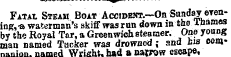
Fatal Steam Boat AcciDEMT .-On Sunday evening ,-a waterman ' s skiff wasrun down in the 1 names by the Royal Tar , a Greenwich steamer . One young man named Tucker was drowned ; and his companion , named Wright , had a natrow escape .
Untitled Article
_ THE NORTHEBN STAR f
-
-
Citation
-
Northern Star (1837-1852), Oct. 7, 1843, page 7, in the Nineteenth-Century Serials Edition (2008; 2018) ncse-os.kdl.kcl.ac.uk/periodicals/ns/issues/vm2-ncseproduct950/page/7/
-