On this page
-
Departments (1)
-
Text (6)
-
Untitled Article
-
Untitled Article
-
Untitled Article
-
Untitled Article
-

THE NORTHERN STAR SATURDAY, SEPTEMBER 25, 1841.
-

Untitled Article
Note: This text has been automatically extracted via Optical Character Recognition (OCR) software. The text has not been manually corrected and should not be relied on to be an accurate representation of the item.
-
-
Transcript
-
Note: This text has been automatically extracted via Optical Character Recognition (OCR) software. The text has not been manually corrected and should not be relied on to be an accurate representation of the item.
Additionally, when viewing full transcripts, extracted text may not be in the same order as the original document.
Untitled Article
MAKYLEBONE—WELCOME TO O'CONNOR . On Friday latf , the Working Man ' s Hill , Cireus nreet , New Road , was crowded to excess , for the Purpose or meeting Hr . O'Connor . Mr . Christopher wat called to tbe chair . A gentleman , whoae suns we did not catch , moTed the following resolution : — " That we welcome Feargus O'Connor , Esq ., on hia release from the dungeon in which hia persecutors had Immured him , and pledge ourselves to agitate for nothing short of the Charter . "
Mr . Scott seconded the resoraHon . He said it was with pleasure he saw Mr . OXJonnw amongst them after his suSsrings . Oar advocates have been prosecuted , imprisoned , and thrown into dragoons ; some of them hare lost their lives through being sent there ; every feeling of human nature has been violated ; bat he was glad to find that the public sympathised with the oppressed ; this meeting was a proof of such sympathy , and he hoped they would prore that their friends were held dear by them . - The resolution , on being put , was carried unani mously . Mi . O'Cokhoe was greeted with great applause on rising to speak ; after which he commenced as follows . —
Ito the cheering had in some degree subsided , he said it would be six yean to-morrow since £ e had first addressed them at a meeting held not far from the spot on which they were now met Daring that period Radical principles had undergone aaerere trial—they had been well tested , and had well stood the test ( Applause . ) The WhigB had succeeded for a time -in disuniting the K * dies 2 body—because the Radicals , ever -willing to hope good , had been determined to give them a fair trial . They had hid their trial—the delusion was gone by ; their power to delude had gone ¦ with it ; and the people were now one body—firmly united for the attainment of one object ; and that object not the destruction of any portion of society , but the destructiMt of the system by which ruin
was brought on all . ( Long and continued cheering ) This was why they had gone on increasing , and not decreasing , in number . The Teries of yesterday were the ConaurrattTes of to-day ; the Whigs of yesterday were the Reformers of to- « ay ^ but the Radicals of years gone by were still Radicals . Their principles were unchangeable : tfce principle * contained in the People ' s Charter were precisely the same principles whkh its advocates had ever professed . Mr . O'Connor then went on to explain the causes of the disppointments which had been experienced ; be was sorry for the disappointment on Friday , but it was not his fault ; he knew nothing of the meeting till the morning after it had been holden . Again , on Wednesday there was a meeting at the Archery Rooms . Now , on that occasion it had been
published throughout London , and in the Star a notice bad appeared , that be was te be at Brentford on that day ; be could not , therefore , hare been expected at Bt Paneras , when it was known that he was engaged elsewhere . He had never failed in attending any engagement , howeTer great the distance , er inconvenient Since his release from incarceration , he had been at meetings nearly every night ( Hear , bear , and cheers . ) He had a great duty to perform , and would sot shrink from it ( Cheers . ) While incarcerated hia spirit had been still free ; his courage bad nevkr failed , and his activity bad never Blackened . ( Hear , hear . ) And b » might now be well proud , and more than prond , ( o contemplate the spirit and enthusiasm of the people on his reappearance . ( Hear , bear , and loud
cheering . ) Meetings such as those which he bad lately been habitually attending , were exjnttT » trag to the spirit , and might held up the heart of any maa ; though if it were to be nothing but night after night talking asd talking , he would soon gire them up , as a mere keeping of the people from their families . Bat be saw a something in the distance , a bright « load of promise , whence he augured results of » character to glad the heart . He saw evidences in the appearances of the times , that this moring of the spirit upon the waters was the prelude of a new creation'in which all things should be politically good . ( Hear , hear . ) The people were bow in power ; the OoTerment was de facto in their baai *; fox be was satisfied that if they bestirred themselves rightly , erery measure to
be carried in the House must be first carried out of it He had stated sore thai once or ten times , that three parties were incompatible with the state ; and now , th « . nfe Qod there were but two parties . The Whigs , as ft party , were annihilated ; they were politically dead ; and their grave was dug deep in public execration . iLoud cheers . ) The Whigs had ruled us ten . years ; coercion for Ireland , and starvation for Eogland ,- had been their ruling principles . They were now defunct Would the Tories be permitted to role on like prindeiptes ? Would Sir Robert Peel rule Ireland by the sword ? Would he make the almost wholly Catholic population bow its neck to the impious domination of the bloated law church ? He might try , but should be be insane gnnngh to do so , be would surely find that
the people who had ousted one faction from the seat of power , would hurl thence their successors with lea trouble and as little compunction . ( Cheers ) Peel had been tried in Ireland ; be began hia career there . Ireland was now threatened with a revival of the power of the Orange faction . Sho'dd he dare it .-tJre people of England would take up the g&untiet ; they would teach i » i »> mtpn that they belie England , who represent her sous as being nationally averse to Ireland ' s rights ; that they were looking forward to the establishment of those principles of universal justice which reeogniseed their rights and grievances as fully as their own . ( Cheers . ) He . had promised Sir Robert Peel , at the first meeting which he attended after his release from prison , that whenever the sword should be drawn in
Ireland the scabbard should be thrown avray . in England : he now reiterated that pledge . . ( Loud and long continued cheering . ) Mr . CTConnor then spoke of the slanderous imputations of physical violence so lavishly bestowed upon the Chartists by the factions ; they were called " torch and dagger" men ; their object was avowed to be to equalise property by plunder . Thousands of times had tiiese calumnies been disa-Towed , and yet with simple impudence had they been repeated . This was indeed a pretty charge to come from these who had robbed the people of the whole country . ( Great cheering . ) It reminded him of a saying of Mr . O'CcmnfeU ' s upon one occasion . In answer to a libel charge made by one of the Beresford's , he said , " What , the Beresf ords accuse us of a wiih to plunder ?
The Beresfords , who have robbed Ireland of mountains of land ! " ( Hear , hear , and great cheering . ) They did not want to steal the land ; they merely wanted to enjoy its fruits , the fruifca of their o-vrn labour , paying a reasonable compensation to those who with whatever justice , were legally acknowledged its proprietors . They wanted legislative representation , by which they might be enabled not to rob others , but to protect themselves against robbery . ( Great cheering . ) Mr . O'Connor went on at great length to castigate both factions , and to demonstrate the actual dependance of all the so-called higher ranks cf society upon the workin g people for subsistance . He descanted on the anomalous provisions of the law , and the shameful dispirity of its operation with regard to rich and poor ; and insisted upon
the right ot a universal participation in the legislative power , as the only safe , certain , and permanent remedy for all the political evils of the state . ( Hear . ) We must be no longer tampered with ; the rule of justice must be the rule of Government ; the ¦ working classes must be rendered happy . If there were one hnndr-rd classes , and , if by Universal Suffrage being enacted , all power fell into the hands of the -working classes , I ¦ would not complain , for the "working classes would have an interest in supporting all the other classes , if useful' ; thus the working m * a would not deprive his employer of the means of employing him ; rather woala he support his employer ; ssit now was , the great body was at the mercy of all the little knots . After repudiating physical force , and girizz-his
definition ef the difference of moral and physical force , Mr . O'Connor referred to the challenge of Mr . Hetheringtoa . I hops , said Mr . O'Connor , that any gentleman , who may attend at taa discussion , will give a patient hearing , and offer no interruption . Single handed I will meet them , and try if any differences which may exist cannot be amicably arranged . ( Hear , and cheers . ) Mr . O'Connor thta referred to an expression use ;! by Sir . Attwood , relative to his ; Mr . A . V , not bsing ready to concede to Ireland her rights , and which . Mr . Lovett promptly met ; and concluded by declaring that though bfi had every comfort and protection , ha would not be satisfied till the people -were comfortable an "; protected . He found that be "was again able to battle in their cause , acd he hoped he was destined for many services in the cause . . Cheers >
Mr . O'Connor retired amid the applause of all present , and tbe meeting shortly after separated . _
Untitled Article
SHEFFIELD . ( From our oten Corretpondent . J Dr . MTJouall , —This eloquent , vindicator of the rights of the oppressed masses delivered his second lecturs in the Town Hall , on Wednesday evening , September 15 th . Mr . Gill presided , as on the previous evening . The Hall was again densely crowded by an attentive and enthusiastic auditnee . Tag lecturer commenced by congratnlatiug the meeting on the downfall of the perfidious Whigs ; at the same time , he could not rejoice in the triumph , of their opponents , the Tories , ft faction whom in heart -and soul he detested . ( Cheers . ) The lecturer then adverted to , and commented upon , the several panaceas put forth by the Whigs and sham-Radicals , first taking Household Suffrage , shewing that , under Bttch fivstem . a masa of intelligence and worth vfuold be
excluded from the franchise , scarcely inferior to that excluded by-the present system . Police returns from die town of -Liverpool shewed that > here was 17 , 000 persona residing in cellars , aud living by u disreputable means . 7 * The same returns shewed that there was 45 , 000 dodgers , and 20 , 000 clerks and shopmen living in , » nd around tho town . of liverpool . Now , under a system of Household Suffrage , the 17 , 000 vicious members of society inhabuiug the « ellars woulfi be enfranchised , while the -35 , 000 lodger * ani . 20 , 000 clerks and shopmen would be exekded from , the right of suffrage . How preposterous , wonld this be . ( Cheers . ; Yet thf 3 was gravely proposed by certain parties who -would not sapport Uniwsal Suffrage , beeause , forsooth , of the irnoranoe and immorality of a great portion of the wwMn £ flaaar Whit immbfcgj ( Cheers , ) Let tittB fcftve ti- » suffrage extended to every man , and
Untitled Article
than while right was established , no evil would result for the honest and intelligent ; the 45 , 000 lodgers and 20 , 000 shopmen would effectually swamp the corrupt 17 , 000 living by disreputable means . ( Cheers . ) The lecturer then entered at great length into the subject of Corn Law repeal , combatting the arguments , and shewing up the fallacies of the " cheap bread" gentry in masterly style . In the course of his remarks , be shewed that our foreign trade , in many parts , was lost , not through the operation of the Corn Laws , but throagh the villanous competition of the manufacturers with each other . Before the introduction of machinery , and when our cotton goods were made wholly by the hand-loom weavers , the fabrics were substantial ,
and English goods , before all others , were sought by all the nations of the earth ; but was this the case now I No , the millocrats must make fortunes in a day , no matter by what dishonest means ; goods were made rapidly , and of any rubbish they could impose on the buyer . This had disgusted the cheated foreigner , and he was now manufacturing for himself . ( Cheers , ) The lecturer then showed what would be the eSact upon the currency » y Corn Law Repeal , and adduced some striking arguments utterly subversive of the theory of the " big loafers . " The Doctor concluded an hour and a half a address , by a fervent and eloquent appeal to bis hearers to agitate for nothing less than the Charter—the whole bog , bristles and all—and sat down amidst tbe most
tremendous cheering . —Mr . Harney said that , after the able and eloquent lectures of Dr . M'Douall , there certainly could not be two opinions as to the right of the working man to the franchise , and the necessity of making tbe Charter the law of the land . ( Cheers . ) The question was , how was the Charter to b 9 gottenl —( near)—His answer was , by union ( Cheers . ) Mr . Harney eulogised the public character of Dr . M'Douall , and called upon the people to give their support to the Republican Journal . He concluded by moving tbe following resolution : — " That this meeting , after hearing the talented discourses of Dr . M'Donall , being more than ever convinced of the necessity of exerting their every energy to obtain tbe glorious Charter of their rights , do pledge
themselves to join tbe ranks of tbe National Charter Association ; and further , assure the Executive Council of their undivided support . Lastly , tbis meeting give to Dr . M'Douall their hearty thanks for bis services in tbe cause of democracy , and for bis eloquent advocacy of the rights of the millions upon tbe occasion of bis present visit to Sheffield . " Mr . M'Kettrick seconded the resolution- The Chairman took tbe sense of tbe meeting , when it was carried . Thanks being voted to tbe Chairman , and three cheers given for Dr . M'Douall , three for Feargus O'Connor , three for tbe Welsh Victims , three for O'Brien and all tbe patriots , and three for tbe Charter and no surrender , tbe meeting dissolved *
Delegate Mketisq . —A meeting of delegates from places in tbe neighbourhood of Sheffield , took place on Sunday last , in tbe Association-room , Fig-Tree-lane . Tbe attendance was not so numerous as could have been wished ; still as the beginning of a good and necessary work , tbe meeting was of some importance . The following were the delegat es present : —Sheffield , Messrs . Harrison , Bui ton , and Frost ; Rotherham , Messrs . Ramsden and Russell ; Doncaster , Mr . Coulson ; Ecelesfield and neighbouring villages , Messrs . Lunn , Nicholson , Boothroyd , and John Nicholson ; Walkley , Mr . Foster . Jlr . Harrison was called to tbe chair ; Mr . M'Keitriek of tbe Sheffield association was appointed secretary .
An interesting conversation took place relative to tbe strength of tbe association in Sheffield , Rotherham , Doncaster , &o . It was arranged that meetings to extend the association should be forthwith held in the villages of Ecolesfield , and Walkley . On tbe motion of Mr . Ramsden , seconded by Mr . Buxton , the following resolution was adopted . "That the delegates present do recommend to their constituents , the propriety of making Sheffield the centre for all places within twenty miles of its bounds ; and that tbe several sub-secretaries do correspond with tbe Sheffield sub-secretary once in every fortnight , reporting tbe progress of tbe cause in their respective localities . "
Untitled Article
ATTEMPTED RESUSCITATION OF THE "NEW MOVE . " It is said that there are some kind 3 of poisonous reptiles which acquire strength by irritation ; and as we apprehend that the " new move" partakes largely of tbis character , we have regretted , and do still regret , tbe—to our thinking—ill-judged and unnecessary attack which has recently been made upon
it . It has merel y inspired its dead and almost putrid carcase wiih an artificial show of life , while it has enabled it 3 persevering concoctors to throw & little oil upon such embers of dissatisfaction , animosity , or personal disunion , as might yet retain anything of warmth ; and has resulted , as we expected it would , in tbe issuing of another manifesto from the would-be apostles of disunion and strife .
This document is something of a curiosity in its way . It is valuable inasmuch ae it developes tbe character of the party from whom it emanates , beyond tbe possibility of mistake or contradiction . As it is probably tbe last" move" of these "knights " upon the Chartist chess board , we have thought proper to bestow upon it Bome little attention , and , in accordance with our usual custom , to afford no one a pretext on which to ebarge us with garbling or dishonest quoting , we give the whole thing in another part of our paper , in the nakednaBS of its own deformity , just as it was sent to us by tbe subscribers . Our readers will find it under a like head to that which stands at tbe top of this article .
We have said that this document betokenB the character of its concoctors , and in truth we feel now compelled to acknowledge the superior penetration of tbe people , who , as with one voice , denounced the " new move" men for treachery , while we lamented only tbe aberration of their judgment and their puerility of mind . Tbis document , however , at its very outset , carries on its front an evidence of such craft and subtlety as belongs not to the honest prosecution of democratic objects . It purports to emanate from " a meeiing of the members of the National Association f and we doubt not that this
heading is intended to lead people to suppose—and when read in the Whig papers , which will gladly favonr the trick , it may lead some to suppose—that the National Charter Association is here meant . This may serve one of two purposes , alike necessary and desirable to the " new move" men ; nay , by some chance it might happen to effect both . It might induce the supposition that the National Charter Association bad repudiated the Northern Star ^ and had adopted or assented to all the abuse thereof contained in tbis address ; or it might induce tbe supposition that tbe National Cbarter Association was an illegal society ; subsisting in branches and acting in sectional parts ; as the subscribers to this document
state that they "remain , on behalf of the members of the National Association residing in London . " Indeed , "we have som 9 reason to believe , from the very suspicious circumstances attendant upon the darkling intimation about " liability to apprehension , " given to some active and useful London Chartists ( see our County Council report ) , that the next " move" contemplated by these precious " new move" gentry , is tbe hounding on of the Government to seek some pretext for prosecuting that really " National" Association which they ( the " new move" men ) have laboured so hard and so impotently to destroy . If this be their object we tell them they will fail . Tbe members of the " National" Charter Association are too well
aware of their own position . They know tbe law , and though the ; bold it to be an arbitrary and an unjust law , which prohibits Political Associations of a national character from holding local and sectional meetings , they are still prepared to avoid its danger . Tbe ; do not talk of the members of the u National" Association meeting in a tavern ; tbe ; meet in their respective localities , not as members of tbe National Charter Association , but as Chartists each in bis individual capacity . Tbe National Charter Association has no meetiags ; it exists only in its principles , in its enrolment of members , in its officers , and in tbe public acts of its Council ; while its objects and purposes , being perfectly legal , are prosecuted by its members individu&ll ; and in their personal capacity .
. We like to convert evil into tbe means of good , where practicable ; and hence , therefore ; we take tbis opportunity of again impressing this legal provi " sion , which we have before noticed , upon the minds of all tba members , * nd especially of tbe Councillors and sub-Secretaries of tbe National Charter Asso-
Untitled Article
ciation . A Chartist meeting might be holden , or a trades meeting might bo holden , and all the persons attending it might happen to be members of tbe Methodist Society , and yet it would not therefore be ft Methodist meeting , nor , in legal phrase , ft meeting of the Methodist Society . It would be a meeting of Chartists , or of "tbe trade , " as the case might be . Just so ; the meetings in tbe respective localities through the country , though they may be attended principally , or even wholly , by persons who are members of the National Charter Association , are not therefore " meetings of the National Charier Association ; '' they axe meetings of Chartists , and as Chartists the several individuals composing them
are perfectly competent to the discussion ol all matters which may affect their interests or that of the cause to whiob they are devoted . We hope this will never be lost sight of by the parties who report these meetings for the Star , or who take a prominent part in them . We have no doubt that " friends" are plentiful , and we are exceedingly desirous that not the slightest pretext should be afforded to tbe enemy by tbe people themselves . This is our reason for the digression into which wo have thus been led by the announcement of Messrs . Hbthsrington and Lovett , that a meeting of the membersof the" National Association" was held atthe Globe Tavern , Shoe-lane , Fleet-street , on Tuesday week .
Our readers , of course , know that this 'National Association" is not tbe National Cbarter Association ; it is tbe " New Move" Association of Messrs . Hethkhington and Lovett ; and the fact that a meeting of its members—( the members , mind —not the council , or committee , or officers , but tbe whole society—the members of the National Assooition)—was bolden at a Tavern in Shoe-lane , may help them to some idea of the very flourishing and numereusbody which these New Move" Nationals" command .
The meeting was bolden at the Globe Tavern ; whether in the club room or the Bar-Snug , deponent sayeth not ; the address is signed Henry Hetheringtok and William Lsvktt , and these gentlemen do not condescend to tell us whether any other persons were present at this meeting of the " National" Association or not . They do tell us , however , that tbe address was unanimously adopted ; from which circumstance we take leave tosuBpeet that they most probably had the whole thing to themselves . B * that , however , as it may , here is the address of Messrs . Hethkbinqton and Lovett
in the capacity of " Nationals . " And a very pretty address it is ! In the early portion thereof , after modestly claiming credit for " having been mainly instiumental in embodying in the People's Cbarter those political principles which , for a great number of years , were cherished by alltrueHeformers , " they tell us , we think very justly : — " That the past conduct of ft number of those who professed to subscribe to the just principles of the Cbarter , was wanting in that integrity , honesty , aud justice which are necessary qualifications to secure the co-operation of the wise and the confidence of tbe good . "
We perfectly agree with this sentiment , and bo we fancy will all who remember that Henbt Hethebihgtox and Wu . Loybtt have " professed to subscribe to the just principles of the Cbarter , " and who look at the" past conduct" of these gentlemen , illustrated as it is by their present conduct in reference to this same " new move" transaction . Wo are also disposed to believe with them , ' * that the falsehood , exaggeration , and violence of those who were active to scheme , but too cowardly to act , has led to the sacrifice and incarceration of hundreds of
victims , by which means our cause has been retarded and defamed . " We have less fear for the future , aud , therefore , lose something of our regret for the past in tbis respect . The people are now too " wide awake" to suffer barm from the "falsehood , exaggeration , and violence" of such men as Hemt Hetheeisgto . n and Wm . Lovett ; and our cause now stands npon too firm a basis , and is beginning to be too well understood , both by tbe operative and the "higher" classes , to be in danger of any injury from such causes .
After this very modest , just , and veritable denunciation of all persons prominent as Chartists , save themselves ; after thus , covertly , and by insinuation ascribing falsehood , exaggeration , violence and cowardice to all who are not ready to bow to their cap , MessrB . Hethehington and Lovett proceed to intimate that " accordingly "—that is , because all who bad not acknowledged their leadership were " wanting in that integrity , honesty , and justice which are necessary qualifications to secure tbe cooperation of tbe wise and tbe confidence of the good , "—they , " about five months ago , put forth a proposal for forming a national association . "
Respecting which proposal they Bay , after enumerating tbe objects of their association—to create and extend an enlightened publio opinion in favour of the People ' s Charter , among persons of all creeds , classes , and opinions , by the means of missionaries , lecturers , circulating libraries , tracts , &c ; to build public balls in which for the people to hold their meetings , instead of in public-bouses ; to establish schools for the benefit of our infant population ; and to impress on our brethren tbe necessity of devoting to those ennobling purposes those means which had been previously wasted in frivolous efforts and childlike displays : —
" This proposal , while it was warmly greeted by the press , and received the commendations of a great number of intelligent minds among all parties , was met with falsehood , intolerance , and bitterest rancour , by the most prominent organ ef Chartism , tbe Northern Star . Its proprietor and editor jointly denounced it as a production of Messrs . O'Connell , Hume , and Roebncfc—as a plan intended to destroy Feargus O'Connor ' s political supremacy , and subvert one which he had previously concocted . Education was ridiculed ,
knowledge was sneered at , facts were perverted , truth suppressed , aud the lowest passions and prejudices of the multitude were appealed to , to obtain a clamourous verdict against us . We were denounced by them and their hired partisans as ' thieves , ' liars , ' and traitors ' to the cacse of Chartism , as persons who , if a * guillotine ' existed in England , would be its just victims . Nay a sermon ! has been preached by one of those professors ot freedom to show the necessity for privately ' assassinating ' us .
" As far as we have been able to obtain insertion for a vindication of out conduct , through the channel by which we have been calumniated , we have called , bat called in vain , for proofs of their base assertions . As far as they have dared to reply to us , they have proclaimed themselves false , intolerant , and reckless in the eyes of every reflecting man . " This is pretty well for the meek victims of "falsehood , exaggeration , and violence" ! It would really seem as if the authors of this document had set themselves to verify their own statement , that " a number of those who professed to subscribe to the
just principles of the Cbarter , was wanting in that integrity , honesty , and justice which are necessary qualifications to secure the co-operation of the wise and the confidence of the good . " We need but point tbe attention of those who habitually read tbe Northern Star > and who read it through all the diacnsBion consequent upon the first introduction of this new and secret move called the " National " Association , and demand fearlessly whether falsehood , exaggeration , intolerance , bitter rancour , and want of integrity , honesty , and justice , were ever more fully exemplified than in these two paragraphs ! They are really so perfect a tissue ot all these enviable distinctions that
it is difficult to conceive bow they could nave been written by anybody , much less any one " professing to subscribe to the just principles of tbe Charter . " We shall perhaps best answer them by recapitulating , briefly , tbe reasons on which we have , from tbe first , grounded our opposition to this new " National " Association ; and which we still maintain , ought to induce tbe people to discountenance it . These reasons we have given again and again . Our readers will remember them and will form their own estimate of tKe charges of " falsehood , intolerance , and bitterest rancour , " brought against us by these meek and dove-like " new move" ' subscribers to tbe just principles of tbe Charter . "
Untitled Article
Those reasons were—in short—that the Move " altogether was nnaccordant with "the just principles of the , Charter" which it professed to advocate . Tha * proposal" wm to establish »** National " Association ; and they went about the establishing of it by sending their" proposal" through the Postoffice , to such persons as they thought fit , enclosed in a letter , of which the following is a copy : — " London , 118 , Tottenham-court Road , ' March 18 * 1 .
Db a * SiR , —The following address is intended to be submitted to all the leading Chartists throughout the kingdom that we can have access to , in order to obtain their signatures , when it will be printed and published as their joint address ; previous to which it wilt be considered a breach of honour for atiy individual to cause its publication . It is also INTENDED THAT XHB PERSONS SIGNING IT SHAIX * OBM
a Pbovkiohai . Board of Managbmert * oa six or Twkltb Months , las may be advisable , ) to aid i » forming the Association by the sale of cards , or otherwise , afterwhioh the Board of Management is to be elected by . the Members according to the rules and regulations . By returning this to Mr . Lovett , 113 , Tottenham-court Road , signed or otherwise , by return of Post , you wUl oblige , yours respectfully . " & . O .
Now , if there had been no national organisation at all in existence at this period , we should have denounced this as a most inconsistent and unwarrantable mode of seeking to establish one . Periona professing to advocate the Charter cannot consistantly do otherwise than aot upon its principles ; but there is in this proceeding a flagrant disregard of those principles . Here is the attempted establishment of a * National" Association without any appeal to the nation . A few individuals take upon
themselves to act for the nation . The very spirit and essence of Toryism I Had there been no National Society at that time in existence , and had these parties , instead of creeping thus stealthily and Becretly about it , laid their plans at once before the people for acceptance or rejection , we should have commended them as zealous and consistent patriots . But , instead of that , Messrs . Lovktt and Co . send their proposals to such parties as they think likely to act with them , to be returned by return of post ;
THE PARTIES SIGNING IT TO FORM THE PROVISIONAL » 0 ARD OF MANAGEMENT FOB SIX OB TWELVE MONTHS 1 So that this " National" Board of Management was to be , to all intents and purposes , self-elected ; tbe proposals hinting at tbe same time that this selfelected Board of Management was to have the fingering and appropriation of two hundred and fifty-six thousand six hundred pounds of the people ' s money ! Now , we tell Messrs . " New Move Nationals" that there is no self-elected body in existence to whom the people ought to entrust the unrestrioted management of so serious a sum . Nay ,
further , we tell them that it is utterly inconsistent with "the juat principles of the People ' s Charter , " for any self'elected body to exercise controul either over the funds or the movements of the people . Why , do the people find fault with the constitution of the House of Commons t Because it assumes the oontroul and expenditure of the national funds , while it is not eleoted by the nation . Why were the old Tory Municipal Corporations so deservedly unpopular 1 For the very same reason ; because they were for the most part self-elected , and yet claimed and
exercised controul over the people ' s money . And , are we to be subjected to the abuse and violence" of Mr . Hethbringtoit and Mr . Lovett , beaause we protest against the establishment of Chartist Associations on the very same principles , and by the very same means , of pure and unmitigated despotism , whioh the Charter is intended to subvert ? If this be the " intolerance" of which Messrs . Hetherikgtnn and Lovett complain , we can promise them no abatement of that intolerance . We shall ever protest against the principle of assumed power , and for that of self-government .
We now deliberately reiterate a portion of our " falsehood , intolerance , and bitterest rancour" of the 17 th of April last : — ° There are some very curious factB connected with tbis document . It denounces idolatry , while it assumes leadership . It claims co-operation , while it respectfully resolves that , with or without it , it will U 3 O , every ' possible effort' for the attainment of its object . "Let us just ask a question or two . If the names attached to the document bad a right to expect so much public oonidenoe , why keep the
project secret , except from the * Leading Chartists' 1 Apropos , we imagined that one of the great objections to modern agitation was Leadership . Why assume leadership ! Why not call a meeting in London , on tbe spot , and where the pretensions of tbe Bix gentlemen were best known , and where , if acknowledged by a publio meeting , the thing would have had the stamp of publio confidence and the sanction of publio approval , not only of the 'Leading Chartists' but of the body of Chartists }
" Why have a self-elected Board of Management ? because we find the following most astounding admission : ' It is also intended that the persons signing it shall form a Provisional Board of Management for six or twelve months . ' Is this Universal Suffrage ! Is this the free choice of officers ! Is this Election by Ballot ! Is this vigilant popular controul ? Here we have six gontlemen
actually nominating a National Board , writing to and inviting whom they please as members of that Board . Monstrous ! most monstrous !! and asking them to keep the project a complete secret from the people , until the infernal machine shall be sufficiently loaded to be discharged , ( also we suppose in tbe dark , ) when the country would be told , ' ! you are too late , the deed is done ; why did not you object in time V
" Here we have a whole nation surrounded in the dark by half a dozon gentlemen , and handed over , neck and heels , to tbe tender mercies of a Provisional Government of their appointment 1 But they are all for Universal Suffrage , and , as a matter of course , they have aotad upon that principle , and only elected those whom they knew would be acceptable . In faith , it is marvellous lucky for poor O ' Connor that he did not even recommend to such an appointment , or offer funds to a missionary , or he would be called a ' despot , ' and would cease to be an 'IDOL . '"
Supposing , then , that the plan of these parties had been the best plan in the world , their mode of seeking to establish their " national" society was not one which honest Chartists could either approve or support . Of this they evince a perfect consciousness in their earnest deprecation of the publication of their sohemo before they bad become sufficiently strong by the adhesion of " leading Chartists" to cram it down the people ' s throats ' . — "Previous to which it will be considered a breach of honour for any individual to cause its publication" ! Why this fear of premature publication ? It is not
characteristic of Chartism . Chartism , " strong in the conscious rectitude £ its principles" ever seeks the light , and courts publio ifcy . But Messrs . Lovett Hethebtngton , and Co ., knowing how the people had heretofore been " led" by . their simple confidence in men whom they believed to be talented and honest , calculated on the force of this habit being sufficient to induce an overlooking of the iniquitous principle npon Which they sought to constitute their sooiety . if they could but introduce tbe thing with an imposing array of " leading Chartists . " Hence their dread of premature publication , and their " breach of honour" denunciation . Again , mark the cautions
haste . The "leading Chartists" whom they did consult were allowed very little time for thought about the matter . The address must be returned , signed or unsigned , by next post . Nothing can show more clearly than does this wily manoeuvre , the consciousness of the "New Move" leaders that reflection would necessarily show to the honest men with whom they corresponded , tbe impropriety and inconsistency of the whole proceeding . Some who were thus caught complained afterward of the trick put on them . They had been accustomed to put implicit faith in HsTHssiNGTONand Lovett , and therefore they signed with but slight examination of the
Untitled Article
general features of the plan . W « repeat ^ that almost every expression in the short but most wily letter with which the " New Move " men introduced their " proposals , " Contains evidence of their perfect consciousness that the proceeding was at otter variance with all their own professed principles . And yet these are the men who , in the address which we now print from them * coolly speak of themselves thus : —
" Hiding the principles of democracy , we will yield to no man * dictation : -we believe that both England and Inland have been cursed by man-worship , to the sacrifice and delay of that freedom we are now contending for ; and because we have dared to bouastiy assert our opinions , we have incurred the highest displeasure of all those whose vanity expect * the homage of a crowd , peculiar patronage , and exclusive power . Bat waning against inch selfish folly and mischievous authority , whether displayed in the courtly aristocrat or the social oppressor , we shall ever exert our humble powers to prevent individual ox social despotism ftorn being introduced !"
We have written thus far on the assumption , that there was not then any national concentration of the people ' s energies for the attainment of the Charter . But , to demonstrate still more fully the haracter of this " new move , " we must here repeat another portion of our " falsehood , intolerance , and bitterest rancour" from the Star of tbe 10 th of April , the first article we wroteapoatbe subject : — " There is alrody a National Association in existence , embracing all THE OBJECTS OF THE PROPOSED SCHEME . This A&SO
ciation , if legally constituted and honestly conducted , supersedes the necessity for another ; if not , it is requisite that its illegality , or its corruption , or the incapability of the means it proposes to attain the end sought , should be demonstrated ; that the necessity for another and more effeotive association may be shown . But the subscribers to this document , do not affect to find fault with the association now in existence : on the contrary , they say that they have * no
disposition to oppose' it . This admission at once cuts the throat of the ' new movement f tor these parties must know that it is impossible to organise another ' National Association' without crippling the energies of that which is already in existence . In fact , hone know better than those at the head of this ' new move , ' that its effect , if successful , must be so to divide the forces of the advocates of right a ? to neutralise and destroy the operation of their power . * • *
" And the crowning reason of all is , that the attempt to establish it would necessarily fail , while it would as necessarily jeopardise the whole strength and vigour of the movement , by dividing our forces , and frittering away our strength . Let the people stick to the National Charter Association of Great Britain—let them strengthen the present Executive —let the classes be regularly visited , and the funds collected and placed at the disposal of their own accredited and chosen officers : let a oneness of feeling and purpose be manifested by all , and our success is certain . Let us suffer ourselves to be thus split , and chopped , and divided , and our defeat is certain . "
In these articles , and in various others written about that time , we thus gave . onr reasons for opposing tbis movement . We shewed that the new plan contains no advantages which are not already provided by the old one ; that every one of the objects proposed to be attained by this new organisation under the management of a self-elected Board of Management is equally easy of attainment by the really National Organisation now existing , under tbe Management of a General Council and Executive Committee , elected by the people . We Bhewed that two National Societies cannot subsist without destroying the energies of each other , and that no good or Buffioieut reason has been
shewn why the already existing National Organisation should be given up to gratify the taste for " Man Worship" and personal distinction of Messrs . Lovett , Hethebingtor , and Co . ; and when these gentlemen find themselves called on for an answer to our reasonings upon the subject , they cry ont that their proposal , " while it waa warmly greeted by the [ Whig } press , was met with falsehood , intolerance , and bitterest rancour , by the most prominent organ of Chartism , the Northern Star "; and unblushingly assert that in the Northern Star " education was ridiculed , knowledge was sneered at , facts were perverted , truth suppressed , and the lowest passions and prejudices of the multitude were appealed to . "
To this womanish abuse it is unnecessary for us to reply . The writers know it to be false , the world knows it to be malicious , and we feel it to be powerless for harm . Those who have read the Star will estimate it rightly . These men prate of facts being perverted ; while they impudently attribute to us tho indignant expressions of tbe people , in their resolutions adopted at public meetings ; ascribing to us the words "thieves , " "liars , " traitors , " and various other epithets applied to them by parties over whom we had no controul , nor any other influence , than simply that wbioh is equally open to Messrs . Hetherington and Lovett—the influence of truthful reasoning !
These men prate of facts being perverted ; while they ascribe to the sermon of Mr . Watkins a meaning which no honest man can find in it , and at the same time speak of that sermon , and of some expressions used in it , ia such connection with the Editor of the Northern Star t as amounts to a positive assertion that we have held out threats of assassination against them 11 These men prate of " falsehood , " and of the " perversion of facts" ; while they speak of the reception of their " new move" by the country in such a manner as to imply that every one who disapproves of it is a " hired partisan" of ours 11 !
These gentlemen prate of " falsehood ; " while they . assert that we have denounced their " new move" — " As a plan intended to destroy Feargus O'Connor ' s political supremacy , and subvert one which he had previously concocted . " Why do they not show where and how we contend for any political supremacy tot Feargps O'Connob ! Simply , because they know that tbe only supremacy which we have ever asserted for Fbabgus O'Connob , is one which he would be most happy to share with them—a supre macy of hard labour—of pecuniary sacrifice , and of consistency of principle and conduct .
These men prate of "falsehood , " while they assert that they " have called , but called in vain , for proofs of our assertionsV These men speak of those who have opposed their scheme in the following terms : — •' Their vanity has inflamed their intellect , their prejudices have darkened their understanding , and toleration and charitable feeling have been blotted from their minds . Believing themselves supremely wise , they spurn with Gothic ferocity all knowledge , truth , or justice ; and judging from their actions , they seeem to think that liberty can only be realised by violence and proscription . " And yet they prate of intolerance and rancour !! i These men ask : —
"Whether the best means of obtaining the Charter , and the placing of our liberties on the securest foundation , do not form proper and legitimate questions of inquiry i ' or every man in the United Kingdom !" While at the same time they apply language such as that we have just quoted , to those who dissent from their opinions , and meet the arguments of their opponents with the cry of "intolerance , " "bitter rancour , " — " violence "— " proscription" —" cunning * schemers" — " wily politicians "—and "the political supremacy of Feabgbs O'Connob" !•
These men talk of the " suppression : of truth , " and yet cry out that the Editor and Proprietor of the Northern Star haye jointly denounced their pet move as a bantling of Messrs . Hume , Boebuck , O'Connell and Co . ; cry out thjtf * they have called and called in vain for proofs ; and yet " suppress tbe truth" that , in Mr . O'Coraba ' s letter to Mr Hethkbington , published in the Star of the 24 . th of April list , proofs of [ this were given to the following tune : —
Untitled Article
"Now , I pray you attend to the summing up ef the evidence : —Before Christmas I inform the Editor of the Star of ft certain * move which is to be made . In January » great Household Suffrage meeting is eon * vened at Leeds . Mr . Collins is invited , ftnd refuses to attend . Mr . Francia Place subsequently writes * letter to Mr . Collins , Advising him to attend , for tb « purpose of forming a . union between the two classes Mr . Collins and Mr . O'Neil attend , wad endeavour to have all the resolntLons , and the address to the Queen proposed by the Committee of the working men ' s meeting , set aside . . They coquette with the enemy . They denounce the Committee . They are to be found running like pet rabbits in and out of the Timet-ofiic&
the organ of the Association . " On Thursday , Collins attends a meeting of the people at which resolutions denouncing Ministers are passed . On Friday , he dines with Mr . O'Connell , and the Association , at » 7 a . 6 d . dinner , and drinks the health of those Ministers , and backs the obje cts by a speech , which is published in the Leeds Times : and when attention is pointed to one of the declarations at thai dinner . it is attempted to be qualified by Collins ! " Collins , in reply , asks na ( in the very tenna of your own observation , ) to point out the difference between Household Suffrage , as he pleases jto define it , and Charter Suffrage . Upon the day after the dinner at Leeds , a > meeting takes place in the Rn .
tnnda , where Messrs . Hume , O'Connell , and Roebuck deliver themselves as follows : — " Mr . Hume submitted a definition of what he considered Household Suffrage ought to be , which was to betaken into consideration by the association . Ht stated that the leading men of the working classet generally concurred in the definition , and had promised to give their assistance , were an agitation ftr such a Household Suffrage to be set on foot . " Mr . O'Connell cordially concurred in the sugges tions of Mr . Hume . He considered it as of the first
importance thai the reasonable portion of the Chartists should be got over to the aid of the rational Reformers . He urged the necessity qf some central body being established in London , for the diffusion of knowledge upon political subjects . The public mind should be saturated with facts bearing on the present gross defects in the representation of iht people . " Mr . Roebuck said that such a body teas at present in contemplation in London , and he trusted that it would very speedily be set in operation , so as to act in concert with the Leeds Association . ' *
" New , Sir , here we have Mr . Hume stating : — That the leading men of the working classes generally concurred in bis definition of Household Suffragt , and had promised it their support ' " Mr . Roebuck said that : — - 'An Association was being formed in London , for the purpose , and would , he trusted , be very speedily set in operation . ' "After this , Sir , your battle must be with Mr . Hume and Mr . Roebuck , and not with me . Ho Bays the leaders have concurred , while you and your friends are the only leaders who appear to have had anything to do with the subject ; so that I call upon you to contradict Mr . Hume flatly , or call upon him
to say who were the parties , if you and your friends were not . Subsequently to this came the negotia tions—aye , subsequently * and negociations : —fot there were two I Previously to the first Vincent was in prison , and he attended at the second ; but the Leeds meeting not having succeeded according to Mr . Collins ' s instruction , the . thing was placed in abeyance for christening . '' Thus ' , then , ia it not clear that . in the beginning of January you were in diplomatic confederacy with Messrs . Hume and Placeis that you were subse quently confederated in February ; that you sent out your address in March ; and now observe that Mr , O'Connell , before it was published ia any paper .
announced the very terms of your agreement with Mr . Hume , according to the precise terms of you own letter ; but not one word of this is mentioned in your circular . He says your object is to agitate for Household Suffrage and shorten the duration of Parliaments . . " Pray , Sir , keep the latter object in view , and connect it with your adhesion to Triennial Parliaments . Then , Sir , to this add the fact of Mr . Place being the author of a bugaboo document signed 'An Old Chartist , ' and extensively circulated among the' leading Chartists , ' to whom your circular was sent ; and bear in mind that it was circulated ju » before the Leeds meeting . The object of that
document was to scare all from any connection with the old and established move . Then , Sir , add the fact of Tillman , the Secretary of the National Association , receiving letters from Place , Lovett , Collins , Richardson , and others , ' plaguing his life out , ' to use bis own terms , about the 'illegality . * Then add Mr . Collins' and Mr . O'Neil ' s absolute refusal to allow a delegate to be appointed to consult with their fellows in Manchester , upon the very subject upon which they professed to hinge their only objection . Then , Sir , add the fact , that on the 20 ta March , Mr . Roebuck did me the honour to call upon me , and that he then told me that an Association was
about being formed . I replied , that one was already formed . He answered 'Yea , but there are some apprehensions as to its legality . ' I rejoined , 'Of course no law will legalise a Chartist Association . " Mr . Roebuck laughed , and said , ' It looks very like it ; ' and added , ' They havesent me the rules of their new Association for my opinion . ' Connect this with Mr . Collins' admission that he had appliedI to Mr . Roebuck for bis opinion , and then say if any doubt remains as to the identity of the persons named by Mr . Hume and Mr . Roebuck at Leeds , and Mr . O'Connell in Dublin , and to an object agreed upon , but not set forth ia your address . Who told Alt . O'Connell V
We opine that , after this , the " rectitude of principle'" of iilessrs . Hethebinqtos and Lorjsra will be more than doubted . ¦ We were willing , while a shadow of chance fot their succeeding with the public remained , to excsli them * on the ground of an ill-matured and puerile thirst for leadership , which could not bear to see the National " Board of Management" in other hands than their own . We adopted this view of the matter as the more charitable one , in preference to thai of considering them deliberate traitors to the oaase . We find it difficult now to admit this supposition ; and certainly tbe document we this day publish from them much increases the difficulty . However , we have admitted this notice of their last effort for existence , just to shew " how hardly some people die . " We now leave them to repose quietly on the
bed of infamy and contempt whioh they have prepared for themselves ; and we advise the country and the men of Londdn to do likewise . Let them fulminate their "National" edicts from the back rooa ot the Globe Tavern , and amuse themselves with th « report of their pop guns fired through their own organ , the appropriately named " Odd" Fellow . They need send no more to us ; for we do not purpose further to annoy ourselves or the country with such "Characteristics of the most ignorant and noisy portion . of the Chartist body—persons who , without thought or judgment , are empty professors to-day " , but worshippers at any other shrine tomorrow . " "' ' ¦
We very cordially evince our good feeling for Messrs . Hetherikgton and Lovett , by adopting from their address the following words as an appropriate close for . this article ; and an answer at the same time to all their , bluster about the "intolerance" of the Northern Star : — 'We believe that the . great bulk of our Chartist brethren is composed of men whose conviction in favour of the Cbarter has sprung from observation , inquiry , and patient investigation regarding the causes of political injustice and social misery . Men of this description may ha deceived and enisled for a season by mystification and falsehood ; but their minds , bent on inquiry , and ever open to conviotion , will boob penetrate tbe flimsy veil which has been drawn over their understanding .
" To men of this character we confidently sppeat j and we ask them whether the best means of obtaining the Charter , and the plaoing of our liberties on tbe securest foundation , do not form proper and legitimate questions of inquiry for every man is the United Kingdom ! Or , is it that the solving of these questions forms the exclusive prerogative of any particular individual or party among the people fthus practically exemplifying in conduct the despotic / principles which we seek to overthrow and bidding fair to render Chartism a by-word and derision . "
We only add to this that we have no fear . We know the people too well . They will not permit Chartism to become " a byeword and derision" W gratify a few " violent" spirits ; and therefore wfl shall hear no more of " discussions on the New Move" or of any other notice being taken by the people or their friends of the defunct " wily politicians" or their " cunning seheming . "
Untitled Article
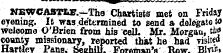
NEWCASTUE . —The Chartists met on Friday evening . It was determined to send a delegate W welcome O'Brien from his ' cell . Mr . Morgan , i ^ ° county missionary , reported that he had yisit « 4 Hartley Pans , Seghili , Foreman ' s Row , BlyMi Bedlington , Cramlington , at all of whioh ' places most excellent meetings were held , and where the banner of tbe Charter was unfurled .
The Northern Star Saturday, September 25, 1841.
THE NORTHERN STAR SATURDAY , SEPTEMBER 25 , 1841 .
Untitled Article
*• " ~ : THE NORTHERN STAB . ..... ; ., //; :.. " " 7 ' ' " "''" ' ;;^ -- -- ¦— ¦
-
-
Citation
-
Northern Star (1837-1852), Sept. 25, 1841, page 4, in the Nineteenth-Century Serials Edition (2008; 2018) ncse-os.kdl.kcl.ac.uk/periodicals/ns/issues/vm2-ncseproduct568/page/4/
-