On this page
-
Departments (3)
-
Text (7)
-
Untitled Article
-
Untitled Article
-
Untitled Article
-

iKrtwpolitan polite Intclligtnce
-

ein aireet - . ¦——¦*——¦—¦¦¦•—~ •m=* Printed by DOUGAL M'GOWAN, of 17, Great Win<M£ street, Haymarket, in the City of Westminster, atw=
-

Uato intelligence.
-

Untitled Article
Note: This text has been automatically extracted via Optical Character Recognition (OCR) software. The text has not been manually corrected and should not be relied on to be an accurate representation of the item.
-
-
Transcript
-
Note: This text has been automatically extracted via Optical Character Recognition (OCR) software. The text has not been manually corrected and should not be relied on to be an accurate representation of the item.
Additionally, when viewing full transcripts, extracted text may not be in the same order as the original document.
Untitled Article
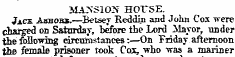
MA > "S 102 f HOTSE . Jack Ashobb . —Betsey Reddin and John Cox were chsiged on Saturday , before the Lord Mayor , under the following tircurasianees : —On Friday afternoon the female prisoner took € ox , who vras a mariner just returned from sea , to a drapers shop to purcliase her a shairL At first , luweTer , she could not make ~ zp her mind as to "what Mud of a shawl she -snsald liave , and both -retired Tutliout making a purchase . Subsequently they paid a second visit to tie dm » ers , and tV ; s time jIIss Betsev fixed her
fancy 03 a fine showy coloured shawL The shawl was wrapped up in brown paper and handed to Miss Betsey , "who immediately took "to her heels , leaTin s Cox , "srbo -was quite drunk , to pay for it . The shopieeper suspecting nil was not right , pursued the female £ ^ d gave her into -custody . Miss Betsey , in her defence , said Co ? : Met her , and voluntarily offered to buy the shawl f r her ; but Cox said lie ' had no Temraf-rrnm-e whru ^ ver of the transaction . He , Cox , was paid off on Thursday , and had been cruising aboBr ever aune . Cos was liberated ? rith a caution ; but Miss Bet > t » v was remanded for a character .
"WxDXXSDAT . FrKAl ExASLTNATTOi- OF VTH-LIAM BlTRGiss . —This day Burgess was brought uy for final examination " r- ; fore the Lord ilayor . The public curiosity seemvC nj lsave increased , if we are to judge from the cro-KTi ? _?~ cmt > led in all the avenues to the justice-room , an 3 i = tile justice-room Ieel £ The prisoner seemed to be Kiiher out of spirits , and drooped very mueh over the Tar , in which he was seated , ilr . Charles Chatham Lawrence , < n 5 e . S , Lincoln-place . Sew Xorth-road , Middlesex , siatrd that he was a cashier in the banking-house of John Lubbock and Co ., in ilansion-house-street . On Tnesibv . the Srd of September , about twenrr minutes keforv rvvo o ' clock ia the afternoon , the che ^ jne produced , for the sum of £ S , 000 . drawn by Mr . Charles Keys-er upon Sir John ^ Lubbi < ck a nd Co ., was prest-ntcd to him for
payment by a person who was not known to him , but who ¦ was accompanied by , he verily believed , the prisoner Surges * . "Witness -inquired the name of thi- pai ty presentins the checyie , npon which the person who accompanied ihs .- prisoner gave the name of Oxenford . Witness then inquired how they would haTe the amount of the chequv . upon which one of them said in gold , or part iu gold , cr trorils to that effect . "Witness then stated that , as they ¦ naated thr money in gold , " they had better get it at the Sank of England , and ha would give them *? ight . £ 1 , 000 notes ; and he accordingly g ^ ve the pers « n who accompanied ihe prisoner the eight £ l , iKK ) bank notes produceiL } Lr . Thuinas Ager , of ^ o . 15 , Edmund-terrace , Peutonville . a xeller in the issue department of the Bank of Eng land , stared that about two o ' clock on the Srd of
September a person , who was a stranger to Mm , presented at the counter the eight bank-notes for X 1 . OIK ) each produced and renuired payment thereof in gold . VTjtiiess was short of money at the time , and determined io get £ 11 . < M ! O from the treasury , and . accordingly , went with l * onard Deane , one of the porters in the i > 5 Utr jL . * p : iriment o : the Bank to the treasury , which i > an adjoining apartment , to get the gold . They brought back ten bags , eacL containing £ LVW in guld , and witness desired Deane to lav eight-of the bajs on the counter before the person ~ % \ to "was then standing there , and who thm productd two large canvas bags from a carpet bag which he had ¦ with him , and put both the bacs into the carpet bag , and thea attempted to lift it , but was unable to do > o , and "sra .- ultimately assisted ! ¦ ¦* two i > orters , who carried
the mo bags for him out of the Bank . Mr . ^ aloinoD said he had a few observations to make before the Lord ili » xor decided ojx > 3 the coarse to l > e pursued low-anl * ilr . Barjjess , Ms client- It -wwald be seen by tht evidence which had been adduced that Mt . Burgsss neitiirT ar ^ euted the cheque nor received the notes nor the soveri" ^ C 3 > , but that the person who had beer , represented as an accomplice with him had committed the forgery , and done all the subsequent acts , the blame of which ¦ was &an * ferred to the unfortunate prisoner . «¦ It "wi » uld be ol 1 - serrt-iJ that 3 dr . Enrgess did not only not personate Mr . Oxenford , but that "he had dune no more in the matter of identification thin an ordinary stock-broker ot Bank clerk itronlil tave dor irho supposed that the j > erson who 113 d applied to T »* -m i . is in realitv the individuiil he pretended
to bu . There was no proof whatever that the prisoner had perfoni > --d any act calculated t-j ^ Low- that he was swar e tlial 3 dT . who had since destrx'Ti-d himseH . ivas an > other than the Mr . Osenford he repre > ented _ him » eif to bt . To > av the least of the history of all tht transactions , tlicre ¦ was sva-rdiing su ambiguous in them as to lead to a failure of satisfactory pro * -f that tht prisoner ira * consciuu * be was ; coicj ? litting an act of delinquency . If the Lord Mayor deterSlilJ ^ . to submit the ease to another tribtmal , hi (^ f , S ^ 3 i aB } believed it would be satisiaeiorih showu "SsaiSferfesoilEr was deCLived by Elder , who was a much oMer and a tnpre experienced tnM ; mid belonged to tinchiss of J >< jrsa 4 lealfcrs , amongst whom were to be found -several in wiose honour it -would be unsafe to cvuiide . " tThat exiuld Sfr . Burgess gain bv engaging in an affair oi
Srrr' He-a young man , onJ ^ nty-lour vear .-of-agc . ¦ aio held a imc siroauou , . and had great prospects before " n : ^~ i . He had been placed In that situation by a axrsci' JT t'f iht- Baiik , wiule Elder was u person who had no reo- 'imaendstion of the Mud , and was the indii idual 1 » the acki owicdgmeni of all engaged in all the acts which had been carried oa the reyii ' ar instmnieEt "bv \ ehicli the plur : oer was tweeted . Mr . Burgess » a > , in fiu-t . th . dupe of Zldtr , It v . ^ s macli to 1-c i ^ p etted thut Elder Tras noi in the bar where the prisoutrst- ju- The yrisunei had 3 ctri . no Qo ^ bt , with a very culpailc i > unl uf cautioc . but he Tu a young man who , although pt-ssessed of an exceilec : education , was extremely inexp-jrienced and tLoasiiiii-- = s , said tcss . therefore , just the sor : of }> ersoij t ..
be TTcrkr-3 upoa by such a man as Elder , who , by destro . i ing hi ^ i ^ eii , manifested his decided opinion thai there wa > no ciii : i ^ aa escape ior a man who had not oi . } y done all the mi-rhief , but subjected Mr . Burgess to the imputation ofbeiis his aee- > mplice . The Lord Mayor : 1 believe ti ; t prisoner r «'» be a guUry participator . If he had a gix > d atuatit-ii i ^ i tlie l ^ a iik . Whv did lie run ii ^ "av as -the companiv > a > . •! Eliler ? Mr . Salomon : 1 can give a g&oJ reason : < .. r H » ha ^ ng absconded , but I do no ; consi'lt r it prndu't : j state it non . The Ix ^ rd Mayor : 1 shall sa \ nothiiii- x-i jsrejudice the case , but " 1 shall commit thr prL-ji-rT -, jt trial . The witnesses having Wen all swwa to ij > r > eir at the Cvntral Criminal »>> uri to gii :- f . i Jenrc sjrain ^ i zlm pxisojit-r at the uer : sessiou , be- na ? t .-: ken b % Jf » l «? t r *« T : S . Z > uT lit \> .-. Vf ^« TH
GUILDHALL U' £ .-r ihe IJzboes op Chi-na . —JoLn M' ( 'hry > - tal , ia the tattered dress of the . 23 rd Rt-giment 03 2 sstive Infantry , but who was hardly able to walk ii : Cu "_ ¦^• jUenre of xhc riieuiDatw-s , applied to Mr . Alderman « ij > id for rt'lieil or to be atimitted into one of the hospitals . Tue poor fellow stated , thai on Kri-1 ay lie applied to the Citj- of London Union for a . ttie relief , and he was sent down to Peckhaini » itli th- _ - intimation that he ^ was to attend at juildimll to be passed to Ireland as yesterday , -. nforronately , from having nearly lost the u « " of his imbs , he did not arrive until after the pass-master \ &d left : heinp iQ and destitute , he had no place to jo to , or a farthin'T of monev ; were he to walk bark
d Peekham it would be his ruin . . Under thex circmnstances he wished to get an asylum in omof the hospitals until he could be passed . Mr . Alderrog ^ TrVood said he had no power to assist Mm , he had better apply to the parish a ^ ain . In reply to several questions ,. the poor fellow said that he had formerly been in the Madras Horse Artillery , hut had his discharge purchased bvthe officers of the 23 rd Native Infantry , who maoe him the handmaster . When hostilities commenced -with China he ¦ went with the regiment , and was in all the variou > ensaceinejiis connected with the Chine&e waT . The
"victorious army often being obliged to sleep on the ground , he , amoagsi handreds of others , got violently attacked with rheumatism ; so severe was the fever , that , when he recovered , it was found that he would never obtain the use of his limbs , on which lie wa . - sent home invalided- Having some p . rize money to receive he nad remained in London , but as that would not be paid for two months , he was completely worn out and in want , and at the present time was witboui a farthing to get a lodging . U / pon the poor fellow being again informed xhat nothing could be done for him , ie left the offiee . remarldns , " this ia the price Ofglorv . "
ABSAfiT . —On Monday , Eobert Clifford , a journeyman carpenter , was brought before Mr . Alderman i . Johnson , charged -with breaking a policeman ' s arm . Sergeant "While , So . 201 of the < 5 tv Police , stated thai the prisoner WaS Drought to the police-station abont trro o . ' clock on Suuflaj morning "by a poheeman named Samuel Coveney , and charged wife assaulting him . The constable stated that he was on duty at the corner of St Martin ' s-le-grand and Sewgats-street , and thit the prisoner came up and asked him which was If ewgate-street ! The constable told him that tras Newgate-street . The prisoner said it was a d—d lie , and gave ^ him what is called the leg , or wrestlers trip . The constable fell , and his arm was so broken / bat iht dhow -tvasibrced upwards half -way to the shoulder . Hi sent the man to the hospital immediately . Mr . Alderman Johnson inqniredlf anr further provocation was stated to
have been given than he had already mentioned , and aslied if "the policeman was sober ? Witness replied , quiuso . Tee Alderman asked if the prisoner was also sober * The sergeant said he had been drinking , but knew verj irefl what he was about . Mr . Alderman Johnson inquired whether the constable ' s statement was made in the prisoner ' s presence ? The sergeant said it was . The certificate of 34 r . Reid , the house-surgeon of St . Bartholomew ' s , stated that Samuel Coveney was admitted with a fracture of the bone of flie left arm , and the iBJnry ¦ was bo serions that it was necessary to make him an inpatient . The prisoner , in answer to the charge , said he ms extremely sorry . He was not sober at the time . The Alderman remanded him till Saturday , in the hope that the injured man maj then be able to attend and give evidence .
CLERKENWELL . DiseiucxFCL Assault ?— -Mr . John Baker , a tradesman lmns in St . John ' s-lane , was charged with asasnlfcing-Mrs . SheppanL a respectable ' married wojnxn , Irving in Snmner- ^ treet , ClerkenwelL Mrs . Sbepp&nl -deposed that on Wednesday last she was jeisbg iaroagh St . Jahn's-square , -when the prisoner tssiot st , J » a ^» dHDgber ^" the c 3 oak , exdaimed , "I iriflg ^ ejou in chai ge . " lie lady exclaimed tJiat she ^ adnfiTffBeraliimbefore , and asked "ffhy he should interferewi&her ? lieprisonersaidieTOscertain she irasthepCTBon -who stole a-dreeti frtanMm . She again Tehranenflj protested-she knew noflung whatever abont iim , hoi he threatened to give her in charge to
Untitled Article
a constable unless she accompanied him to his house . Greatly frightened , she complied , and when there the wife and children of the prisoner declared she was not the person , and she was set at liberty . Mrs . Sheppard declared she had been ill ever since from the fright The prisoner , in defence , said , a person whom lie had treated hospitably had stolen a sheet from him , and lie thought Mrs . Sheppard was the person . Baker was fined £ 2 , and paid the money . Chasge or Begging . —On Monday Catherine Collins , aged 15 , a miserable-looking creature , with scarcely any other covering than an old plaid shawl , was charged with begging . Horsford , the Mendicity officer , proved the offence ; and it appeared from the statement of this officer that the prisoner , her mother , and two sisters , inhabit a miserable room in Church-lane , St . Giles's . The wretched mother sends out these three girls to beg . The other two are of the respective ages of eight and ten rears . The prisoner had been alreadv twice committed for begging .
The mother ^ who had the face of an old toper , was called in , and she said she had often applied for admistjv > n to St . Giles ' s workhouse , but was refused . She got an allov * ance of bread from one of the overseers , but it was totally inadequate to the supply of herself and children . Horsford said , when he arrested the girl ou that evuning she was shivering with cold ; and the Secretary to the Mendicity , compassionating her condition , and not wishing her to be sent to prison , sent witness with her to St . Giles's workhouse ; but although the girl had been born in that parish , the overseer poidtiveJy refused Io receire her , and he was compelled to bring her before the Court . He did not blame the girl at alL she was compelled by her mother to go out to beg . Tie poor girl , who shivered with cold , and cried bitterly , expressed her anxiety U > go into the workhouse , or any place to avoid the misery she suffered . The Magistrate sent one of the warrant officers with her to St . Giles ' s workhouse , rexjue ^ tii \ j [ her immediate admission .
MABTLEBOXE . Tuesday . —Tnx Eccentric Frenchman acain !—M . Buchoi Hilton , the tall Frenchman , who has upon more than one occasion attended at this court , as also at Bow-street , with the view of . inducing the mapstratcs to use their best endeavours to prevail upon her Majesty Queen Victoria to obtain for him a large sum of money alleged to be due to him from the Kiiii ; of the French , forvaluable services performed by him ( the applicant ) during the revolution at Lyons , waited upon Mr . Long to request his advice and assistance under circumstances of a somewhat novel character . Mr . Long : Stand up and let me know what you want . Complainant i v unbuttoning a large green Macintosh , and looking remarkably serious ) , —I have been to the French ambassador , and 1 want him to
give me an order to go to France , but he won ' t let me have one . Mr . Lone : I can ' t help it ; what do you think 1 can do for you < Applicant - . All that ' 1 wish for is to go away from this country five . Mr . Long : 1 can ' t make the ambassador ? ive you a passport ; he will , of course , do as he thinks proper alxmt it . Applicant : Can't you call him here before you , sir i Sir . Long : No . Applicant - . Nor his secretary ? Mr . Long : Certainly not ; stand down ; I have no power to assist you . Applicant : Louis Philippe has offered a lar <; e price for my head , and if 1 carry it to himself he must pay me the money for it . The Frenchman , who . ** . singular application , combined with his peculiarity of manner , was productive of some laughter , then quitted the vourt , evidently disappointed . GBEEXW 1 CH .
Mosr > iT . — Shoplifting—sot rs High Life . —Sarah VvatlK-rby , the wife of a seaman , was charged with steJiug from the ^ hop of iles > rs . Lcrshaw and Lowe , lim-n drapers , of l *> ndon- > treet . Greenwich , three pieces vi ribbon , valus 6 s . A lad named Walker , in the service of the prosecutors , dejmsed that the prisoner entered the shop between nine and ten on Saturday night . She purchased wme calico and other articles , amongst which was some ribbon , but not that constituting the present charge . Witness did i > "t > ell her any of that iron produced . John i « cott Anderson ile ]> osed that he also is in the employ of prosecutors . On Saturday nv ~ ht witness was in the shop , and distinctly ^ aw the prisoner , whilst his fellow-&ho ]> - min ' s back was turned , secret two piecrs of thr ribbon beneath her cloak . He immetuatelv informed Mr . Lowe
oi the circumstance , who sent for a police-constable . W " ime ~ s idt-iititied the iirtjcjes hx ihe private niurk 3 . * prosecutors' propertj . Police constable Hav , 'Jl K , JejHjsed that he was called upon to take tliC prisoner into rustodj . He waitt-d at the proM-cutors' shop-door until sbe came out , when he asked her to girt - up the ribbon .-be had taken . The prisoner denied ha \ iu ; r an \ , when lie * aw her pat her hand into her bosoui , and euilcaiour t . j throw something away . He caught hold of her hand , and found in it the two pieces now produced . 15-- then tot / k her w tht statiun-la > asc . when directions v . tre given that she should be searched . The searcher subsequently handed to him the third pirvr . Margaret Sj . rye said ilmt « m ?* aturda ; slie n * a ^ c-ai 3 * .-d upt » n t «» March tho prisoner : prior to Joiner so she asked her vlitther sht- hail anything about her she wished to j ^ tiu ]' . Prisunu answered no . She then proceeded to
search her , and , whilst unlacin ;; her stays , she obsen ed j-rironer thrust her hand into her bosom and withdraw ^ - ¦ methins which she endeav oured to throw into the lire , -h * - immediairJy laid hold of her Irani ! and U » nl the jiitct-•> i ' jn-ev-n ribtx-n , which .-lie subsequently handed o \ er tn r " :: p constable- Mr . Evan ^ , solicitor , who appeared for t ' . ie wretched woman , who ScH-med tofevl dt- > - ;> H her dis--rracrfu ] situation , declined znaking " «> defence . Sinwas then fully committed , and the witnesses l > ound o » rr : ¦• prosecute . Mr . E ' . " ans then made application that the prisoneriui ^ rlit be beld u > bail , ^ tatia ^ that she » as ven ! ic : s » y in the family way . and in such a bad state vi health that she was an out-patient of the Kent l > irpi-nsary . a < Wing that he hud unexceptior . able bail presi-nt , who would become bound in £ : XK ) . should the magistrate ; - -- ' 3 iiire it . Mr . Jeremy , after a litth consideration , agreed U > accept two bail , in i" 50 < -jch u-r iiris jner's .-ippi-anmce ^ . t the Old liailfv &e « i > ioii »
WxBSZSDiT . — < iEUSS OrTB . At . T . t PON A CinLD 1 > A ItjawiT Caxkiage . —Oiarlfa Havers , a fellow ibsguis .-d in the garb of a pent It-man , residing at . No . ' J Park-place , Ea > t Greenwich , was jiiared at tlje ha ] bt-fori- Mr . Jeremj . rLarged with indccv : it ] > assaulrii )! . ' Cathi-rjnc Krauris . ; i y-iun ^ femal * -. » b *» ut f »» nrttri-ts \ e-ars of ag * . iu * * ni- of The ' arria ^ es of the L » adon and 'Jrf « - « wjf-h Ilailir .-ji . Tli < - cn . m ]) laiKant . a pretn and interesting child , being sworn , -tau-d tliut she at present resides with her grandmother . a" AIaideiiit . ) nt-5 ull , Greenivich , and that yesterday afU-rijoon she was sent by her grandmother on business to her » i .- ther , who n-sides in High-strett , Bloomsbury . Her i ..- "lhtr accompanied her on her return as far as SkiMiicr-^ treet , where she leit her to pursue tier nav to the railway i laliol ) a ! thr foot of Lon < lon-bridi . ' e , wlie-re i > Le met with
the j . ri .--. uer . who asked her if ^ he was going t «> Grei-n-« ii-h b y the train . Heing answered in the aflinnativi-, lie ^ ai-J Ik- » ai going t « .. o , and would accompany her . She rejertt-d Ms ( iffei . when he » aid it was all nonsense , he wanted a rigar and then they should both go together , ^ he refused , when hi- seized her by the hand and dragged her into a tobacconi ^' s . ^ Vheu they came out , he asked lur to go and have some brandy and water , which she refused . He then accompanied her to the railway station , where he insisted on paying her fare , although she put down money for that purpose . He then followed her and sot into the same carriage with her , and seated himself beside hex , closing the shutters . On the journey down tlif prisoner put his arm round her waist and his hand into her bosoui . She told him to be quiet , and shifted her seat , but the prisoner followed . On arriving at
Wreenwieh she claimed the protection of another person , « bo travelled in the same carriage with them . The charge w ^ j- corroborated by other persons , who , suspecting the prisoner , watched him , and witnessed his indeci-nt behaviour . The prisoner , on being asked what he had to say for his disgraceful conduct , said merely , " 1 was mistaken in the person : I took her for somebody else . " Mr . JereniT , in passing sentence , remarked , that in the whole course of his magisterial capacity he had never met a more disgusting case , and that he should not be doing his dnty did he not put the law in full force against the prisoner . It was really a monstrous state oi things that a child , even of such tender years , could not escape the observation of a set of lewd fellows who infested the streets merely for tin- purpose of inveigling young females into their power for the gratification of their sensual lusts . It was the grossest case he had ever met with . He then sentenced the prisoner to pay a fine ) of £ 5 , and , in default , committed him for one month . The prisoner shortly afterwards paid the fine , and sneaked offi .
BOW STREET . TcrsDiT Sbopiiftisg . —This being the day appointed for the re-examination of Leah 3 lary Roper , who stands charged with stealing a roll of satinet from the shop of Messrs . Hardirick , the court was crowded at an early hour with silk-mercers , linen-drapers , and others , who have los > t property to a considerable amount ; by some -of whom the prisoner was identified as having freqnented their establishments for tlic ostensible purpose of making purchases . It appeared from the evidence , that on the afternoon of Monday , the 2 nd instant , the prisoner entered tinshop of Messrs . Hardwick , silk-mercers , in High nolborn , where she made purchases of various articles , amounting to a few shillings , to pay for which she placed a half sovereign on tlie counter , telling the young man in attendance that ^> he had business a few yards away , and would call on her return for the change . She then left the shop , and immediately after a roll of satinet , containing forty-six yards , valued sis guineas , was missed from the counter .
On returning for her change , she was apprised of the loss , but die denied all knowledge of it , and being taken into the warehouse , where she was again questioned > y the prosecutors , she admitted having- taken the property , and pledged it at the sjiop of a pawnbroker at the opposite side of the street , where , upon being accompanied by an officer , the silk was recovered , and she was given in charge . The prisoner was next charged with stealing twenty-four yards of silk from the shop of Messrs . Harvey , of Knightsbridge , « nv mercers , A shopman belonging to Mr . Stephens , pawnbroker , of "VVardour-street , Soho , produced a remnant of silk , pledged by a female he believed to be the prisoner , in the name of Kerson , on the 18 th of November , for the sum of £ 1 15 s . Constable Thompson also said he had ascertained that , during the last two years , the prisoner was in the habit of paying her tradesinen with pawnbrokers' duplicates for silk goods , some of which hi succeeded in obtaining possession ot The prisoner declined ¦ maVtng any defence . She was fully committed for trial , but ordered to be brought up again in a week . QUEEN SQUARE . Tdibdat . —Alloys Aj-fatb . — Maillson SarahShuttle--nrorth , a very pretty-looking and smartly-dressed girl ,
Untitled Article
about eighteen years of age , was charged with unlawfully detaining three silk handkerchiefs , six cornelian studs , and one shirt , the property of John Miller , a rough-looking , sea-faring man , who appeared to be about double her age . Defendant having admitted that the property was in her possession , Mt . Bond said , " what is yonr reason for detaining it ? " Defendant , ( in a simpering tone ) : He sued me for my hand and heart I told him I could not consent to marry him . My friends objected to mv union with such a person . Mr . Bond : Do you not think it dishonourable to detain these things , which were given to yon by this person under the idea that you were likely to become his wife ? Defendant : I'll acknowledge it ' s dishonourable ; but he has cruelly persecuted me . He gave
me into custody for stealing these things , and I was immediately discharged . Mr . Bond ( to complainant ) : I suppose you were courting this young woman ? Complainant : Courted her ! ah , that 1 did ! My choice was made . I set all m \ heart on hex . I have not asked her for half the things I gave her . I gave her cornelian earrings I gave her a siher riu « from lm own finger ; I gave her a row of beads . Defendant : You endeavoured to take away my character . You persecuted me . . Complainant : I have walked the deck in many a heavy gale ; I have worked hard for everything I possess . If I didu ' t bear a good character I couldn ' t be a ship ' s officer . I set my heart on her , and thought 1 should be happy , and she tricked me . Mr . Bond ( to defendant ) : Do you admit having had these presents he speaks of ? Defendant : Yes , sir , some of them . " Some of them , " exclaimed the son of Neptune , " all of them , and more . Didn't 1 buy
you your wedding bonnet ? Didn ' t I give you your wedding ring * Didn ' t I give you three gold sovereigns ? " The lady began to shed tears , and give symptoms of fainting , when a' bussman , who was near her , put his arm round her waist , and sinking gradually into his arms , the lady was led to a seat . The seaman continued : I gave her three gold sovereigns , and then she spelt for more . Our names were called out in the church ; the day was fixed , and all settled , when she wrote to say she was going down into Lincolnshire . Mr . liond recommended her to give up the handkerchiefs and studs . Defendant handed them over . Mr . Bond said he would make no order about the shirt , but could not see wiuit uso a shirt could be to the lady . Defendant appeared to think it but little , and us complainant was leaving the room uxclaimud , " Now , sir , to show you that 1 have no ill-feeling , take your shirt . " The tar did as requested , and the parties then withdrew .
UAliLBORQUGU-STKEET . Wednesday . —A Tau ok a Slop-pail . —A case of disputed proprietorship of a house-pail having occurred between Joseph Bannister and Stephen Edwards , a brace of butchers in Newport Market , Mr . Hardwick , the sitting magistrate , was called upon to give his solemn adjudication ou the matter . The complainant entered at largo into the statistics of Uis light to the pail . He had bought it , he said , for . his stable , twelve months ago , and bad used it u [> to the time when he missed it , one day last week . He discovered the pail doing duty in the defendant ' s yard , and on claiming it the defendant refused to give it up , alleging that he had purchased the fee simple , when new , of a travelling hawker , for Is . lid . V ' oinnlainant declared
he could identify the pail in various nays , but more particularly by a notch in the side , which had been cnt with a view to identification . " Is this your pail ? " said tindefendant , untying a large parcel , and producing the cAo . < e in action . " I'll swear to that notch , " said the compiainaut , examining the pail ; " and here's prffof enough as it ' s mine , " clapping to his nose something he had scraped , from the pail with his thumb , and flering the same <\ idence to the by-standers . " Here ' s a lump of horse-duntr which ¦ shuws the pail must be miui , cos the defendant never keeps no horses . " '" Your worship , " said the defendant , ' this man ' s only a common costermonger , and consequently aint to bo believed on his oath . I ' ve got two witnesses what ' 11 prove as this pail is m \ pail . " The
defendant first called hifi son , a . sharp little boy , about tun years of a ^ c . The nature of the evidence which the bi . y had to offer was what may be termed the " proof personal . * ' It affords an illustration of the " wisdom of our ancestors" in prescribing the practice of " bunipin . ? for bounds . '' a process w'la-reby a witness is sure to have a jwirticular fact forcibly impressed on his mind by u corresponding forcible impression on a retentive part of his person . The Chief € lerk , however , in his tirst question , hail marly put the lad out of court . The boy wii-S asked whether it was a ^ wnl tbinj ; or a bad thing to t ell a stor > . Bf >\ - " Oh . a good thing , it' the story is a rum un . " Mr . Havdwick suggested to the clerk the expediency ot
varyingthe terms , of the query . Accordingly , the boy was asked if it was right or wrong to tell a " lie ; " and having given a satisfactory answer , he was required to say whether hi ; knew whose pail it was . Buy : " It ' s father ' s . " Mr , Hardwick : *• How do yon prove that ' " Boy : " Cos mother gave me a jolly good hilling for cutting that there notch in it . " The daughter uas next called . Sh » ' said if the bottom of the pail were examined , a specimen of her abilities in line engraving with a crooked nail would l > 0 found ,. The paii was reversed , u . u < l the lxteroglvphics were discovered . Against tliis body of evidence it wa » impossible to struggle . The case was dismissed . The defendant ~ houldered"the pail , an < l walked off in triumph .
Thursday . —Distressed Needlewomen . —A poor creature , shivering with cold , who said her name was Edwards , complained to Mr . Hardwick that she was utterly destitute , and had been denied relief at St . (' lies ' * workhouse , where she had applied for shelter . Mr . Hardwick asked her what claim she had on the parish . The applicant said her husband lost his life snddenlv about two years ago , " and since that period she had been living in St . Giles ' s parish . She had endeavoured to maintain herself at needlework , but the long hours of labour and scanty pay had so ruii ) fd her health , tliat latterly she IumI been unable , when the opportunity of a job , which was now very seldom , presented itself , to do even as much as
would nay for lodging . She had sold her clothes , and been obliged to part with her shawl the previous night to raLsc the price oi a bed . —Mr . Hardwick recommended tho ease to the notice of the parish . There w ; is a society for furnishing employment to distressed needlewomen , and as this appeared to be a case which came within the meaning and intention of such an institution , he should advise the parish to take the applicant into the house for a few days , let her have medical attendance , make inquiry into the truth of her story , and , if found worthy of encouragement , give her a recommendation to this society , tho managers of which would probably do something for her . —Cole , the messenger , said this should be done .
WANDSWOKTII . Wlfi \ tiDAI . KXTSAOBDISABV CASE J nines Jamt =, who tcls nine years-in the M division of the Metropolitan police , and afterwards chief officer of the Banbury constabulary , was placed in the dock before Mr . Paynter for final examination upon two distinct charges of felony ; and Kichard Tyas , described as a watch-case maker , but who was . foT somu time in the City police , was also finally examined upon a charge of endeavouring corruptly to obtain reward for the restoration of the property stolen by thu first-mentioned prisoner . The evidence taken ; is excessively voluminous . The circumstances under which the prisou « rs came into custody are briefly these : —Mr . Burt , a con-keeper , in Crescent-lane , Clapham , had a child ' s
chaise and a truck stolen from Ids premises ; the chaise on the 21 st of September last , and the truck six weeks afterwards . He heard nothing of Ids property until Friday * the 20 th of November , when a letter was left at his house , which was to tho effect that the writer would for a reward of five shillings tell him where the property was . The letter was signed Thomas Long , and the answer was directed to-be sent to a coffee-house in the neighbourhood of FinsburT-square . Mr . Burt showed the letter to Sergeant Emnjerson , 9 V , and that officer , by Ms wish ; answered it , agreeing to the writer ' s terms . On the morning of Tuesday , the 3 rd of December , the prisoner Tyas brought another letter , and in consequence of what was stated therein , Mr . Hurt made an agreement to meet
Tyas at the TValworth-gate , at ten o ' clock the next mom , ing . Tyas kept the appointment , and took the prosecutor to the shop of Mr . Wedge , a broker , in Trafalgar . row , Walworth-comnion , where he saw the chaise and claimed it . The man who called himself Long was to have met them to have showed Mr , Burt where the truck was , but he did not , and tke latter gave Tyas a shilling for his trouble , and went home . On Thursday morning Tyas went with the prisoner James to the prosecutor ' s house , and Mr . Burt identified him as the man who had brought the first letter . Prosecutor and the prisoner proceeded towards V alworth , followed by Police-constable Minne , 70 V , was in plain clothes . When the party hid reached the Brixtou-road , James left them , telling the prosecutor to
give the reward to Tyas . The prisoner afterwards took the prosecutor to Messrs . Carly and Son , brokers , Portland-row , Walworth-common , and there he saw his truck . ; he then gave Tyas into the custody of Police-constable Minne . Tyas , when before the magistrate on Friday , declared that he was innocent of any fraud ; he was asked by James to take Mr . ' Burt to the shops where his property was , and he did it as a friendly act . He gave the policeman Minne information as to where he would find James , and the constable succeeded in apprehending that prisoner on Friday night , at Islington . James was examined on Friday , and his defence was that he had heard a thief bragging of having robbed Mr . Burt , and where he had sold the property . lie wrote to that person , thinking to do him an act of kindness , and he asked five shillings for his trouble ¦ this he considered was doing no harm .
The magistrate said that the fact of corruptly obtaining monev by helping another to his property which had beeji stolen 'was a felony , and the attempt was a misdemeanour , supposing the fact of stealing the articles was not proved against him ; he should commit him for the misdemeanour . Evidence having been heard in support of the charge , Mr . Paynter said he should commit the prisoner James upon two distinct charges of felony , and the prisoner Tyas would be separately indicted for endeavouring corruptly to obtain reward for helping aootherto Stolen property , which was a misdemeanour under the 7 th and 8 tb George IV ., c . 29 . The prosecutor could also , if he thought fit , indict James for conspiring with Tyai for the like offence . The prisoners were then fully committed for trial at the next session of the Central Criminal Court .
Untitled Article
DkI . JO . -f- ClIAROE Of MANS-LAL'bUT £ U AGAIXST A liiACK Doctor . —Edwin Jamos Poi-t , aged 49 , was placed at the bar this morning , on a charge of killing ; Maiyi Harris , at Birkenhead , by the application of white arsenic to her right breast , which pro- ; duced a sore ; or ulcer , and a mortal sickness , on the 1 lth of October last , of which she died on the 24 th of the siime month . From the evidence adduced on the part of the prosecution , it appeared that the prisoner advertised in the papers that he had discovered a process by means of which he could extract cancers from any part of the body without cutting , which he had practised for upwards of six vears . The
deceased , Mrs . j Harris , who was a respectable female residing at Aston Hall , near Wem , in Shropshire , heard of the prisoner , and on the 10 th of October she took ] od £ -ii ) £ 3 at Birkenhead for the purpose of consulting the prisoner , who resided in that neighbourhood . On the 11 th the prisoner was called in , when , after examining the right breast of the deceased , he applied a plaster to it . He called again to see her on the 12 th and 13 th , but she was out . On the 14 th he saw her , apd applied a second plaster , shor tly after which she > vas seized with vioJent vomiting , and complained of a ] burning sensation in the stomach and throat , and looseness of the teeth . After this she became gradually worse until the 24 th , when she died , and her friends removed her to Wem , where an inquest was held upon the body , and a verdict returned that ! the deceased died from the effects of
cancer . However , on subsequent inquiries being made , a communication was sent to the Coroner for Cheshire , who being of opinion that the inquest held in Shropshire was a nullity , issued his warrant for tlie disintemientof the body , caused it to' be removed to Birkenhead , and ordered a post mortem examination to be ra < i < le . This order was carried into eifect by Dr . Vaughan and Mr . J . C . Foulkes , of Birke-nhcad . Thesfe gentlemen described the internal appeanjHee of the body to be in a highly inflamed state , and to T * iive all the sysmptoms of the effects of arsenic . Dr . Hrefci , professor of cliemlsti-y , and doctor of philo - sophy , proved that on analysing the breast oi' the deceased he found about three-tenths oi a graL in it . In the tissues of the stomach , liver , and spleen , he found about ! a quarter of a grain . From these facts , and the others proved in evidence , the doctor inferred that arsenic had been applied to the breast ,
and absorbed , into the system . Mr . Temple addressed the jury at considerable iength for the defence , and cloven witnesses were then called on behalf of the prisoner , all ; of whom stated that they had been treated by Mr . Port either for cancer or tumour , and that he had j succeeded in curing them . The jury retired for about forty minutes , and then returned a verdict of Not ( iuilty . Immediately on the . verdict being pronounced there was a general burst of cheering from all parts of the Court , which was with difficulty suppressed . One person , who gave his name as Hugh Hughes , an Excise officer , who was pointed out by the ciier of the Court as taking a prominent part in the cheering , wiis brought before his lordship , and committed autll the rising of . the Vquri . Ilia lordship theii addressing the prisoner , suit ] , " Take care of yourself for tin ; future , you may not be so fortunate another time . "
! NOJ { T ! 1 £ K . \ CIRCl'lT . York , Dko . 0 . —John M'Cann was to-day put on his trial , chargvei with the wilful murder of Benjamin Gott . Another count in the indictment charged him with manslaughter . This case must be eviMi yet fresh in the recollectinii <> t" our ] readers , as it created , at the time of its ijct-urrL-iiii-, considerable excitement . Five other persons , nanu'd Itogan , O'Brien , Donovan , Quin ,. and Power , who had heeirconeerned in the matter , were tried at the last assizes , and were convicted of manslaughter ; hut in consequence of some legal objections being raised to the form of the injdictincnt , judgment was respited , and those persons are still in custody . M'Cunn at that period was not apprehended . Mr . liliss and . Mr . Overt-nd were for the prosecution , and the prisoner was defended bv Mr .
Wilkin . s . The facts of the case were briefly narrated by Mr . Miss , and wore : is follows : —On Whit-Monday last , the JTtli of May , there had been a procession of Orange lodges . On tlie occasion two bands were engaged , one of which was culled the Idle and Calvcrley band , and of that band ( iott ( the deceased ) was a musician . As they were passing through thu town uf Bradford , tlie baud played certain tunes , ami amongst others " the Hoyne Water , " which gave great dissatisfaction to the Irish population of the neighbourhood , who fancied also that a still more offensive tune , called "Croppies lie down , " had been played . When the procession was over , autl the musicians were returning home in a stmgglinjr manner , a number of Irishmen were seeii coming behind them , having sticks and other weapons in their hamls , ami making use of threatening language . T-he Irishmen commenced : w attack , and the first tiling they diil was to knock down the man who was playing the drum . They then fell on Gott , and from the > iolencr that was employed his death resulted . Oil a
l > oft rnort' : nc : examination the deceased s skull was found to havp been most severely fractured , and death nas attributed to that cause . Amongst the people in the crowd was the prisoner , and he took an active part ih the proceedings . Thomas Thornton , the first witness , mis undergoing examination , wifen Mr . Wilkins ssiid he thought it would be idle for him to attempt to combat the minor charge against the prisoner . He had rcnil the depositions over twenty times , ami he found no means of resisting it . He would , therefore , with his lordship's permission , wish to plead guilty to the charge of mautilaugkter . Mr . Justice Coleridge briefly addressed the jury , informing them of the circumstances alluded to in the commencement of this report , and recommending them to tind ; thr prisoner guilty of manslaughter . The jury , vvithuutihesitation , pronounced the prisoner Guilty of Manslaughter , and sentence was deferred till the opinio . i of the fifteen judges could be had upon the legal objections before referred to .
THt Ti b . n-olt . —John Criti-h ' uw ami William Bolton wore nc \ i plivved at the bur , charged with having on the 25 th of August last , at Sheffield , feloniously and unlawfully attempted to destroy a certain steam-engiiie , by the explosion of a lsirge quantity of gun-powder , tl . it : propurty ot' John Wilson , Thomas Dunn , William Jetfcock , and George llounsheld . This case would have been ' tried yesurday , but Mr . Grainger , on behalf of the . prisoners , then objected . to the whole of the jury . A . fresh jury was this uioriiing empanelled for the trial of the prisoners . - Mr . Wilkins , ( Mr . Oiermd , and Mr . Smith were , for the prosecution , and Mr . Grainger was for the defence . The yrosi cutors in ibis case were some of the largest coalpit owners jin tlie neighbourhood uf Sheffield . In tlie month Of May last there was u ireneral "
turnout " of tint colliers in that part of England , and the prtisecutjoiV pits had been unworked from May until the date of this occurrence , in August . Towards the end of August there were symptoms of returning good sense on the part of the men , and on the L'titli , it was determined that some of them at least should return to their work . At tho mouth of the pit there was , as is frequently the case , a steam-engine , worked for the purpose of hauling up the coal , a 3 well as of letting persons in and out of the pit as occasion might require . This was the engine which the prisoners were charged vvitli having blown up . The indictment was founded ou the 7 th mid 8 th of Ueo . IV ,, c . 30 , s . 7 , which renders it felpny for any person maliciously to pull down , destroy , or ( damage with intent to destroy any such
steam-engine . Jonathan llabershon was the first witness called . He deposed that he was under-ground steward , at No . •„ ' , Deeps-pit Colliery , near Sheffield . There was a steam-engine at the mouth of that pit . The boiler , which weighed wheji filled about eight tons , was detached from thu engine , and was surrounded with brickwork . On the night of Sunday , the 25 th of August , witness , who lived close to the pit , was awakened by the report of a tremendous explosion , and in about half an hour afterwards William Prince , who slept in a kind of cabin at the mouth of the pit , called him up and took him to examine the boiler . On reaching there he found all the brickwork blown down | and scattered about : The boiler happened to be filled with water , but no water had escaped . The steam-pipe , however , had broken away from thfc
steamchest ; the pipe for the conveyance of water to the boiler had also been broken , and a small shed over the boiler had been blown down , so that the steam-engine was put out of working condition . On removing the debris witness found two caps and a hat very much damaged , as well as a tin case containing a collier ' cartridge ; and some loose gunpowder . In the tivehole were found several portions of fx barrel , and everything smelt strongly of gunpowder . | Cross-examined by Mr . Grainger : —The pit had been worked twenty-two years . The boiler was about three yards from the steam-engine . Was quite sure that two caps were found . The cartridge found in the tin case was sUch as colliers commonly employed in the operation of blasting , and gunpowder was occasionally used for that purpose in some of the pits near Sheffield .
William Prince remembered the : J 5 th of August last . He was in bed jin the cabin at the mouth of the pit , and shortly after ; eleven o ' clock he saw some men peeping into the cabin , through a small crevice in the door . In a few minutes after he heard an explosion . He thought there were jabout six men altogether . Cross-examined : —The night vras dark . Could not see the laces of the persons whuj looked in at the door . Mrs . Ledger deposed that she resided abuut half a mile from the colliery . The prisoner Bolton was her brother , and had dined at her house on thp "iJth of August . About twelve o ' clock on that night she was awoke from her sleep by a noise at the door , aud she heard a moan apparently proceeding from u man in great bodily pain . She opened the door , and found her brother crouched down at the door . He was very much burnt on his head , face , neck , and hands , and was covered with black , and his clothes were torn . Witness obtained assistance , and put him to bed , when
Mr . Shaw , a surgeon , was sent for , who attended him for fourteen dajys whilst he remained confined to bed at her house . Cross-examined : —The prisoner appeared very much intoxicated when he got to her house , and he vomited a quantity of spirits and ale . He was delirious also duringjthe night , and continued so for several days . John Shaw / jun ., a medical student , who was caDedin to see the prisonei ; , confirmed the last witness ' s statement as to his condition a ! t that time . Witness asked him how he had received the injuries about his person , and he replied b y fire-damp , j A woman present gaid it would be best to tell the doctor itll they knew about the matter , ani they then said they hkd heard a great explosion , and thatthey suspected the prisoner had been concerned in blowing up a steam-engine . The woman begged of witness not to mention the circumstance to any one , and the prisoner joined im that request . John Shaw , surgeon , of Attercliffe , oorroborated tiac greater part of this testimony , and detailed a statement made , to him by the prisoner , wherein he con-I
Untitled Article
fessed hi « participation in the act with which he wa . charged . They put some gunpowder in a barrel whicli they placed in the fire-hole , and , setting light to a fusee one end of which communicated with the powder barrel ' they ran away to await the effects of the explosion ; but as this did not take place so soon as they had anticipated , they went to the fusee to . blow it up . He had just reached the spot where the engine was when it did happen , however , and he remembered little or nothing further . ' The prisoner Bolton had made this statement to witness on several different occasions . Cross-examined : The prisoner told him that he had met with two men before the occurrence , who would not let him go till he had had a Certain quantity of something to drink . He did not say that he was ve , r > ' drunk . William Maybury , tailor
living in Todd-street , Manchester , deposed , that he met the prisoner Critchlow with tivo men , named Dixon and Stocks , on Tuesday , the 27 th of August . The skin was then all off his face . He said that he had the wet scurvy , which accounted for that circumstance . Ije met the same persons together soon after in the Coach and Horses public-house , and he heard Stocks ask ( Mtchlow if lie had been to a doctor , to which Critchlow replied no , he was frightened to go to a doctor lest he should be found out . Critchlow then asked Stocks if he had seen that day ' s paper , and if there was anything particula r in it . Stocks answered , that he had seen the paper , and that a cap had been found . Critchlow said that that was his cap , and he then proceeded to detail the circumstances attending the explosion , adding that he had before very
large whiskers and a good head of hair , but when the powder went off it flashed in his face , and scorched it all off . He was otherwise also a . good deal injured . Crossexamined : —Havenotgot much above tailoring yet . There was a rat-den at Davis ' s public-house . Witness did not provide the rats or the dogs . He assisted Davis sometimes in keeping and obtaining the rats . He did pay for his board and lodging at Davis's . Was not in the habit of attending prize-fights . Had never been at one . Didn ' t teach boxing ; put the gloves on sometimes for a little bit of amusement . Had been in trouble once , about six years ago , for hitting a man in the shop where he then worked . Had never seen Critchlow previous to the first interview whi < "h he had referred to . Several other witnesses corroborated the main features of the evidence
already given . Mr . Grainger addressed a long and ingenious speech to the jury on behalf of . ' tlie prisoners , commenting , chiefly with regard to Critchlow * s case , on the want of all evidence connecting the prisoners together . Mr Justice Coleridge summed up , and laid the case before the jury in the clearest manner , who retired for a' few minutes , and then returned with a verdict of Guilty ugainst Bolton , and of Acquittal as regarded Critchlow . His Lordship , in passing sentence , observed upon the magnitude of the crime of which the prisoner had been found guilty . It was especially a crime in a county like that , where property of incalculable value was often invested in the engines of the description alluded to , which , valuable a-s they were , were particularly liable to the attacks of
vicious persons . In a moral point of view , the crime was \ fry great , for if people chose to leave their work , then to band themselves together , and to go out at night taking hail-els of gunpowder with them for tho purposes of mischief—people who went so far as that would , require \ ery little inducement , he feared , to go much farther . The prisoner had , however , suffered already in his person \ cry severely for what he had done , and it appeared that one of his unhappy companions on that night had paid a severer penalty still . When he should recall that to his remembrance , it might prove to him , perhaps , a more bitter recollection , and give him a great deal more pain than he was likely to suffer at the hands of the law . The sentence of the d > urt was , that the prisoner be imprisoned for eighteen calendar months , with hard labour .
A man named Thomas North Stocks was next indicted for harbouring John Critchlow , welt knowing that he had committed a felony . As Critchlow had been acquitted , however , by the jury , the charge against Stocks was , of course , abandoned . Dec . !> . —Emii £ zzi . kmk . vt bv a Rural I ' olice 0 ffickr . —It having been previously arranged that the trial of Joseph . Steadinan Maddison should take place this morning , great excitement prevailed in the city of York on the subject . Tlie court was crowded to excess , and much speculation was afloat as to the probable result of the trial . The case presented many peculiar , and interesting features . The prisoner » us charged with having , on the 12 th of June last , in the city of York , feloniously embezzled £ 17 , the
property of George Swann , Esq . Mr . Wilkins stated the case . If 1 am well instructed , he said , the case I am about to lay before you , in all its facts , is one so strong and overwhelming , that it seems to me the onlv hope to the prisoner of escape from the charge against him i * in the legal acumen and ingenuity of In * counsel . It appears that , in the year 1842 , the increase of crime in and about this " neighbourhood had been so rapid , that several gentlemen met togegethcr for the purpose of establishing a society , having for its object the protection of the lives and properties of those living in and about it . In the fii-st instance , I believe , these subscriptions were small , but in the course of a . short time the expediency and necessity of an institution of this sort was discovered ,
It was then determined by the promoters of it that they should establish a police of their own , who were-, I believe , to act as a patrol within the circumference of ten miles from the city . The prisoner was one who made application for a situation under them , and 1 am free to admit that he came to York with testimonials of a very high description , and he was in consequence appointed the superintendent of the police . Shortly after the appointment , or I believe contemporaneous with it , he was informed that it was part of his duties to collect in the subscriptions from the different parties who were the subscribers to this association , and that immediately on the receipt of them he was to pay them over to ' Mr . S % yann , the banker ; and so formally were those duties made
known to him that a resolution was psissed respeetiujf them by the committee of the association , which was read over , and distinctly described to the prisoner , lie complained , I believe , at the time that iii . > salary was not large enough . However , the gentlemen comprising the committee thought it was , but made him a present of £ 10 , and allowed him a profit of five per cent , on the whole of the moneys he was to collect . It was his duty once a month to go to the bank , and take with him a recei pt or voucherforacertamgum of money he would require for paying the policemen under his control . In short , - the prisoner continued to collect money up to the 6 th of July last , receiving t-vrry week large sums for the payment of the police . It will be shown that since the 22 nd or 23 rd of •' ariuary ( although we shall show you distinctly that lie received sums of money ) he never paid one single farthing into the bank . * It should be borne in mind that since the 22 nd of January the prisoner had not
paid one farthing into the hands of Mi-. Swann Even- month the prisoner received from Mr . Swann £ 70 or £ 80 with which to pay thepolice officers under him . At length , on the 6 th of July , when the prisoner went to get Ms usual payment of Me Swan& , that gentleman refused to pay any more ! Mr . Swanfl said that he had already paid more out than had come in . No subscription had come in since January , and he refused to j > ay anything further . The learned counsel read a fetter addressed by the prisoner to R . II . Anderson , Esq ., solicitor to the police force , which clearly confessed the defalcation laid to his charge . Mr . Wilkins concluded hy calling a number of witnesses in support of the charge . Mr . Bliss addressed theory for the prisoner , and witnesses were called who testified to the prisoner ' s good character . The jury retiredfw three . hours , and then returned with a verdict of Guilty , with a recommendation to mercy . —Sentence deferred .
Northern Circuit , Dec . 10 , — -Murder . —Win . Kendrew , aged 22 , farm labourer , and John Kendrew , 24 , shoemaker , brothers , were placed at the bar , charged , the former by the coroner ' s inquisition with the wilful murder of ' Mr . William Inchbald , at Dunsforth , in the parish of Aldborough , in the West Riding , and the latter with feloniously harbouring and maintaining WUHani Kendrew , well knowing hiiri to have committed a . felony in shooting Wn » . Inchbald . Mr . Wilkins stated the case to the jury , and then called thirty witnesseS j who clearly proved , by a chain of circumstantial evidence , the case , the details of which have been recently before the public . The following additional evidence was given bjr the father of the prisoners : —William Kendrew said— - }
remember the Wednesday night before Mr . InchbalQ was shot ; I went to bed at nine o ' clock that nigt » - No one lives with me . My son William caine to Be about twelve o ' clock that night . He came to toe door , and he would come in , but I didn't want to take him in at that time of night . He said , " If I o *™ open the door he'd got a double-barrelled gun , a *" he'd blow my brains out . " I let him in , and " slept at my house on that night , and on Friday night next , Sept . the 27 th * I went toworkin tne morning , and at night when I returned William na <» gone , and I never saw him again until now . I foiM that a new fustian coat of mine was gone then , in its Dlace was an old iean coat of William's . W
son John , the other prisoner , brought back my < £ * j to me . I was present when the police-officer searcfleo my premises . The gun was found in a pig-stj- * had never seen that gun before . —Evidence was adduced In suppert of the charge against John KjBO ' drew , but it did not appear to be conclusive . —i " jury retired , and , after an absence of ten ™ S ??^ returned with a verdict of Guilty against WUua » Kendrew , and of Acquittal as regarded John Kendrew . —His Lordship , in a most impressive ana affecting manner , pronounced upon him the fw ^ of death , and told him to give up all hope of eartw mercy . — The -wretched man appeared wholly I" moved , and left the bar in the most careleas manner , exclaiming , as lie went , " Thank ye , if that be all .
Untitled Article
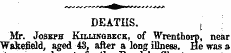
DEATHS . t ; Mr . Joseph Killingbeck , of Wrenthorp , near "Wakefield , aged 43 , after a long illness . He was a strenuous advocate for the People ' s Charter , a contant reader of the Northern Star , and was much pers ecuted forMs prinei ;
Untitled Article
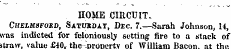
HOME CIRCUIT . Cuelmsford , Satuxday , Dec . 7 . —Sarah Johnson , 14 , was indicted for feloniously setting fire to a stack of straw , value £ 40 , the property of William Bacon , at the parish of Hempstead . Mr . Byland conducted the prosecution , and Mr . C < Jrey appeared for the prisoner . The prosecutor deposed , that the prisoner waa in his service as nursery-maid On the 16 th of August , and had lived with him for more than six months iu that capacity . About ten or eleven o ' clock on the morning of the day in question ho was out in the field harvesting , when he observed some smoke in the diroction of his stack-yard , and upon going there he found a stack of straw on fire , and it was completely consumed . The value of the stack was £ 40 . On
the morning of the fire he hud reprimanded the prisoner for not paying-proper attention to the children . She did not make any answer when he spoke to her . Harriet Stock , a servant in the employ of the prosecutor , proved that on the morning ; of the tire , and just before it broke out , she saw tlie prisoner come in a direction from the staiik- . yard , with her master ' s baby in her arms . There had been a f ive at the neighbouring , village of BlagUen abuut a fortnight before , and on the day it happened the prisoner said she liked to see a good fire , and she should like to see her master ' s place on tire , adding that if the straw was fired it would be sure to % ht the buildings . On th « day of the fire at the prosecutor ^ , she told the prisoner that the police , had been there making inquiries , and had asked some questions about her , and on her
saying this the urisonev appeared very confused , and walked away . Catherine Rumbull , another of the prosecutor ' s servants , also proved that she saw the prisoner come out of the stack-yard a very few minutes before the stack burst into flames . Thomas Moore , a police constable , deposed that lie apprehended- tKe prisoner ou the day Of the fire , and she took him to the place whew the stack had stood , and pointed out in the ashes where she first saw the fire . The prisoner was taken before a magistrate the next morning . Her mother ivas standing by her , and she told her she was sure to go to prison , a . s she was taken ou suspicion of having caused thu fire . The prisoner replied , " Nobody saw me do it , although I was in the stack-yard . " David Smith , an inspector of police , deposed that the prisoner was placed in his charge after she had been taken into custody , and hu heard her say to a woman , named liumball , who was sitting up with her , " If I naid I had
lighted the lire , people would belie \ e me , but I am not so soft . No one saw me do it , and they cannot hurt me . " When tin- prisoner was before the magistrates slie said that she knew nothing about the fire . This was the case against the prisoner . ilr . Grey briefly addressed the jury , but the evidence wsis too clear against the prisoner to give him the leant chance of doing so successfully . Mr . Justice Williams summed up , and the jury , after a short deliberation , returned a verdict cf Guilty , but at tlie same time strongly recommended the prisoner to mercy on account of her youth . The Learned Judge ordered the prisoner to be called up for judgment , and after remarking that the conduct of tlie prisoner evinced great 2 iialignity , said he felt it his duty to sentence her to be transported for fifteen years . He added , that the recommendation of the jury should be forwarded to the Stcn-tury of State , who might , if he pleased ; direct the infliction of a milder S <* TltOTl (* l '
IIiGirtVAV Kobberv . — Josepli Tunbridgc , JO , John Hammond , IS , and John 'Hi'own , IK , were convicted of a highway robbery , with violence , upon William Surrell , and sentenced to be transported for seven years . This case concluded the business of the assi / . f .
C 1 IE « TEK . Dec , i ; . —Awfii t'Asfc or l'AiuuciDE . —A young woman , aged I'O , having the appearance of a servant , was placed at the bar , charged ' with the wilful murder of her own tiithur , Kiclmrd Gallop , at Monk ' s t'oppenhall , on the 1 ' nd of Nov ., by the administration of arsenic . The Attoriiey-Ueneral , Mr . Temple , and Mr . Townsuud , were counsel for the prosecution ; ami Mr . Traflfurd for the prisoner . From the - ' evidence adduced in support of the charge , it appeared that about eight months ago the deceased , who was a joiner , and bis family , removed from Liverpool to Crewc , in the township of Monk ' s ( . 'oppeuhall , for tlie purpose of working at the extensive works belonging to the ( irand Junction Railway Company . The decided and his wife did not live happilv together , and
about six months ago the hitt .-r committed suu-ule bv cutting her throat . After that tlie ftiiui ' . v coimistui } u ( tinprisoner , her father , the daughter of his wife by a former husband , and a lodger , named William Frazer . After the death of Uis uife , the prisoner ' s father treated her with considerable severity , and , on one occasion , when she had roasted some potatoes too hard , he threatened to beat her with a strap . This she complained of to her half sister , and said that , a . s she had no comfort at home , she would go to service . During the time the prisoner was residing in Li'trpool , she became acquainted with a young man named Duval . and about the beginning of Oct ., there being a cheap train from Crewe to Liverpool , tlie prisoner announced her intention of going by it , but her father was very angr y with her , anil refused fo allow
her to go , as Ire said it was only tor the purpose ot seeing her sweetheart , and lie disitpprowil of the connection . Shortly after that the prisom r purchased a pennyworth of arsenic , for the purpose , as she said , of destroying rats aud mire . Subsequently she purchased u second pennyworth , and on the - ' lid of N'ov . she purchased twopenny worth . About three week . ) before tho last mentioned day the father of the prisoner became ill , and so continued up to that du \ , when , after partaking of some arrowroot , he was seized with violent vomiting and purging , which increased during the night , and early on the morning of the 3 rd of November he died . A surgeon attended him during the night , uml treated him for cholera . On the Sunday morning a countable , named Ki-ntv , went to the house and saw the prisoner . Ho told
her he had come for the purpose of making inquiry rcspeciing the death of her father , and cautioned her . After this he proceeded to put a number of questions to her , which , together i \ itli her answers , he produced . Mr . TlVlllbrd objected to this evidence betnj ? admissible , as it hud been lmulr by the prisoner under inducement , and he cited the case of the King v . Drew , quoted in the I'd vol . of ¦ ' Kusuvll on Crime , " j > . S- 'y . The learned judge overruled the objection . The constable Kcuty then read the statement to the court , from which it appeared that the prisoner admitted she had purchased the poison , but said it was purchased by the direction of her father , for tlie purpose of destroying rats , und that she had seen a rat on the previous Thursday , und had told her sister of it . Whilst Kenty was in the house the
prisoner took a handkerchief from a chest , which , the constable took possession of , aud in it be found a packet containing utu ootuica . The prisoner afterwards placed a small paper parcel in a drawer , which the constable also took possession of . In a cupboard he found two loaves of bread and a piece of cako . All these wire placed iu the hands of Mr . David Wildic , of Liverpool , for the purpose of being analysed . It was proved by the evidence of Mr . Stevenson , a surgeon , that the body ot the deceased , on post mortem examination , presented all the appearances internally of having been acted on by some irritant poison , and both he and Mr . Kayner , of Btockport , were of opinion that death was caused by the effects of arsenic . The half sister of the prisoner proved that on the Friday before the death , tlie prisoner made
the cakes and the bread , and that ' she ( the witness ) , the prisoner , and Fraaer , the lodger , all partook of tho cakes , immediately lifter which they all were taken ill and obliged to go to bed . Air . Wadtc , the chemist , deposed to having analyzed the stomach of the deceased , and its contents , in which lie discovered white arsenic . He also discovered arsenic in the cakes and the bread ; and in ' grains of arrow-root he detected 100 grains of arsenic . It was attempted tb elicit , in behalf of the prisoner , that she was labouring under insanity ; but the only facts deposed to by the witnesses on this point were , that about six months ago , at the time her mother committed suicide , her conduct was rather strange : that she did not sleep for a whole week , and that , during the time the mother of the prisoner was pregnant of her , she Was
insane , and several times attempted to destroy herself . Mr . Traflbrd addressed the jury for prisoner at some length , contending that the case was enveloped in so much doubt that the jury could not safely convict . That the probability was , the deceased had taken the arsenic by mistake , and that if administered by the prisoner at all . the probability was that she had done so when labouring under the effects of insanity . The learned judge briefly summed up the case to the jury , telling them that if they believed the prisoner had administered the arseni' -, it was their duty to find her guilty . As to the plea of insanity , his lordship observed that there was no evidence to support it . That was a species of defence too much relied on of late years , to the danger of public security , and the great hindrance of justice . The jury consulted together for about
five minutes , and then pronounced a verdict of Guilty , but begged strongly to recommend the prisoner to mercy . The Judge : " What ! recommend a prisoner to mercy who has been guilty of the murder uf a parent ? " The learned Baron having placed the black cap on , proceeded to pass sentence of death on the prisoner . His Lordship said , " Mary Gallop , after a long aud patient trial , you have been found guilty by the jury , upon evidence which could leave no doubt , of the murder of your own father ; that murder committed by the most odious and detestable ot all means—that of poison ; an act of deliberation evidently meditated some time before , carried into execution with perseverance , with great art and contrivance ; and I wish 1 could see any symptoms , in the conduct you afterwards
exhibited , of repentance , or any feelings of remorse for what you have done . It is impossible for me to show you any mercy . Prepare for that awful account to which you sent the author of your being with little or no preparation at all . Seek for the mercy of Crod—repent of this and all your sins ; and by that means seek for that merey hereafter which it is not in my power , consistently with my public duty , to show you here . ' His Lordship then passed sentence of death upon her in the usual form , and the prisoner walked from the bar with a steadfast step , having manifested throughout tlie whole tr ial little or no consciousness of the situation in which she stood , beyond a wild and almost incessant roll of the eye , and an occasional flush of the countenance .
Dec . 7 . —The Brutal Manslaughter at Stockport . — Henry Jones , aged 22 , was indicted for killing his wife at Stockport , on the 25 th ult . The facts of this case appeared in the Northern Star of Saturday last . The prisoner was found guilty , and sentenced to ten years' transportation . Rape . —Joseph Hanaer was found Guilty of a rape at Bawden ; James Bradbury was convicted of a similar offence at Bollinfee ; and Thomas Hignett of a like crime at Marion . They were severally sentenced to transportation for life . ;
Ikrtwpolitan Polite Intclligtnce
iKrtwpolitan polite Intclligtnce
Ein Aireet - . ¦——¦*——¦—¦¦¦•—~ •M=* Printed By Dougal M'Gowan, Of 17, Great Win≪M£ Street, Haymarket, In The City Of Westminster, Atw=
ein aireet - . ¦——¦*——¦—¦¦¦•—~ m = * Printed by DOUGAL M'GOWAN , of 17 , Great Win < M £ street , Haymarket , in the City of Westminster , atw =
umc me same anu xum > u » w . , « prietor , FEARGUS O'CONNOR , Esq ., andpublished . V WutMAM Hewitt , of No . 18 , Charles-street , ** ° r . street , Walworth , in the Parish of St Mary , « ew" * ton , in the County of Surrey , at the Office , N » < Strand , in the Parish of St . Mary-Ie-StranO , m * City of Westminster Saturday , December 14 , 184 *
Uato Intelligence.
Uato intelligence .
Untitled Article
8 = « = THE NORTHERN STAR . j Decembers , 1844 . ¦¦¦ - >
-
-
Citation
-
Northern Star (1837-1852), Dec. 14, 1844, page 8, in the Nineteenth-Century Serials Edition (2008; 2018) ncse-os.kdl.kcl.ac.uk/periodicals/ns/issues/vm2-ncseproduct1293/page/8/
-