On this page
- Departments (1)
-
Text (6)
-
/ & 7 ~
-

|Wtorf%'S8ttli.
-

~<^o2j2~^~ > <Lj9s&t^^r ^£ /<
-
1 linll | | ~<^o2j2~^~ > <Lj9s&t^^r ^£ /...
-
No. 6. New Series.] LOIDON, SATUBMY, SEP...
-
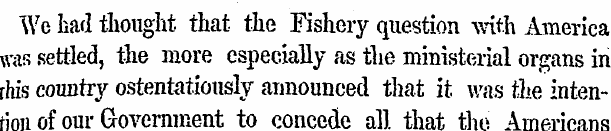
We had thought that the Fishery question...
Note: This text has been automatically extracted via Optical Character Recognition (OCR) software. The text has not been manually corrected and should not be relied on to be an accurate representation of the item.
-
-
Transcript
-
Note: This text has been automatically extracted via Optical Character Recognition (OCR) software. The text has not been manually corrected and should not be relied on to be an accurate representation of the item.
Additionally, when viewing full transcripts, extracted text may not be in the same order as the original document.
/ & 7 ~
/ & 7 ~
|Wtorf%'S8ttli.
| Wtorf % 'S 8 ttli .
~<^O2j2~^~ > <Lj9s&T^^R ^£ /<
~<^ o 2 j 2 ~^~ > < Lj 9 s & t ^^ r ^ £ /<
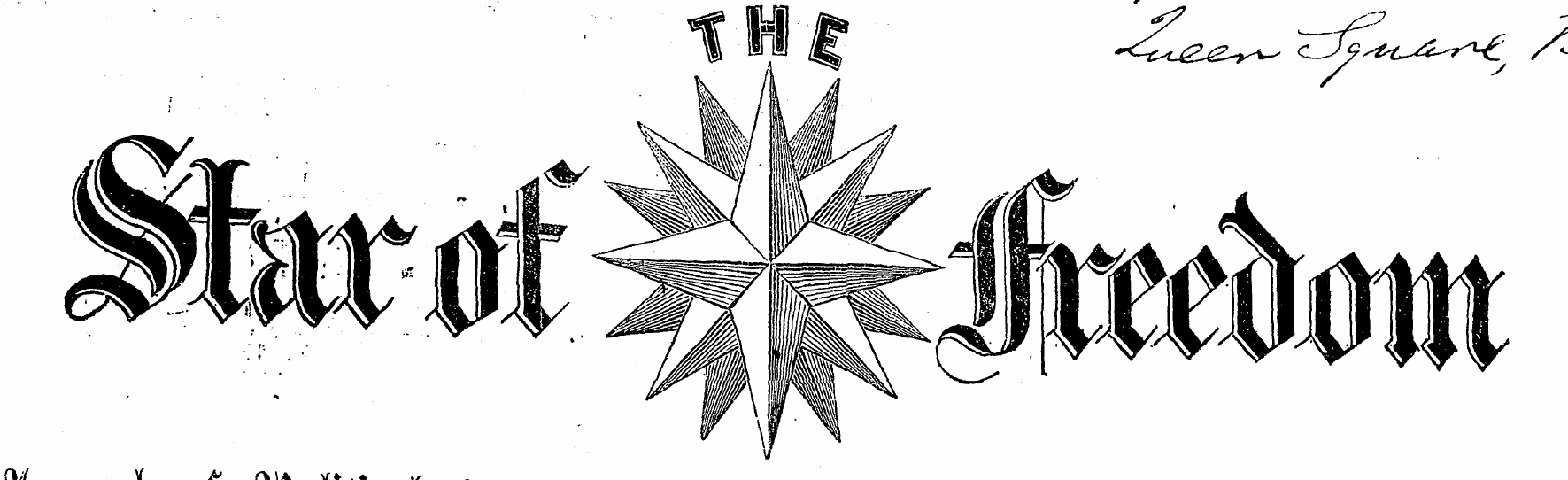
1 Linll | | ~<^O2j2~^~ > <Lj9s&T^^R ^£ /...
1 linll | | SH ^ i ^ In ^^^^ 41 m ^^\ rfiHi 44 ' ^ s > Wtl 4 ' -P 4- . JPr Ifmr III rn 1 IY 11 T gonial rf f riitid f npsj , fobs' |« bA , aA taraiik Chmndt
No. 6. New Series.] Loidon, Satubmy, Sep...
No . 6 . New Series . ] LOIDON , SATUBMY , SEPTEMBER 18 , 1852 . Peice Foubpence Halfpenny
We Had Thought That The Fishery Question...
We had thought that the Fishery question with America was settled , the more especially as the ministerial organs in rhis country ostentatiously announced that it was the intention of our Government to concede all . that the Americans rould hy any possibility demand . This , however , now seems
uncertain , for every fresh mail brings us intelligence of fishing vessels hoarded by the Queen ' s officers and fishermen driven out of the Bay which is the subject of dispute . Stupid and headstrong as aristocratic governments proverbially are , we can hardly suppose that the Derby administration has descended to the mingled treachery and folly of saying Peace here , and acting War there . Should it turn out to be
so the great body of the nation will rise as one man to reprobate their conduct , and drive them in disgrace from that office which in the ordinary course of events they cannot hope long to retain . The Missisippi , United States steam-frigate , has returned from a cruise over the debateable waters , where she
was sent to protect and instruct the . fishermen . What she has done exactly does not appear , but her officers have been feted by the colonial authorities and her Majesty ' s naval and military officers , and instead of the frowns of war , all went " merry as a marriage bell . " That at all events looks
peaceable . The colonists do not seem disposed quietly to allow what they consider as their rights of exclusive fishery , to be taken from them . A public meeting had been held at Nova Scotia , and resolutions passed . The colonists complain that they are sacrificed to imperial interests ; that if their fisheries are
to he taken from them they are entitled to reciprocity or some other compensation , and muttered hints abound to the effect that the loyalty of the colonists will be in proportion to the justice with winch they are treated . It is evident that Sir John Paldngton has recklessly stirred up a hazardous and disagreable dispute , and greatly aggravated the difficulties of the cabinet .
The dispute respecting the Lobos guano islands ^ seems to be approaching a crisis . Mr . Webster adheres to his opinion that they are not the exclusive property of Peru . Several American vessels have gone there to load . The American officers have been ordered to protect their countrymen . The Penman government has dispatched two ships of war to the spot to resist aggression , and established a permanent military post upon one of the islands , and it is said intends to confiscate encroaching vessels and perhaps imprison their crews . If this is to be relied on . we may look to soon hear that the
parties have come to blows . Some difficulty between the government at Washington and ihe Mexican authorities seems to be preparing , owing to the non-performance by the latter of certain contracts , giving to American citizens rights over the isthmus of Tehuantepee . ft is hardlv probable that the Mexicans after their recent experience of the prowess of their Anglo-Saxon neighbours , will provoke a contest .
The excitement with regard to Cuba is growing stronger in 4 e States , and will be greatly increased by the present news from that Island . The Spanish authorities had gained some intelli gence of a plot , and made arrests by hundreds . The I'ress , upon which a revolutionary paper was printed , has been terror
seized , nine men have been sentenced to death , and and discontent prevailed . The American citizens at Cuba * erc calling for protection , and expressing an opinion that America onght to interfere . All this will swell the numbers ** d add to the imfluence of the order of the Lone Star , and * c should not be greatly surprized to hear of another descent
B Cuba—this time with greater success . It was announced that a high mass would be performed in « ne of the Catholic cathed rals of New York , for the souls ot Lopez and his companions , who fell in the former expedition . The priests , however , declined to allow the ceremony to pro-C for fear of offending the catholic population of the Vnish dominions ! *
The United States legislature has declined to expend money npon new fortifications . Areeent mail gave us a description of a disgraceful scene iu Senate , between Mr . Polk and others . This week s
We Had Thought That The Fishery Question...
mail brings a ludicrious account of a speech of General Cass , at a Democratic meeting . The General , says the reporter , after talking awhile , said it was hot work , and pulled off his coat—a short time afterwards , he found it , hotter , and divested himself of his waistcoat—but whether full dressed or in deshabille this may be depended on , that the ultrademocratic party in the States , bid fair to go al : cad in a way that will astonish their opponents .
The adventurer , who disgraces the title of Prince President of France , has commenced his tour into the departments . He was accompanied to the railroad station by ministers , generals , and officers . A large body of civilians assembled , and hired applauders shouted Vive Napoleon and Vive VEmpereur amid the silence of the masses . The authorities are everywhere
making desperate efforts to get up the appearance of an enthusiastic welcome , and as they are plentifully supplied with money , they will as far as flags , bands ' of music , triumphal arches and processions go , succeed . ' What they will lack will be the hearts of the people , who , though compelled to submit to despotism , have not fallen low enough to applaud their own degradation .
In addition to the scanty numbers who have voted for the election of municipal councillors , and the coercion upon voters which has been exercised , we have this week an incident which aids us in forming a just estimate of the value of ad .-dresses emanating from the municipal councils . It is announced that three of the councils in the Euro and the Loire , have been suspended bv the prefect , and commissioners have been
appointed to exercise their functions . The-reason given is that the members of the councils suspended , are men whose social and political opinions do not give any guarantee for their adherence to the cause of order . That means of course , that they do not approve of the massacre of December , and desire to see Universal Suffrage more than a sham . When none but sycophants arc allowed to speak out addresses in favour of the Emperor , are easily procured .
AtWeller , near Belfort , those in power have been showing then * love for industrial liberty . Some operatives there struck for work in order to obtain higher wages ; for this they have been prosecuted and sentenced to various terms of imprisonment . Another instance of the marked fear of the President , and
his dread of any gleam of truth entering the territory he defiles is shewn by the books which travellers are reading being taken from their hands when they touch French soil , and examined , to see that they do not contain treason . This is a homage to the truth and power of Victor Hugo ' s work , " Napoleon the Little .
An extraordinary address lias been issu « d by the Colonel of the 2 nd Dragoons ( French ) to those soldiers whose term of service is about to expire . In this precious production , military discipline is made the source of the highest inspiration of the citizen . The soldiers are reminded that they know nothing but " obedience and duty . " To them independent thought , the assertion of private opinion , all ideas of innate dignity are mere shadows ; they are bounded by " obedience and duty . " It is impressed upon them , that the
characteristic of the soldier is industry ! That the regiment is the nursery of every virtue ! They are told , too , that if the public peace should be again disturbed , they are to tell the discontented that they know better how the affairs of a nation should be regulated , because they have been soldiers , and that when they see troops in arms they are to come to them because they will then be certain to be on the side of right . This shows but a part of the system of those whose object it is to drill the mind as well as the body , and to establish upon overthrown intelligence a military despotism , worse than
barbarism . From the rest of the continent the intelligence through the usual channels is meagre . The Austrian Emperor is preparing new reviews and dreaming of creating a naval power . Italy is wincing beneath a tyranny which she is preparing to shake off . Prussia is losing her influence . in Germany , and when the Zollverien expires bids fair to be left almost alone . In Ireland the agitation for Tenant Eight is to be reeanized , and to be allied to an attempt to destroy the Irish Established Church . With this object there have
We Had Thought That The Fishery Question...
been conferences of M . P . ' s and priests . Much as we desire to see some step taken toward establishing equitable relations between landlord and tenant , we fear that the men who are to lead this movement are actuated , some bv national antipathy , some by selfish feelings , and some by sectarian haired . It is reported that Mr . John Bright ' s journey to Ireland partly prompted by a desire to investigate the Tenant Eight question , of course for the purpose of finding arguments against it .
Light or nine men are in custody on suspicion of being concerned in the murder of Mr . O'Byan , and government has offered a large reward . The great event of the week obscuring other events and absorbing all interest is the deatii of the Duke of Wellington . We do not wonder at . this , for the close of such a liftmay well marl ; the close of an old and the commencement of a new era . Even if that were not so , men , no matter of what opinions , would naturally feel interested in the close of a life which has extended into the
reigns or lour sovereigns , which , has been prominently connected with the greatest events of modern history , and which has been marked by the attainment of the highest honours and the greatest emoluments in the power of government to bestow . In a summary like this it would be impossible to sketch the history of such a man as the dead Duke of Wellington . Such an undertaking should not be hastily attempted , or hurhurriedly executed . The exaggerated praises of biejotted
admirers on the one hand , and the unjust depreciation of inveterate foes upon the other must be avoided . It may be that the event is too near us too little matter of history to allow that to be done . This , however , we may briefly say , that the Duke was anything but " a man after our own heart" and that we have not that hish amnion iuiui uur uwu nuanauu mar , we nave not mat nign opinion
, of his moral nature which is expressed by most of the organs of t \\ o press . He was an example , not of genius , but of the success of perseverance . His mind , limited in its range , was correct and perspicuous within its circle of action , and his firmness was unwavering . But the most remarkable of his qualities was his immense power of concentration , which enabled him to fix upon any object or idea , and cling to it with tenacity . To this he was mainly indebted for his success as a General . Compared to Napoleon , he was an intellectual
pigmy . The great combinations ot the Emperor were utterly beyond his grasp ; the sudden resources and rapid adaptations of the modern Casar , were too subtle for his brain ; but then he never committed a gross error—never laid himself open—always calculated and prepared long beforehand , and acted with caution , and this together with the nerve and stamina of the troops he commanded , ensured victory . As a statesman , the career of the Iron Duke , has been eminently unsuccessful . He was the determined enemy of
reform , but was uriven step by step to acquiesce in changes which he had not the ability to prevent . But it must be acknowledged that he showed his practical common sense , by seldom or ever struggling against what he saw was inevitable . That the Duke , an aristocrat by birth , should lean to the aristocracy was nothing more than was to be expected
that , bred up in the rigid discipline of the army , he should command obedience , is not to be wondered at ; that , habituated as he had been to a life of long use of force , he should have been ready to shed the blood of a people demanding their rights is only natural . In fact , the prominent idea in the Duke ' s mind was the sacrcdness of duty , which appeared to him to consist in bowing to authority ; and to carry out and enforce that idea he would not have shrunk from anv
extremities . Destitute of the tenderer feelings and of sympathy , he could make no allowances for error committed under the influence of excitement . He was , in truth , what he was so aptly called , the " Iron Duke "— -a man not calculated to arouse affection , to win love , or to rule through an acute perception of themental qualities of others—a good general of a comparatively small army—a bad legislator for a great nation ^ -a being of details and minutiae , not of comprehensive intellect , —for the most part , cool , equable , and apparently moderate , from the general balance of his mind and the impassibility of his nature , rather than because he possessed the highest- ' arid best qualities of humanity . ., ¦ ''
-
-
Citation
-
Northern Star (1837-1852), Sept. 18, 1852, page 1, in the Nineteenth-Century Serials Edition (2008; 2018) ncse-os.kdl.kcl.ac.uk/periodicals/ns/issues/ns2_18091852/page/1/
-