On this page
-
Departments (4)
-
Text (9)
-

^ THE NORTHERN STAR. June 7 I84,
-

Imperial ?arl!'at ^ _
-
_ HOUSE QF . LORDS, Jfoxwr, Jote 2. The ...
-
HOUSE OF COMMONS, Monday, Jess 2. In rep...
-

(teit$pMUMW<
-

CBartfet Jhtteliipwe*
-
LONDON. A»DBESS Ol" THE MeIKOPOLITAX DIS...
-

Bankrupts, $ct
-
BANKRUPTS. (From Tuesday's Gazette, June...
Note: This text has been automatically extracted via Optical Character Recognition (OCR) software. The text has not been manually corrected and should not be relied on to be an accurate representation of the item.
-
-
Transcript
-
Note: This text has been automatically extracted via Optical Character Recognition (OCR) software. The text has not been manually corrected and should not be relied on to be an accurate representation of the item.
Additionally, when viewing full transcripts, extracted text may not be in the same order as the original document.
^ The Northern Star. June 7 I84,
^ THE NORTHERN STAR . June 7 I 84 ,
Imperial ?Arl!'At ^ _
Imperial ? arl !' ^ _
_ House Qf . Lords, Jfoxwr, Jote 2. The ...
_ HOUSE QF . LORDS , Jfoxwr , Jote 2 . The Earl of Shaftesbury sat as Speaker at a quarter fiefine five o ' clock , in the absence of the Lord Chancellor , Aotoo * Bis seat oo tte woolsack soon after five . JJter ihe presentation cf an immense number Of petition * from all parts of . ihe country , gainst the llaynooth EndowmentBill , The lows CHASCFXLO & said , he -wished to call their lordships' attention for a few moments to the case of Mr . OTJriscolt In consequence of what passed in that and the . other ionse of Parliament relative to the conduct
of Mr . O'DriscoU , a communication was made to the Lord Chancellor of Ireland , who did what it was his duty to do , hy directing an inquiry to be instituted . Before that inquiry was brought to a termination , however , 3 Ir . ODriscoll misconducted himself in such a manner with reference to proceedings in the Roll ' s Court in Ireland , as , in the opinion ofthe Lord Chancellor of Ireland , rendered it necessary to dismiss him from the magistracy , and he had accordingly been superseded . ( Hear , hear . ) On the motion of Lord Brougham the Debtors and Creditors Bill was read a second time , and ordered to be committed to Tuesday .
THE MAT 500 TH BILL . The Duke of "Well-. " . * gto . v , on moving the order of the day for the second reading of tbe Maynooth College ( Ireland ) Bin , said—My lords , I think it my duty to request your lordships' attention whilst I state to your lordships the principles of this measure , and the nature of the proposition which has been submitted to your lordships in this ISO , in order to carry into execution its objectnamely , the maintenance of this institution . My lords , this institution was founded fifty years ago by the Irish Parliament , and this bill contains a recital of the provisions of the acts by which it was originally founded , and hy which it was regulated ; first , in the year 1800 , and subsequently in the year 1808 . My lords , it cannot he denied , and I will not stand here to be the person to deny , that those acts are inconsistent with the enactment of the codes of law by which the Reformation was esta blished in this country and in Ireland ; but , my lords , although those acts are inconsistent with the enactment
of those codes of law , I deny that there is—and I think I can show to your lordships that there is not—anything inconsistent in those laws with the religious principles of the country , and that it was never so considered either 50 years ago or subsequently in 1 S 00 , or in 1808 , and that it cannot be so considered at the present moment . My lords , in order clearly to understand the principles on which those laws were founded , it is necessary that I sbould , call the attention of your lordships to the state of affairs at the period when they were first enacted . Tbe necessity for this institution was occasioned by the failure of the laws enacted to establish the Reformation in Ireland . My lords , those laws , and the enactment of those laws , had been resisted in Ireland from the period at which they had become the laws of the land ; plot succeeded plot , rebellion succeeded rebellion , forfeiture of property succeeded forfeiture of property , and at length the country had become the seat of the operations of a foreign and civil war in a contest for the possession of the throne .
The Duke of Newcastle . —My lords , I rise to order . I beg to apologise to the noble duke and to the house for attempting to interrupt him , but preliminary to this discussion I would pat this question to the noble dukewhether he has the Queen ' s permission to make this proposition to the house 2 ( Cries of " Order , order / 5 ) Lord Bsodghax—Tbis is not speaking to order . ( Hear , hear . ) This is the most disorderly tiling I ever witnessed in my experience of Parliament . The noble duke has not been speaking to order . This ought to have been after the speech of the noble duke ( Wellington } . ( Hear , hear . ) The Duke oi Xewcasile again rose , amidst loud eries of " Order , " and said—I wish to put the question , as it affects the Act of Succession , as it affects individuals , aud as it affects the nation . ( " Order , order . " )
Lord Baoccn . vs . —5 never will sit here and allow any man to say that we have not a right to eater on , to continue , and to close any discussion without the leave of the Crown . The leave of tlie crown is required only in one case , hut it may be given at any period of the discussion of the measure , and that is when such measure affects the revenues or tbe patrimonial interests ofthe Crown . The Duke of Newcastle again attempted to address the house , amidst lov » d cries of "Order , " and eventually the Duke of Wellingiox was called on to proceed . The noble duke then referred to die history of the establish ment of the college during the lord-lieutenancy of the late Marquis Camden . The necessity for educating the Roman Catholics at home arose from the state of the continent at the time , over which the triumphant armies ofthe French republic were then inarching ; and now that a different
aspect of affairs had happily arisen , the Government considered it wise aud proper to continue a system of domestic education to the BoaaE Catholic priests who were to administer to the great majority of the Irish people tlie rites of the Roman Catholic Church . He admitted that the expectations indulged in on the first establishment ofthe institution had not been realised , but this he attributed to ihe scanty means placed at its disposal The bill before Ae house increased those means , and he hoped in future to see an improvement in the education , manners , and habits of the students . They had supported this institution for half a century ; caring twenty years of that time die country had been eagased in war . ' Whatever might
he the opinion as to the legal effect of the decision Of their lordships on lbs Writ « £ Error in September last , he believed there was no man in his senses who now doubted that it was absolutely hopeless an < limpossible to carry any measure by violence or tumult in Ireland against the wishes of the Government aud Parliament of this country . Standing thus intrenched , aud without any danger whatever pressing on them—knowing as they did that the great body of persons engaged in tumultuoas proceedings Iwo years ago were Human Catholics , it would look somewhat like persecution if , having supported this in Stitution SO long , they now withdrew from it the patronage of the State . He trusted they wald give their unanimous consent to the bill .
The Duke of CiMr . F . iiWE looked upon this as a political , aot a religious question ; and as such , he contended it was in every sense on ? oi the most conciliatory and wise measures that had hssn proposed for many years in Parliament . The Govera-ffieni deserved the gratitude of tho country for having brorght it forward ; and he hoped it would be eminently successful in that country for the advantage of which it wa- specially designed . Lord Roses thin rase to move the amendment of which he had given notice , for a select committee to inquire into the character ofthe education given at Maynooth , with the avowed object of getting rid of the bill . If , as he thought , the annual grant had been inconsistent with the duty of a Protestant Government , much more was he opposed to tbis measure , which permanently endowed an institution over which the State could not
exercise the requisite control . He drew a broad distinction between toleration and endowment . The first ground laid for this measure was , that it would tend to conciliatetheHoman Catholics . No one was more anxious than he was to conciliate Ms Roman Catholic fellow-subjects , hot he could not consent to "do evil that good might come . " Instead , however , of being received as a boon , it had been hailed in Ireland as a measure extorted oy fear ; and he quoted theletter of Dr . Biggins to show that no conciliatory effects could resultfrom the measure . 3 for did he think it would do anything to improve the sort of education given at Maynooth . It would merely afford acuities for recruiting the priesthood from the lower classes of the people . By a reference to the textbooks and many details in the history and conduct of the institution , the noble Earl maintained that the system of instruc tion given there had anti-social and disloyal tendencies
To ascertain that fact he proposed a committee of inquiry and tbe people of England , who had petitioned so largely against this bill , would not be satisfied if investigation were refused . Sir R . Peel himself had , in 1840 , declared that he should vote for the grant with much more satisfaction if there was an inquiry , which the principals ofthe college should be the first to promote , " when so strong an impression prevailed that their system of education stood in need of improvement" If inquiry were thought accessary when the grant was annual , how much more now , when the endowment was to be permanent ! This bill was considered by the Protestants of Ireland as a heavy blow to their interest ? . Ihey felt that they had been betrayed by those whom they were taught to consider their friends , and they might well be disgusted with the line of policy that was pursued when they found that they were to be sacrificed to the howl of a priesthood which & ad always been the enemy of British connexion , i
The Bishop of Lwmos thought tlie noble Earl had made out a case for inquiry with reference to the bill itself . After the most careful and anxious consideration , he found himself under the painful necessity of refusing his assent to it , as involving a violation of one of the most fundamental principles of the constitution , while it held out no prospect of such advantage as might be thought to justify it on the grounds of expediency . The principles taught at Maynooth were calculated to make the priests democrats in politics , and in the church intolerant bigots . They were at once inconsistent with the faithful discharge of duty to the State , and utterly incompatible with the maintenance of peace in a commonwealth composed of persons having different opinions . Could they be justified , then , in endowing a college to carry out such a system without at least exacting from those to be intrusted with the working of it some distinct
and definite pledge that the system itself should helmproved , and its worst features removed ! This was the first link that had been forged-to tie together the State and the Roman Catholic Church . He could not consent to any measure , which would make the College of Maynooth an integral part of the constitution . He gave credit to the pare and charitable motives of the Government is bringing forward this measure . He could well understand their embarrassment when they turned their eye to the map of Ireland ; but the right principle on Which , in bis opinion , that country should be governed was this—never for any consideration to do what was clearly wrong in principle ; to do their best to discover what was right ; to follow it out honestly and fearlessly , trusting for the issue to the Supreme Disposer of events , i who , in accordance with His written word , would deal favourably with that nation which' upheld His own truth , or at least did nothing to impede it ? progress .
The Earl of St . Gebsassvindicated the provisions of the mUj and insastedihat the new system of bona fide and effectual visitation which it contained . would of itself do much to improve the system of educationirarmea at May . sacs * . Hitherto the grant had been wholly inadequate ; * ° w « tuggarc £ ! j . t » eatos « the priests received at that
_ House Qf . Lords, Jfoxwr, Jote 2. The ...
seminary rankled in their minds long after they left it . By making the endowment in some degree commensurate withItsttnpbrttnfobjccts ; r ^ irliainentwould do much to " insure their gratitude and conciliate their support . He recommended the measure as one of justice to the great majority of the Irish people . The Duke of Manchester opposed the hill , and read several extracts from evidence giY Ciftftef ore various committees to show the injurious iiiiflfcjLof the -Roman Catholic priesthood on the minds of The people in Ireland .
lord Beaukost , on the part of his co-religiomsts , emphatically denied many of the statements which had been rasule \ sj the . opponents of the bill . If they really believed the doctrines of the Roman Catholic Church to he as they described , the toleration would be a crime . He altogether repudiated the ultramontane doctrine of allegiance ; and it was not fair to quote books of no authority to prove that such doctrines wereinculcated at Maynooth . He did uot regard this as an isolated measure ; if it were , it would not purchase the allegiance of the priesthood if it were alienated . Their charity must be extended to the working clergy . They must also do something for the laity , and already he was happy to think that a measure had been introduced elsewhere , which , faithfully followed up , would not only be a great benefit to the laity , but also to the higher classes of the clergy , by improving the system of academical education in Ireland .
The Bishop of Casbel urged the necessity of inquiry . His own mind was indeed made up on the question , but inquiry would be useful to those who had not so strong opinions as he entertained , both with reference to the injurious system of separate education for ecclesiastics and the intrusion of Jesuits into tlie College of Maynooth . The main ground , however , on which he objected to this hill was , that he could not be a party to teach what he conscientiously believed to be erroneous . It was not Christian charity or morality that he should teach to others what was antagonist to his belief as a Protestant by conviction ; and b ^ jfc th e Sta te coul d hones tly and consistently endow ^ Hftan Catholic college she must unprotestantize her ^^ r He would infinitely prefer the voluntary system to the endowment of two antagonist Churches .
After a few words from lord Clifford in favour of the bill , the debate was , on the motion of tbe Earl of Hardwieke , adjourned till Tuesday .
House Of Commons, Monday, Jess 2. In Rep...
HOUSE OF COMMONS , Monday , Jess 2 . In reply to a question from Mr . Rose , -SirT . FaEHAHTLE said , that the Lord Chancellor of Ireland had felt it to be bis duty to issue a supersedeas for removing Mr . O'DriscoU from the bench of magistrates for the county of Cork . The adjourned debate on the Colleges ( Ireland ) Bill was resumed by Mr , M . Milnes , who declared his intention to support this measure . Those who opposed it on the ground that it did not give religious education , were , in his opinion , guilty of a sophism in the sense which they gave to the word " religion . " They said that we ought to establish colleges for Koman Catholics on Protestant principles , or
that they would not consent to the establishment of them at all . Such language he considered to be equivalent to an absolute negation of all education to the Roman Catholics of Ireland . He saw no reason why such theological lectures as had been given formerly by Schleicrmacher and Seander , and were now given by Xeauder in the University of Berlin , should not be given to tlie students of every religion in the new colleges of Ireland . He considered that the line of conduct pursued by the Roman Catholics of that country on this subject was not either wise or useful for themselves . Their education should be founded on the larg j c imprehensive continental basis , rather than on the system of any religious hierarchy , Thcindirect influence which the Roman Catholichierarchy would exercise over students of their faith would be more
useful to them than any direct influence which we could place in their hands . Though he admitted that this hill made no pretensions to perfection , still he considered it to be deserving of his support Lord Jons Russell agreed that this measure had no pretension to perfection , but considered that to be rather one of its demerits than its merits . He eould have wished that the bill had been prepated with greater care , and had not contained within itself so much crude legislation . It would require much alteration and much improvement to fit it for . the object for which it was intended . If the view of Ireland which Sir R . Peel had propounded on a former night were correct , Government ought on such a question as that of education to have tried to kuit together tlie affections of all the different classes of people iu Ireland , and to have made use of any instrument by which
that great good could be promoted . He looked upon the Roman Catholic clergy as tlie instrument by which the affections of the people of Ireland could be best knit together , and by which their attachment to and respect for the law could be best produced . The co-operation , therefore , of the Roman Catholic hierarchy of Ireland might have been fairly , not humbly , solicited by the Governraent ; and that great element , by which success must be obtained er defeated , ought not to have been omitted in the concoction of this plan . He found thatthe Roman Catholic bishops in their memorial implied a distrust that the faith and morals of the students in these new insti tutions would be endangered by the measure which the Government proposed . Unless the Government could allay such apprehensions , the very best which it could hope for its measure was that it would be null , whilst the fear
was that It would be noxious . The Roman Catholic bishops would not derive any alleviation of that distrust from the declaration which had been made in'that house that we did not wish to promote Roman Catholic ascendancy . They would not look for comfort on the precedents which were to be found in the University of Bologna or in the universities of Germany , but would rather hy them as dangerous warnings . The Government ought , therefore , to consider whether there was not some means by which it could make its scheme more palateable to the religious feelings of the Roman Catholic clergy of Ireland . He was not of opinion that secular instruction without religious education was an evil ; on the contrary , he thought that it was a good . He thought , however , that the two ought to be combined together if possible . In England religion had always been taught as a
part of education : but the system propounded in this bill would make these new institutions differ from the only university now existing in Ireland , and from the two universities in England , and would not be agreeable to the feelings of the Irish people . Already had Mr . Roche , who , he believed , was a member of the Repeal Association , objected on behalf of his countrymen to leave the appointment of the professors in these new colleges in the hands ofthe Crown . He thought that the house might have adopted such a course , had the people of Ireland been willing to submit to it ; buttaey were notwilling to do any such thing , because they were afraid of the use which might be made of the power lodged in the Crown .
They had a distrust of the use which would be made of it in case Mr . Plumptre should come into office , and would have had a still greater distrust of it had Sir R . Peel still continued to hold the same principles which be held five years ago . He , therefore , recommended tbe house to give secular instruction without regular education in these new iustitions , if it were necessary ; but , if it could give both together , not to omit from tbis bill regulations to accomplish that object . Sir J . Graham had expressed his willingness to attachhalls to each , of these new collegesfor religions education . That might mean much , or it might mean little ; and therefore , to ascertain what it meant , he would ask Sir James Graham whether he would permit the deans of those balls to exercise within them over the
students any authority on such points as their attendance at the places of their religious worship on Sundays , and their attendance at the ordinary theological lectures , and to inflict punishment , even to expulsion , on such students as might be notorious defaulters in either of those respects ? If the Government were prepared to give such authority , he thought that it would get over many of the objections urged against their scheme by the Roman Catholic clergy . There was also another feature in the scheme of Government which made him consider that it bad no pretensions to perfection . There was no machinery by which these colleges could give degrees . He thought that the GovernmiOt ought to institute an university of Ireland , which should be empowered to grant
! degrees to the students which came from them . Without some such institution these colleges would be branded with a mark of inferiority . On points like these Government ought to consult with such men as Dr . Murray , on whose character for learning , meekness , piety , and loyally he passed a high enlogium . If the Government would enter into such consultation with the Roman Catholic hierarchy before this bill was sent into committee , he thought that their measure ought to be allowed to proceed further , and that tbe country might look forward to its ultimate success . He could not agree with Lord John Manners in opposing the second reading of this bill ; for , being of opinion that it was , in principle , a good measure , and that it might in its details be amended in committee , he should give it his support .
Lord Mahon observed that he should support the second reading of the bill , in the hope of amending it in committee . If those amendments which he considered the Mil to require were not made in committee , it would be his unwelcome duty to give the measure on its third reading the most decided opposition . The great defect of this bill was its want of security for religious instruction . To the principle of giving secular knowledge in combination with religious education he was determined to adhere . Mr . B . Hope said , that the question involved in this measure was , whether religion , discipline , or self-government should he maintained or discarded in these institutions . The measure ,, in his opinion , was so unsound , thatte conceived it better to reject all palliatives of it , and to compel the Government to reconstruct it . He gave his strenuous support to the amendment of Lord John Manners .
Mr . V . Stuabt returned his thanks to the Government for initiating a measure which must be eminently beneficial to the people of Ireland . Mr . Hamilton considered no system to deserve the name of education , which was not based upon religion . He , therefore , could not give his full and cordial support to any measure which neglected that important point . On the other hand , he felt that there was a great want of secular instruction among the middling classes of Ireland ; and on that account he did not feel himself justified in withholding his assent from the second reading of this measure .
Mr . Oseobne could not support the amendment of Lord J . Manners . On the contrary , he should vote for & e second reading of the mil , having a horror of separate , and , a . strong predilection for 'mixed education . He viewed , however , several of the clauses with great disap-
House Of Commons, Monday, Jess 2. In Rep...
probation . If its 10 th and llth clauses were uot greatly modified in the committee he should he obliged to . oppose this measure on its thinl reading . " Those clauses appeared to him to have oriajuated in-the Horse Guards rather than in the Home-ofhce * .. Mr . W . Gladstone agrecd ^ th . TiOYu John Russell that the present was an iniperfect ; measui'e ; but insisted that its imperfection was owing to the very anomalous aud distracted condition of Ireland . ' The question was not whether this was a perfect measure , but whether it was the best measure which could be devised to meet the present state of Ireland and its exigencies . He concurred with Lord John Russell in thinking that it would be a very great hardship to force a measure of tins kind on tlie people of Ireland . Lord John Russell also thought it advisable that the Roman Catholic bishops of Ireland ,
and more especially Dr . Murray , should be consulted on this subject . He had not yet heard that no communication had taken place between the Government and the Roman Catholic bishops on this scheme of education ; but he fully agreed with Lord John Russell in asserting that considerable weight oug ht to be attached to the judgment of the Roman Catholic bishops on the adjustment of the principles and details of this measure . He then adverted at some length to the necessity and expediency , not only of communicating with the Roman Catholic bishops on such points , but also of renewing a direct diplomatic correspondence with the Court of Rome , which this Government earned on indirectly even at present . After defending the system of religious education now enforced at Oxford from the attacks and sneers which had been made upon it , he proceeded to contend that the system of mixed education adopted in University College , London , was much fitter for Ireland than it was for England ; for the dangers of it were most likely to be experienced in England , where religious discipline was
lax , than in Ireland , where , from the influence of the Roman Catholic religion , the religious discipline exercised over each individual of that persuasion was personally strict . He then justified tlie principles and details of the measure ; and , in so doing , entered his emp hatic protest against Sir R . Inglis ' s declaration , that it wa " a gigantic scheme of Godless education . " The bill contained a provision for religious education , as far as it was safe to do so ; for it provided rooms iu each of these colleges for theological lectures , which was an explicit admission of the efficacy of religious education . Nay , more , it provided facilities for the voluntary payment of professors to deliver such lectures . After stating his approval of the amendments proposed by Sir J . Graham since the original introduction of tlie bill , he showed that the mode of filling np the professorial chairs was a question involved in much difficulty . He did not , however , think that the difficulty would be insuperable if both parties would lay aside their prejudices , and would give to the subject a , carefuland he would even add , a tender consideration .
, Mr . T . Wise had on a former occasion declared this measure to be a great boon to the country , and though he had since heard much discussion upon it , Mid muny Objections urged against it , he had not seen any reason for changing his opinion , or for concluding that great national advantages would not accrue from the establishment of a mixed system of education in Ireland . He denied that it was a system of Godless education , and observed that , if it were so , nothing could induce him to give it his support . He then pointed out in detail various improvements which he conceived might be made in the bill , and declared his intention of bringing them forward as distinct subjecis for discussion whenever it got into committee . He objected to those clauses in tlie bill which gave to the Crown the power of appointing and removing the professors of those colleges , and contended that the State should provide in each of them for the endowment of a professor of theology , not of divinity .
Mr . Acuxd called attention to the fact that not one of the speakers in behalf of this bill had given an unqualified support of it , and contended that not one of them had proved that it would give such education as would be useful in any respect to the people of Ireland . It had been brought forward by a Conservative Government as a measure resting on sound principle ; bnt it Was really difficult to ascertain what that sound principle was . As far as he could make it out , it was a most objectionable principle . His objection to the bill was not that the Government had endeavoured to devise a plan for the education of the Roman Catholic population of Ireland which would be free from all suspicion on their part , but that it had endeavoured to frame such a plan without any communication with the Roman Catholic bishops . Its proposal had in consequence been met , not with the unanimous . acclamation , but with the unanimous protest , of those venerable persons He then explained some other objections which he had to the bill in detail , and concluded by declaring his determination to give it his most decided opposition .
Mr . R . Jf . O'Ferrail made several suggestions for the improvement of the bill , to which he trusted that the Government would agree , otherwise he should be under the necessity of opposing the second reading of this measure . Sir R . Peel was surprised that a gentleman of Mr . Acland ' s intelligence should have thought it was necessary to prove cither that sound academical institutions were a benefit to a country , or that the academical institutions proposed in this bill would be a benefit to a country in the position of Ireland . He read an extract from a work of Dr . Kane on the geology of Ireland for tha puipose of showing that that able and excellent writer had attributed the poverty of Ireland to the want of in . dustrial knowledge among its population , which prevented them from applying to the best advantage the resources of their country ; and he showed that Dr , Kane
followed up that passage by another , in which he stated that no mode of spreading industrial knowledge would be so efficacious as that of establishing- local colleges in Ireland . He then proceeded to demonstrate two points , first ; the policy of establishing academical institutions in Ireland ; and , next , the policy of educating together within their walls youths of different religious creeds . He proposed , on the part of the State , to provide in those institutions means of excellent education . He also proposed to provide for them professors of distinguished scientific attainments and of high moral character . But did he relegate religious education from them ! No snch thing . He agreed with Lord J . Russell that lie might have pure secular instruction without any religious instruction rather than no education at all ; bnt still lie thought that a mixture of secular with religious
instruction was infinitely superior . But how was that mixture of education to be effected in a country distracted like Ireland by religious differences ? Suppose that he ( Sir R . Peel ) had proposed to accomplish it , what would have been the consequence ' . First , let the house consider what SirR .-Inglis and his friends would have said had he proposed to establish a Roman Catholic professor of divinity in each of these three new colleges . Would SirR . Inglis , who now objected to his plan as " a gigantic-scheme of Godless education , " have supported it , Avhen it embraced a proposal for endowing a professor of the church of Rome ? No , he would have said that it was a covert mode of endowing that church in Ireland , and that , as it had not the precedent of fifty years to back it , he would give it his most determined opposition . Nay , move , if he
( Sir R . Peel ) had proposed to have in each of these collegesprofessorsofProtcstantand Presbyterian divinity , he believed that SirR . Iuglis would have denounced such a proposal also as a manifest proof of utter indifference to all religion . He would leave the house to conceive Mr . Spooner ' s indignation at his foundling a professorship for that " awful delusion" which was called the Roman Catholic religion . On- the other hand , he doubted whether such a proposal would be more satisfactory to the Roman Catholics themselves . He suspected that they would say to him— " We will not , even for the sake of an endowment of professorship of our faith , venture upon a measure , which wiU enable you to interfere with anything so sacred as our religion . " Such being the case , the Government had determined to invite the parents and friends of tbe youth to be educated in these new colleges
to provide religious education for them ; and he thought that such education would be provided for them better by their parents and friends than it could be by Government in the present condition of Ireland . He expressed the deep regret aud surprise with which he had read that portion of the memorial of the Roman Catholic bishops in which they stated that a Roman Catholic student could not attend lectures on anatomy and geology given by Protestant professors without danger to his morals and his faith . After commenting for some time ou that document , he proceeded to notice the objection which had been urged against this measure , because the professors were to be nominated by the Crown . He believed that such a provision was at the first formation of these colleges absolutely necessary . Both the honour and the interest of the Crown were involved in tlie appointment ofthe most competent persons to these professorships . H these colleges were to be instituted in Connuught and in Monster , whose friendship would the Government have to conciliate save that of the Roman Catholics ? He thought
that there should be exhibitions attached to these academical institutions , for the purpose of creating competition Such exhibitions , in his opinion , tended much to promote sound learning and knowledge . It had been complained that he had not made an university in Ireland . It was enough , he thought , to form three colleges at first ; but he admitted that his plan would be incomplete until they were incorporated into one university , if the plan were found to work well , then would be the time for considering whether their incorporation into an university should take place , and what power that university should have in conferring degrees . The Crown could give a charter of incorporation without the necessity of the interference of Parliament . These were the principles on which the Government had come to the conclusion that it had a better chance of promoting a system of religious education acceptable to those for whose benefit it was intended by its present measure than it would have by founding separate theological cpUeges , or by endowing theological professorships in each of them .
Mr . M . J . O'Cokkeil observed , that the amendment of Lord J . Manners raised the question whether they were to have in Ireland a mixed system of education oriiot . To that system he had always been attached ; and as this bill would promote it , he should give bis vote in favour of its second reading . He looked upon the mil as another recognitionof the system which had revolutionised Ireland in the course of the last fifteen years , —he meant the Effusion of sound secular and teli gio \» knowledge , commenced by the national schools , and continued by several provisions ; of the legislature . ' ' . " ' " i Mr . Shaw did not entirely approve ' of this measure ; but he had not heard any of the gentlemen who , opposed it propose a better substitute . ; and therefore , considering the difficulty of the questionjhe did not feel himself justified in opposing the second reading . After a few words from Sir Y , Blake infavow of the hi « ,
House Of Commons, Monday, Jess 2. In Rep...
, The house divided , when the numbers were : —For the amendment—Ayes , 46 . Noes , 311 . . Theamendment was therefore lost , and the bill read a second time . The other orders of the day were'tlieh' -disposed of , and the house adjourned .
(Teit$Pmumw≪
( teit $ pMUMW <
T 6 IDE EDITOR OF THE NORTBEIUf STAB . Sin , —Seeing the necessity for a little more watchfulness over the public good , in general affairs , I trust you will pardon my presumption in urging you not to permit the Land question , valuable , and essentially necessary as it is , to engross too fully the people ' s attention . If you do you , will incautiously leave an open course to the people ' s most dangerous foes—their sham , mercenary friends . Sir Robert , Lord John , Sir James , Lord Lincoln , the Repeal Falstaff , and oilier most liberal gentlemen , require your closest observance . The National Education , the Parish Settlement , the General Enclosure , the Foreign Allotment Emigration , and other wily devilisms , demand from you the most poignant scrutiny , and from
the people an aiding anxiety , or we shall be undermined and overthrown , cast down to a most woeful abasement . Sir , the people ' s indolent neglect in not sufficiently watching their own interest , but trusting too much the management of their affairs to some particular hand or hands , has , in all ages , more or less enslaved them . In Greece , in Rome , in Florence , in the United Provinces , in euv own kingdom , and lately , again , in France , this assertion has been truly proved , Marchamont Nedham , that admirable political writer , observes justly , that "the people should not only know what freedom is , but should likewise be made acquainted , and thoroughly instructed , in the means and rules of its preservation , so that the adulterous wiles and rapes of projecting sophisters may meet a timely check . "
Every inch that has hitherto been passed in our stride for freedom , can only be advantaged and maintained by persevering watchfulness : and this , as much on the part of the people as the people ' s advisers . After these reflections , 1 trust I may be permitted to observe that from us the proposed " . National Education BUI" demands the most active and piercing scrutiny . It is of most serious importance , and if it be not thoroughly rummaged ere it pass into law , may have seed sown therein that shall produce monsters of such unnatural growth as will beget civil war , in the place of civil society , and galling , abject slavery , in the place of happy , heaven-born freedom . The " JBnclosure Bill" seems also a specious affair , aud demands the public attention in its discussion . We must remember that 15 , 000 , 000 of uncultivated acres are at stake : and the people must not be robbed of them without a struggle . In short , all these projected reforms require the closest attention on the part of the people , or lamentation will follow the neglect .
Corruption draws not its slimy length along with slow encroachment as heretofore ; oh , no ! it is thrust upon us with a railway force and speed that thwarts all preparation and consideration , and triumphs , by astounding our judgment with its unwarrantable and overbearing presumption . For some time past we have been lulled into callous indifference ou a smooth deep sea , where the agitating wave was quite calmed down ; but we must now arouse ourselves , for breakers are ahead , and there is a murky gathering of Whiggism in the political horizon that portends approaching ills of various grade . I am , sir , your humble servant , May 2 S , 1845 . L . W .
Cbartfet Jhtteliipwe*
CBartfet Jhtteliipwe *
London. A»Dbess Ol" The Meikopolitax Dis...
LONDON . A » DBESS Ol" THE MeIKOPOLITAX DISTRICT Coi'XCII TO THE LoXDON CiUn . TI . STS AND IHE DEMOCRATS Olthe United Kingdom generally . —Fellow men , — We , the Metropolitan District Council , having for years past occupied a prominent position in the struggle for political and social regeneration , once more venture to endeavour to arouse you to action . A Convention has just held its sittings , and reduced to a practical shape several important questions , to wliich we request your serious attention . First , —The Laud I the Land ! tlie Laud ' has been long and loudly shouted . Your representatives have given their best attention to the question ; and their labours have resulted in tlie adoption of a practical plan , equally accessible to the best paid mechanic or the ill paid labourer . A darling object is thus placed within your reach . Will you embrace the opportunity to possess it ?
Secondly , — ' 1 he Convention have recommended the establishment ol * co-operative stoves , that the producer may have the necessaries of life without paying an exorbitant tax in the shape of profit ; and , further , that the profit that may result from this mode of dealing may be made available for allocating the " surplus labourers" on the land . Thirdly , —The Convention has wisely recommended that you support every , measure for shortening the hours of labour ; and render all assistance to the National United Trades , for the protection of industry . Fourthly , —They recommend that you cultivate good feeling one with the other , and unite as one man , Acknowledge no enemy but the foe before you —the class legislators . Fifthlv , —They have adopted forms of petitions for
the recall of the exiled patriots—Frost , Williams , Jones , and Ellis . We unite our voices with theirs in calling on you to adopt and forward such petitions to the members ofthe various boroughs and counties in which you may reside . Remember tlie patriotic Duncombc only lost his last motion on that subject by the casting vote of the Speaker . One more pull , and that " pull altogether / ' and success must assuredl y follow . Sixthly , —They have arranged that your Executive shall issue a national petition , praying the passing of the people ' s Charter into a law ; such petition to be issued , and sheets signed , to be ready for presentation on the first night of tlie assembling of the next Parliament .
Seventhly , —The Convention call oh yon to form Registration and Election Committees , local and national To this subject we invite your particular attention . We have appointed a sub-committee to expressly attend to this subject , who have from time to time put ibrtb , in the columns of the Northern Star , information which has led-to the best practical results : as witness , the great increase on tlie ratepayers and electoral roll in the boroughs of Lambeth , Southwavk , Westminster , Mavylebone , Tower Hamlets , Finsbury , Greenwich , and the City of Lon
don . We also point your notice to the great practical results on this subject , at Bradford , Leeds , the Potteries , and at other towns , where they already boast of Chartist overseers , Chartist surveyors , Chartist constables , Chartist town councillors , and other officers . Having thus obtained local power , they are in advance of other places for national power . Brother Chartists , follow tlie example . ' Metropolitans ! it has frequently been your boast that you were the advanced guard in the movement for liberty . Time was when this was not an empty boast . Rally again ! Remember
that—. . Freedom's battle once begun , Bequeathed from bleeding sire to son , Though baffled oft , is ever won ! On behalf of the Metropolitan District Council , Johx Simpson , Treasurer . Jon . v Arxott , Secretary . City op Losbo . v Locum * . —A meeting of the members was held on Sunday evening , to consider the propriety of forming a branch of the Land Society ; several shares were disposed of , and arrangements made for the directors ofthe Land plan to attend on Sunday , June 16 th . The regular monthly money was voted to the Executive , and other business transacted .
Clock House , Castle-street , Westmisster . — Mr . Wheeler lectured here on Sunday evening to a numerous audience upon the subject of the Land ; a considerable number of shares were disposed of , and a committee , secretary , and treasurer , appointed . Arrangements were then completed for removing tlie locality to the Parthenium Assembl y Rooms , St . Martin's-lane , and a deputation appointed to wait on Mr . O'Connor to open the rooms with a lecture upon the Land . Considerable other business connected with tlie locality was transacted . The chair was ably filled by Mr . Hitchins , Mr . M'Grath lectured on Sunday evening at the Rock Tavern , Lisson-grove , to a crowded audience , and was highly applauded . At the conclusion a considerable number of shares in the Land Societv were disposed of , and a committee , & c , appointed . "
South London . — 'Die committee and members that have joined the Land Co-operative Society at the Soutli London Chartist Hall , are particularly requested to attend at the Hall punctually at half-past six o'clock on Sunday next . Tower Hamlets . —At a meeting held at the Whittinston and Cat , Church-row , Bethnal-grcen , on Tuesday evening , June 3 rd , 1845 , to take into consideration the forming a branch of the Chartist Co-operative Land Society , Mr . , T . Illingworth in the chair , Mr . M'Grath addressed the meeting , and ably explained the plan as propounded by the late
Convention . He then , in forcible language , depicted the failure of various strikes , showing that Trades ' Unions had failed to remedy the repeated reductions of wages , and that the only means of remedy Avas to remove the surplus labour from the labour market . An animated discussion followed the lecture , after which it was then moved by Mr . Drake , and seconded by Mr . F . Lefevcr , "That we proceed to form a Tower Hamlets branch ofthe Chartist Co-operative Land Society . " Carried unanimously . Nine persons then took out cavda and rules , ana paid the instalment , of their shares . Mr . J . Illingworth was appointed district treasurer , and Mr . F . Lefcver district secretary .
The Land ! the Land !! the Lasd I . ' '—The Chartists of Sorters Town opened their new place of meeting at Battle-bridge , King ' s-cross , on Tuesday evening , June the . 3 rd , when Feargus O'Connor , Esq ., delivered a , lecture . The spacious room was densel y crowded by £ highly respectable and most attentive audience . Mr . Humphrfg was unanimously calledlo the chair , and introduced Mr . O'Connor . Mr . O'Connor said the time had ' afc length come
London. A»Dbess Ol" The Meikopolitax Dis...
when , with advantage to the cause of Chartism , he could advocate the Land principle . " Ten years ago , when thev were called Radical Reformers , he then sa . i 3 . that he would not give ten straws for the principles now embodied in the people ' s Charter it the land was locked up from them ; and ho now said he would not give three for them under similar circumstances . ( Hear , hear . ) But fortunately tiie Land project had now become a pre-eminently popular theme—( cheers ) . All tho opponents to the principles he had yet met , were in such a state of ignorance on the subject , that they did not know whether a potatoe was grown raw , or whether it was gathered ready roasted or boiled . ( Loud laughter . ) In fact , they knew as little of the land and its capabilities as an " Irish pig knew of geometry . ( Much laughter . ) The reason that he attached so much value to the land was , because he was a practical farmer and thoroughly understood the subject . ( Loud cheers . ) The first use the land would be to them was to case
the labour market of its surplus ; tlie second was to create a certainty of work for the people ; and the third was to create a natural rate of wages in the artificial market ; for so long as there was a surplus to fall back on , or a workhouse from which to procure labour , so long would work be uncertain and wages low . ( Hear , Jiear . ^ The present state of things created unwitting idlers ; and he for one contended that the men who would work and could not obtain it , had as much right to good food , good clothes , and all other necessaries and comforts as the men who did work . ( Loud cheers . ) Some had said he wanted to make the people of England all small farmers . He certainly did not wish anything of the kind . He knew some must be engaged in manufactures —( hear ,
hear ;) but he certainly did wish to see many more employed in agricultural pursuits than there at present were . ( Cheers . ) It had been asked , why not go to America , Venzeuela , New Zealand , or to Australia ? Why not emigrate ? He abhorred transportation—he would not Tike to leave his native land at the expense of the Government , much less would he like to transport himself . ( Loudcheers . ) Neither was there any necessity for it , while so much land was to be obtained at home by the combination of the working classes . An auctioneer did not ask , when he put up the lot , whether the bidders were Chartists . No ; he would sell the estate to the devil provided he made the highest bid . ( Loud laughter . ) If asked what the land had to do with the Charter , he replied ,
Jet me have one of these home colonies established , and the colonists eating bacon instead of drinking skilly , then would the people naturally ask is this what you wanted the Charter for ? and the result of such an example would be the enactment of that great measure . ( Loudcheers . ) It took seven years to become a shoemaker ; but any one might loam to stick a cabbage In seven minutes . ( Hear , bear . ) The land was God ' s inheritance ; he intended that it should be for the benefit of all his creatures , but class laws had deprived them of its blessings . lie might be asked why buy land when it is tlie people ' s already ? lie admitted it was theirs by right—but were they in possession of it ? ( Hear , hear . ) Was it not more reasonable to expect that 10 , 000 men on the land could raise that question far better than 20 , 000 men without a foot of land ? ( Great cheering . )
They had been called disloyal . What had they to be loval for ? But let them have a cottage and some land , and then they would have something to be loyal for , and no people would be more ready to take up their muskets in defence of their country than the men , surrounded by their families , in their cottages , on their own land . ( Loud cheers . ) It had been asked , why give up the Charter for tho land ? To those with whom he had worked tho last twelve years , and who knew him best , he need not say he bad no intention of giving it up . ( Hear , hear . ) He never could bear the loss of the affections of the working classes , which he was sure he should lose were he to give up the Charter . ( Great cheering . ) He was not satisfied to talk only ; he was now about
to buy £ 2 , 000 worth of land on which to try the first experiment and set an example . ( Loudcheers . ) In conclusion , he trusted they would keep those two great questions on which he had been lecturing , the Land and the Charter , constantly before them , until their struggle was crowned with success . Mr . O'Connor resumed his seat amid loud and long continued cheering . On the motion of Messrs . Arnott and Laurie a vote of thanks was given to Mr . O'Connor for hLs services on that evening in particular , and tor his great services to the working classes in general . Mr . O'Connor moved a vote of thanks to the chairman , which was carried by acclamation . A considerable number of shares were taken up , and the meeting quietly dissolved .
Metropolitan * District Council . —Sunday , June ! . —Mr . Milne was called to the chair . On the motion of Messrs . Simpson and G . Cooper , the balance sheet of the late "Star soiree" was audited and found
correct . Victim Committee . —The above body met at the Hall , Turnagain-lanc , on Sunday afternoon , June 1 , Mr . Mills was called to the chair . Mr . F . O'Connor attended , and handed in an account of the monies as received by him , also an account of tlie monies received by Mr . J . Cleave , as acknowledged in the Northern Star , and an account of * the various items paid on account of tho Victim Fund by Mr . O'Connor : the account was received . —Mr . Cuftiiy then moved , "That Mr . O'Connor ho requested to make an immediate application to Mr . J . Cleave for an account of the monies received , and likewise an account of the monies disbursed by him on account of the Victim Fund , in order that this Committee mav
have a correct knowledge of the state of their funds . " Mr . O'Connor begged permission to second that resolution , and in so doing would undertake to cany out the princi p le it contained , and report the result of his mission fortnwith . The resolution was carried unanimously . The secretary read a letter from the veteran John'Richards . Mr . Stallwood moved — " That the secretary be instructed to write a peremptory letter to the secretary and sub-treasurer ofthe late ManehestcY Victim Committee , demanding an immediate settlement of the affairs between thclatc and present committees . " Seconded by Mr . G . II . Tucker , and carried unanimously . The committee then adjourned until Sunday afternoon next , at five o ' clock .
STRATFORD-UPON-AVON . A Public Meeting- was held on Monday evening at the Stratford Arms , Henley-street , to form a branch of ihe Co-operative Land Society . The meeting was well attended , and twenty-two persons paid instalments on their shares . Messrs . Staunton , Dickens , Tompkins , Wootten , and Bissell , were appointed a committee ; Mr . W . Hurdis llarborne was elected president ; Mr . Such , treasurer ; Mr . Paine , secretary ; and Mr . S . Smith , assistant secretary . The committee will meet every Sunday evening , and the public meetings will continue on Monday evenings .
DEWSBURY . A District Meeting was held here on the 1 st inst ., when the Land question was taken up in good earnest . Wm . Hey was called to the chair , and a resolution was unanimously passed for the whole of the district to be formed into one branch ofthe Cooperative Land Society . Mr . F . W . Sucksmith was appointed socretary pro te \ n . Twenty-two shares were taken .
ASHTON-UNDER-LYNE . Dinseu to Mr . Wm . Aitken . —On Saturday evening last , May 31 st , a large gathering ofthe Chartists of this neighbourhood was held at the house of Mr . James Asbworth , Hurst Brooks , near Ashton-under Lyne , to pay a tribute of respect to our townsman , Mr . William Aitken . After the dinner , which consisted of every delicacy of the season , Mr . Samuel Hadfield was voted in the chair . The large room was splendidly decorated , and ornamented with portraits of all the public characters connected with tlie Chartist movement . Those of O'Brien , M'Douall , and Collins , did not appear in their former places , but instead , were committed to tiie lumber room . The chairman , in onenine- the business of t , hf > avoh .
ing , made a very animated address , and concluded by proposing , " The people , the only source of all power . " Mr . Richard Thorp responded to the toast in his usual eloquent style . Song , "Ye wealth producers , " by Mr . Edward Ilulme . —Tlie chairman next gave , " Tlie health of Mr . W . Aitken , our friend and guest : may he Jive in the hearts of the people , and may his efforts for them be crowned with success . " Mr . Aitken rose to reply amidst great applause . He entered into a history of the agitation for the Charter from the year 1837 tojthe present time , in tho course of which he well commented on the treachery of O'Brien and others , and concluded a speech of about three quarters of an hour ' s duration hy pledging himself never to relax his exertions for the success of the democratic cause . Song , " Libertv
lree , " by Mr . Samuel Hadfield . —The chairman next gave , "Tho people's Charter , and soon may it become the law ofthe land , " which was drunk with much enthusiasm . Mr . Enoch Hemingway responded to this toast in a very neat speech , in the course of Which he urged the people to support Feargus O Connor until they have accomplished the triumph of liberty . Song , " Exile of Erin , " by Mr James Ashworth . The healths of " Feargus O'Connor , " " Frost , " and others , and likewise . " the memory of the illustrious dead of every nation , " were also drank , and ably responded to by the company . In the course of the evening the manifesto written by W . Aitken , when in prison , was given . The speech of Robert Emmett , and many other an . pvopriate pieces , were recited , and the company separated at a late hour , highly delighted with the evening ' s entertainment .
DUMFRIES . Mr . O'Connor and ms Calumniators . — At the ordinary weekly meeting of the Dumfries and Maxwellton Working Men ' s Association , held on the evening of the 2 nd curt ., in their reading-room , the following resolutions were proposed , seconded , and having been discussed seriatim , unanimously adonted ' arid ordered to be transmitted to . the Northern Star for publication - .-First— "That this association on reviewing the manner . in which Mr . Feargus O'Gon nor his acted in and throughout the Charter , movt raent , find no reason for the withdrawal of that hearty confidence which they have hitherto reposed
London. A»Dbess Ol" The Meikopolitax Dis...
inhim . "« Second— "Tliattheyhavcohs crvcti - " ^ a series of gross attacks upon his political and ^ character , and motives in thecolumns of tim ¦?'* lti Reformer—attacks which , however , even'W ' i ^ H been so triumphantly repelled , the member- ' > - ' association believe , could not have m , $ » injured Mr . O'Connor ' s usefulness , fmm It "H . rious character of his assailants—the scum if- '"' '¦ ' . dal of the Chartist body—who , almost with " ^ ception , havo been scouted from the ranks l ° ! * mon consent , for manifold acts of treimi . ; ' % sacred cause of liberty . " Third- " That tl * * i elation regard the charges of what is tein ) e f- ' ^ l
ory policy , auvanceu ay me eanor of the *? V tr > as coming with a peculiarly bad grace from f , ! . I : ' , if lie did not originate , at aU events strcnuo ,,:. ' S ported , in the first Convention , the opposite , ' . '; T Anti-Corn Law League , so successfully w'H by the working classes ; and here record thoi , ^ and cordial approval of the main feature ' "•'•' policy , and their conviction that it has been J ^ with the happiest results , and that it is dcsfinM , ! < further to advance the interests of the taill % lions . " Fourth- " That the National SS K hereafter dispensed with in the rcadin <» . ™ L ""/ - association . " = ro o » i « ti ,
Maynoothism in Dumfries . —There is aWi nothing in the political way stirring in this I ,, % Wc have not had a public meeting since StiW - here , now several weeks ago , and for weeks i ?* that there was as little agitation of any pubji-. ¦ tion . On the occasion to which wc allude Hip * ble portion of the lieges had about as rich a > ^ they could have wished to set their eyes un ' oi- I " * anti-Mayaooth meeting on the No Popery vivm ?? The audience chiefly consisted of the most fw -e ' ofthe Free Church and other sectaries , and ' platform were the pink of the non-intrusion m \ J dissenting tub-thumpers about the place sVi ? an intellectual phis was visible , and a gr eat mp were of the softer and more gullible sex . The ^ s ing was opened with " prayer and praise" r ^ prig who prayed , after threatening her Maic ' sh- » #
which they had met , attributed the success o ^ " fleets in the last war , not to the superior aki'j , j valour of British seamen , but to the I ' rofcstaW r of the nation , * and this idea was served up again , the speeches of him and his colleagues , flfext tiJ ? the aristocracy go to war , it would not b e a bad & £ to man a ship or two with black slugs , —the more hk Church the better , and try the effect of their pra ^ and Protestant principles on Johnny Cr » pa nif » brother Jonathan , as the case may be . The ' seal ment w 6 * have noticed has been so repeatedly {> pressed , and with so much confidence , that jw could be no lack of volunteers . Its economy , { must recommend it ; and wc commend the plan $ Mr . Joseph Hume , whose exertions iu that Uw foT j
stamped Jura as , if not a great politician , at !< $ , . one of the sturdiest political economists of his davj ^ j generation . Should the experiments prove a fx ! iii the country would still be the gainer , ami v , j ( ingly compensate the enemy for the gunpowder ^* peuued in its trial . After the first resolution hau W'i proposed , and seconded by a Methodist parso- ; .-:.-iiii ^ Jewitt or Jewen , who in the course of his ajdrai among other things horrified his listeners by the ijj . scription of a Roman Catholic procession he had w £ ncssed in Madeira , where he said an old clout wy paraded on tho top of a stick as the Holy Ghost , Mr AndrewWardrop rose to offer an amend ment i n tk shape of a voluntary resolution , which nrincipjp il
contended was the only one that the grant to Jfenooth could be consistently opposed upon , Ai < % , as Mr . W . was recognised by the saints , a hoir'd wji burst from them , mingled with hisses , slioii :-, sjj catcalls , such as we never heard before , miii o !? i- ov . periencc in uproarious meetings is somewhat ext < $ . sire . Indeed , could we suppose all the unl «\ w | i * devils in Pandemonium uniting in one havnwiK ^ howl for their porridge of a morning , it would ? ive buta very faint idea of the aspect of the ( JameMiaa chapel at this juncture . An old Free Kirk jiaap ^ in the excess of her indignation , charged upon . Mr W . with her crutch , and he had some little uifivi . lr , from tlie hampered position iu which he was jila & j ' in parrying her thrusts . Little M 'Kcnzic , who made
himself so notonons when Mr . O'Connor wa * heie last , jumping from the platform , however , suif . 'nloi with some difficulty in disarming and pacifying ife modern Jenny Geddes , aud in obtaining fov Va . Wardrop something like a fair hearing . ' Af ' tu'iizie then conducted his ally to the platform , betmji the railings ef which she occasionally shook 1 st umbrella , and grinned unutterable tilings at W adversary during the remainder of the evening . Not the least amusing feature of tbe proceeding * were the occasional racy and characteristic replies w m Irish Catholic portion of the audience to the Billinggate of the Stiggins crew ; and one . Milesiaii , w « c had been expelled , got up an opposition media * a the door , and those constituting it were favour *
with the other side of the question , including thi wickedness of Martin Luther , and how the tlcvi earned hiin off at last , the short comings of { lam tlie Eighth , the murder of his wlvwi , ' & c , seto t by a brogue of the richest , and the native wit tha distinguishes the Irishman . Mr . Wardrop ' s iwil » i tion was lost , of course ; but the stand he mailea ^ uiw bigotry and intolerance has won him f-o / deii opiuioa from every intelligent person in the town , of wl . w ever political creed . Even the fanatics are a & haiiie of their conduct . Scarcely one of our middle- ; & politicians were present at the meeting , and vei few of Mr . Wardrop ' s Chartist friends thought i worth their while to attend . —Dumfries , June :-i >! 1845 .
Bankrupts, $Ct
Bankrupts , $ ct
Bankrupts. (From Tuesday's Gazette, June...
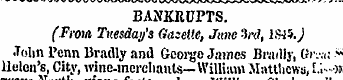
BANKRUPTS . ( From Tuesday ' s Gazette , June 3 «? , ISi '* . ) . Tohn Pcnn Brailly and George James Bivully , ( Jiv .-u * Helen ' s , City , winc-inerchanls— William Matthews , l \ -o » grove North , piano-fortc-nuiher—William Ctavkswi , itcross-street , boot and shoe tnanufiicturcr-. Steiilie : ; : ~ v eett , Cliiswell-street , linendraper—John Yi . te , < 5 ' . "mt- and York-road , Lambeth , ship owner—iltilin Molmn it " Jtichard Simons , Mincing-lane , wine and spirit nu-ri-imnn —William Astle , Wolvcrbainuton , Stafturdshirc , | ii ; i ! : iWi —Francis Harrington Church , Southampton , smjeonn Ltiiicnby Pearson , Newcastle-upon-Tyne , Icatbcr-dulw John Pitt , Plymouth , grocer-John Church Hi'iujim ; - - . Krir tol , stationer .
DECLARATIONS OF DIVIDENDS . G . E . White , Heading , Berkshire , tailor , first ai-Mt' y of 5 s in tho pound , any "Wednesday , at the office ¦; J > Graham , Coleman-strcet . II . and A . Wood , Basingliall-strect , lllackivell . / :... ' ! A si tors , third dividend of 4 ^ il in the pound , any Wediv ? -wkv at the office of Mr . Whitmore , Basingliall-strect , J . Johnston , Anston , Yorkshire , miller , first ar .. l tiiti dividend of Is 5 d in the pound for those creditors v , v hnvo not received a former dividend , and a linal diviifofc of 3 d in the pound to those creditors who have receiver ?! former dividend , on and after June 4 , at the rfficc of i Young , Leeds . Vf . Hcgiubottom , Ashton-nndcr-Lyne , Lancashire , c , c ton-spinner , final dividend of 2 d in the \ w \ xaA , & ui a w i and filial dividend of 2 s 8 d in the pound on new prow any Tuesday , at the office of Mr . Eraser , Manchester , t . DIVIWNDS .
JuneSfi , L . J . Nicolay , Woolwich , draper—June 52 ( "Wilson . Jermyn-street , St . James's , bootmaker-. ! unan « S . Hoadlcy , New Bond-street , coachmakcr-Juiie ? t > > £ Welch , Iling-cross , Holloway , licensed victualler—iu » uw B . Bright , Wigmorcstreet , Mavylebone , licensedvictiv . f . v —June 2 ( i , R . Barbara , Emsworth , Hampshire , liiiemteh-: —Juno 2 fi , R . Tucker , Dean-street , IVcstniitisteiv-i ' -i ' - —June 21 , W . II . Williamson , Dowgate-bil ) , City , * ¦> *» conist-JuneS-l , G . Jackson , Hertford , upholsterer- ' — 27 , P . Murray , Manchester , travelling draper—Junun N . P . Wood , Manchester , banker—June - . ' 7 , N . P . M V and 3 , 1 . Holden , Manchester . bankers—June 26 , J . CviCvi Stan way , Gloucestershire , com-dealer—June 2 * , ' " . ' " . gusou , Liverpool , draper-June 25 , II . DircUs , Live ner millwright—June 27 , G . Broeklehurst , II . Dircks , . * ' <¦ -: B . Kelson , Liverpool , millwrights—June " . ' 5 , A . A . I >* I > i Liverpool , vine-merchant—June 2 ( i , W . Oliver , Uarlimlim Durham , printer—June 2 fi , W , Granger , Kelly-miil . ii ! , ham , paper-manufacturer—June 25 , J . Hall , Wall-all Norrtumiberiand , cowkeeper— June 26 , 11 . Carrie , e , castlc-unou-Tj-uc , bookseller—June 24 , C . Mwcottptt , mingham , factor—June 24 , J . Hay ward , Mitverton . in . wickshu-e , miller—June 24 , J . and G . Clswke , Ropemem street , carpet-manufacturers .
Ceiitificates to be granted , unless cause be shown Mi I contrary on tbe day of meeting . June 25 , J . Hyatt , Commercial-road , Pimlico , vietiieti —June 25 , T . P . llees , King William-street , City , ty , merchant-June 25 , C . M . Firth , St . Micliael ' s-alley , ey , hill , lithographic printer—June 25 , T . Joplin , Sundwidw linendraper—June 26 , W . Granger , Itelly-nii )' , 7 > urDur paper-manufacturer—June 24 , T . S . Stuart , jun ., « ., 1 pool , drysalter-June 2 G , J . and J . Nie-Ul , J . Nicld . cld , and J . Holt , Chavleswovth , Derbyshire , cottnii-spinipini ! June 25 , J . Nicholson , Blackburn , Lancashire , lincndcnd —June- ' 4 , J . S . Howe , Newcastlc-under-Lj uu , StaStn shire , draper-June 24 , "W . Ferguson , Liverpu .. ! , drn dw June 24 , G . G . Smith , Kensington-park , builder ,
PARTNERSHIPS DISSOLVED . W . Smart and A . Tullett , Old Fish-sticr , Do Do commons , wholesale stationers—R . Beaumont ait a ; Kennedy , Leeds , Yorkshire , stockbrokers ~ T . Wic Wic and C . Brooks , Trinity Arms-yard , Swan-snvut , 'i'jt , T : square , Newington , town carmen—11 . lUwsnn ran r . i Field , Leicester , manufacturers—T . Luscombc . W . W . B and E . James , Plymouth , coal-merchants-1 ! . B . 1 B . ! and S . Bromticld , jun ., Tattenhall , Cheshire , uinltste . ltste Beaumont , V . Kennedy , and G . Clark . Bradford , ford , shire , stockbrokers—W . Hamer and J . JJIeaklor . bley . Leaver , Lancashire , cotton-spinners—J . Barrett rrett t Myers , Bradford , Yorkshire , painters—J . Haniiltdniiltr J . Baines , Liverpool , shipbrctes—W . G . Watson , 0 on , t rell , and II . Cory , Narrow-street , Limefiouse , wliihwliih mawttfactuvcrs-r-. "Webb and J . Irving , Liverpool , iool , manufacturers—T . Graham and W . Hayuaid , ' id , ' yard , Queen-street , Mile-end New-town , ciiciuicaiuica ! manufacturers—II . and 11 , P , Glvnu , LivprpuiJ , brrj , brr
E . Tassiker and J . Southworth , Orwell , LaHfa « himshh miners—R . Askew , T . Barlow , and S . Duvvupoi'tupoi Chester , dyers—S . II . Gorringeand L . B . Blatie , Wae , M ter , milHiicrs-S . Yielding and J . Craven , Chovlty . ivity . shire , cotton-manufaeturcrs-J ., J . I ., and 0 . C ; 0 . C LeadeuhalUtveet . City , wme-merchants-T . F . T : F . "I and W . S . Conquest , Old Broad-strefit , Citv , Bus ^ Rus kevs-T . J . and G . Fieldwick , Pancras . lane . City . txity . b house-keepers—C . Raisbeck and J . Hutty , Kingito ' ngato Hull , timber-merchants—J . Thompson andG . Ete . Etc Norfhwich , Cheshire , rock salt proprietors-G . Coig . Co E . Edge , Preston , Lancashire , cotton cloth-mainifAantif —J . Stephenson , jun ., and W . Hyde , jun ., Liverpoot'erpo * mongers—C . J . Jordan and V 7 . Dale , Wntcr . lanc , iianc , agents—J . Williamson ; and P . Harrison , Pcndlef >\ idleti cashirc , dyers—T . Heydon and . C . Handley , * % , W attorneys—B , Patterson , S . Pascal ! , and A . G . E .. G . J Church-street , Hackney , haberdashers-J . B . V . U V . mann and J . G . "W . Kuper , St . Ocorgo ' s-tcrrase , v-ase , ( well , wire rope-manufacturers .
-
-
Citation
-
Northern Star (1837-1852), June 7, 1845, page 6, in the Nineteenth-Century Serials Edition (2008; 2018) ncse-os.kdl.kcl.ac.uk/periodicals/ns/issues/ns2_07061845/page/6/
-