On this page
-
Text (2)
-
Untitled Article
-

Untitled Article
Note: This text has been automatically extracted via Optical Character Recognition (OCR) software. The text has not been manually corrected and should not be relied on to be an accurate representation of the item.
-
-
Transcript
-
Note: This text has been automatically extracted via Optical Character Recognition (OCR) software. The text has not been manually corrected and should not be relied on to be an accurate representation of the item.
Additionally, when viewing full transcripts, extracted text may not be in the same order as the original document.
Untitled Article
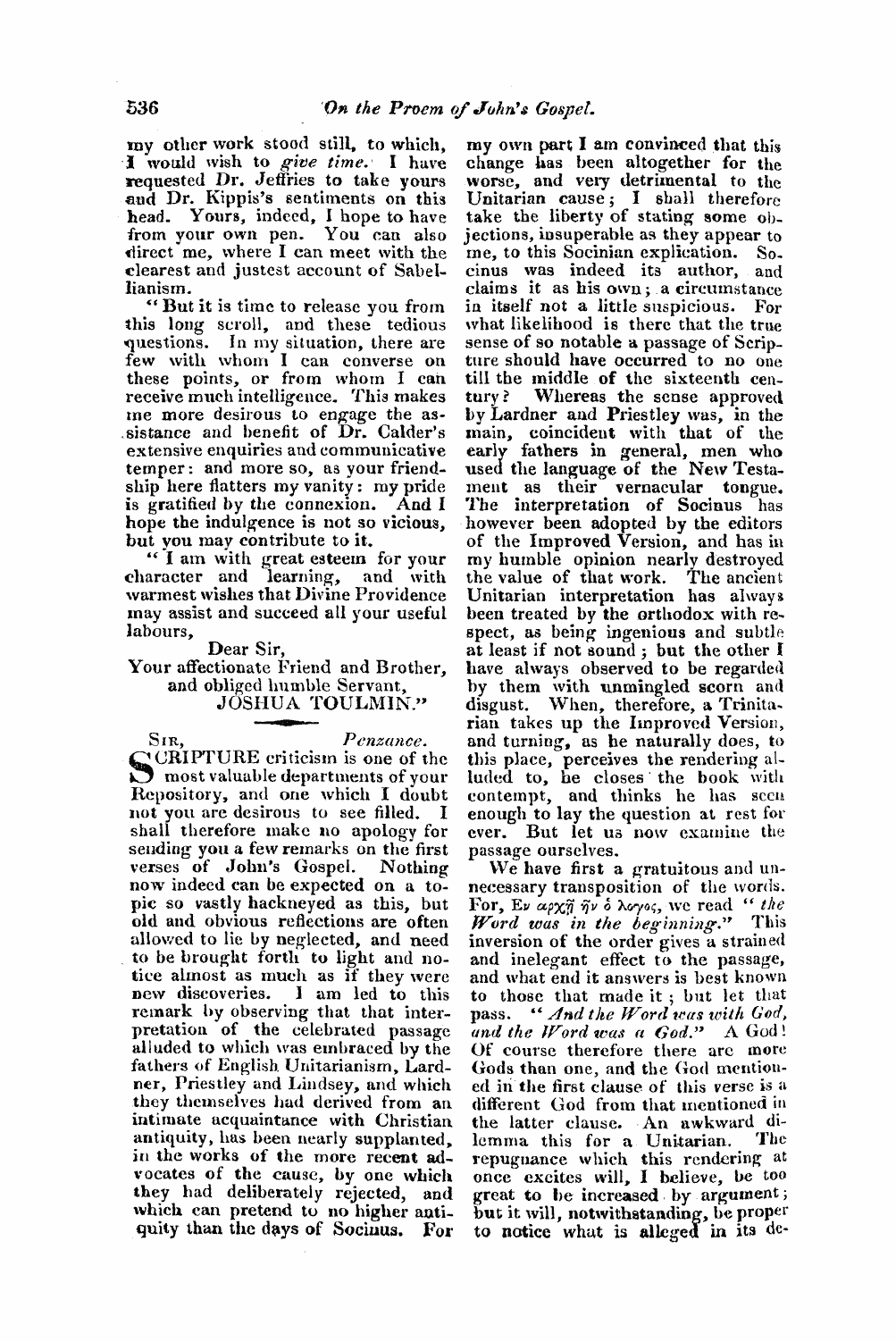
Sir , Penzance . SCRI PTURE criticism is one of the most valuable departments of your Repository , and one which I doubt not you are desirous to see filled . I
shall therefore make no apology for sending you a few remarks on the first verses of John ' s Gospel . Nothing now indeed can be expected on a topic so vastly hackneyed as this , but old and obvious reflections are often
allowed to he by neglected , and need to be brought forth to light and notice almost as much as if they were new discoveries . I am led to this remark by observing that that interpretation of the celebrated passage
alluded to which was embraced by the fathers of English Unitarianism , Lardncr , Priestley and Lindsey , and which they themselves had derived from an intimate acquaintance with Christian antiquity , has been nearly supplanted , in the works of the more recent
advocates of the cause , by one which they had deliberately rejected , and which can pretend to no higher antiquity than the d $ ys of Sociuus . For
Untitled Article
my own part ; I am convinced that this change has been altogether for the worse , and very detrimental to the Unitarian cause y I shall therefore take the liberty of stating some
objections , insuperable as they appear to rne , to this Socinian explication . So ^ cinus was indeed its author , and claims it as his own ; a circumstance in itself not a little suspicious . Far what likelihood is there that the true
sense of so notable a passage of Scripture should have occurred to no one till the middle of the sixteenth century ? Whereas the sense approved by Lardner and Priestley was , in the main , coincident with that of the early fathers in general , men who
used the language of the New Testament as their vernacular tongue . The interpretation of Socinus has however been adopted by the editors of the Improved Version , and has in my humble opinion nearly destroyed the value of that work . The ancient
Unitarian interpretation has always been treated by the orthodox with respect , as being ingenious and subtle at least if not sound ; but the other I have always observed to be regarded
by them with unmingled scorn and disgust . When , therefore , a Trinitarian takes up the Improved Version , and turning , as he naturally does , to this place , perceives the rendering alluded to , he closes the book with
contempt , and thinks he has seen enough to lay the question at rest for ever . But let us now examine the passage ourselves . We have first a gratuitous and unnecessary transposition of the words .
For , Ex / a-pxy vjv o Xoyo ; , we read " the Word was in the beginning" This inversion of the order gives a strained and inelegant effect to the passage , and what end it answers is best known
to those that made it ; but let that pass . " And the Word was with God , and the Word was a God . " A God 1 Of course therefore there are more Gods than one , and the God mentioned in the first clause of this verse is a
different God from that mentioned in the latter clause . An awkward dilemma this for a Unitarian . The repugnance which this rendering at once excites will , I believe , be too great to be increased by argument ; but it will , notwithstanding , be proper to notice whut is alleged ia ita dc-
Untitled Article
536 On the Proem of John ' s Gospel .
Untitled Article
my other work stood still , to which , I would wish to give time . I have requested Dr . Jeffries to take yours and Dr . Kippis ' s sentiments on this
head . Yours , indeed , I hope to have from your own pen . You can also direct me , where I can meet with the clearest and justest account of Sabellianism .
" But it is time to release you from this long scroll , and these tedious questions . In my situation , there are few with whom I can converse on these points , or from whom I can receive much intelligence . This makes rne more desirous to engage the assistance and benefit of Dr . Calder ' s
extensive enquiries and communicative temper : and more so , as your friendship here flatters my vanity : my pride is gratified by the connexion . And I hope the indulgence is not so vicious , but vou may contribute to it .
" I am with great esteem for your character and learning , and with warmest wishes that Divine Providence may assist and succeed all your useful labours , Dear Sir , Your affectionate Friend and Brother , and obliged humble Servant , JOSHUA TOULMIN . "
-
-
Citation
-
Monthly Repository (1806-1838) and Unitarian Chronicle (1832-1833), Sept. 2, 1825, page 536, in the Nineteenth-Century Serials Edition (2008; 2018) ncse-os.kdl.kcl.ac.uk/periodicals/mruc/issues/vm2-ncseproduct2540/page/22/
-