On this page
-
Text (3)
-
Untitled Article
-
Untitled Article
-

Untitled Article
Note: This text has been automatically extracted via Optical Character Recognition (OCR) software. The text has not been manually corrected and should not be relied on to be an accurate representation of the item.
-
-
Transcript
-
Note: This text has been automatically extracted via Optical Character Recognition (OCR) software. The text has not been manually corrected and should not be relied on to be an accurate representation of the item.
Additionally, when viewing full transcripts, extracted text may not be in the same order as the original document.
Untitled Article
Greek liturgies , was called . fcof-aoMCf or subsistence , all of which are terras which pleasb most of their employers without being understood . If we do not unjustly limitthe sease of the term Unitarian , we shall be more likely to preserve it in use .: and
that from the necessity and couveniency of the case . There is no other name which really embraces and describes the members of our congregations . They like to call us Socinians : but this term is extremely
inappropriate , because we not only almost universally disapprove of that religious worship of Christ for which that great man contended , but not a few of us , both people and ministers , entertain more or less of the doctrine
of the super-angelic pre-exktence of Christ , which is commonly supposed to be entirely denied by those who are Socinians . In the extended sense , therefore , of the term Unitarian , it serves a convenient and necessary use , which is peculiar to itself , aud is .
therefore , likely to maintain its ground . But if it be allowed to become synonymous with the term Socinian , there is great reason to fear that popular antipathy will succeed in fixing on us that one of the two synonymes for which we have least liking .
I think Mr . Clarke is also right ia disclaiming for Unitarians a denial of the divinity of Christ . For myself , as a Unitarian , I earnestly avow my belief that Jesus Christ our Lord was most truly divine ; divine in his person , as well as in his doctrine , In
declaring thus much , I do not mean to maintain either his proper deity or his personal p re -existence - y his own nature I believe to have been properly and truly human > such as our own , sin excepted ; but I also believe that in so eminent a sense " he was in the
Father and the Father in him / or , in other words , "the word which from the beginning was with God , and was God , had so become flesh in his person , " that he was indeed most inconceivably divine , and most justly may be called our divine Master and Saviour .
If any should be disposed to regard these distinctions , with contempt as a mere quarrel about wot : ds , I beg to remiud them once more of the impprtanU influence of nainea , in all questions which involve an appeaV ta popular opinion . Aud surely , in a
Untitled Article
On Mr . GJarJ&s Definition qf Unitarianisnu 457
Untitled Article
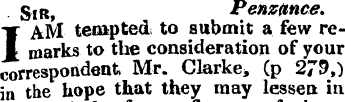
Sir , Penzfrnce * AM tempted ; to submit a few re-I marks to the consideration of your correspondent Mr . Clarke , ( p 279 , ) in the hope that they may lessen in
his mind the force of some of these offences which he appears to find in the conduct of his Unitarian brethren . It is in the abuse of certain names that he sees matter of complaint j and
although lie appears to me to overcharge the case , yet I must own I feel some little sympathy with him , on the whole , and am willing to shew him that lie is not quite so much in the minority as he seems to suppose . I think Mr . Clarke completely right ia the sense which he wishes to assign to the term Unitarian , viz ., that it
ought to designate all those who confine the names and honours of Deity to the one God , the Father of our Lord Jesus Christ , With him I judge that those who attempt to attach any more limited meaning to the word
than this , do an injury both to their brethren and their cause . The very derivation of the word makes the true sense of it obvious to every one : the Unitarian is one that is distinguished as contending for the unity of God . So evident is this matter , that it makes
our adversaries dislike to allow us this name ; it appears to them like a concession of the great point in dispute ; and as names are important , they grudge us the advantage of so good a oixe . We , however , claim the name ; we adopt it , and know ourselves by no other ; because we think it a just and
true name . We contend for the unity of God in opposition to polytheism ; it is indeed possible that we may fancy polytheism where it does not exist , and this our opponents will say . Still , I repeat it , we contend against Trinitarianism on no other ground than because we regard it as polytheism . In short , Trinitarians may as properly allow us our name as continue to use their own : both parties must feel that tuese names very justly characterize the opposite points of opinion existing hetween them ; and it is inevitable that they will be taken by each party in its own sense . To us the two terms
are equivalent to Monotheists and Intheists : to tiieijn they only & > nvey ft reference \ o that distiuqtioji in the umne Nature , which in English they eaUl Pwons , but which , in the otisAnd
Untitled Article
y . XX , 3 N
-
-
Citation
-
Monthly Repository (1806-1838) and Unitarian Chronicle (1832-1833), Aug. 2, 1825, page 457, in the Nineteenth-Century Serials Edition (2008; 2018) ncse-os.kdl.kcl.ac.uk/periodicals/mruc/issues/vm2-ncseproduct2539/page/7/
-
