On this page
-
Text (1)
-
Untitled Article
Note: This text has been automatically extracted via Optical Character Recognition (OCR) software. The text has not been manually corrected and should not be relied on to be an accurate representation of the item.
-
-
Transcript
-
Note: This text has been automatically extracted via Optical Character Recognition (OCR) software. The text has not been manually corrected and should not be relied on to be an accurate representation of the item.
Additionally, when viewing full transcripts, extracted text may not be in the same order as the original document.
Untitled Article
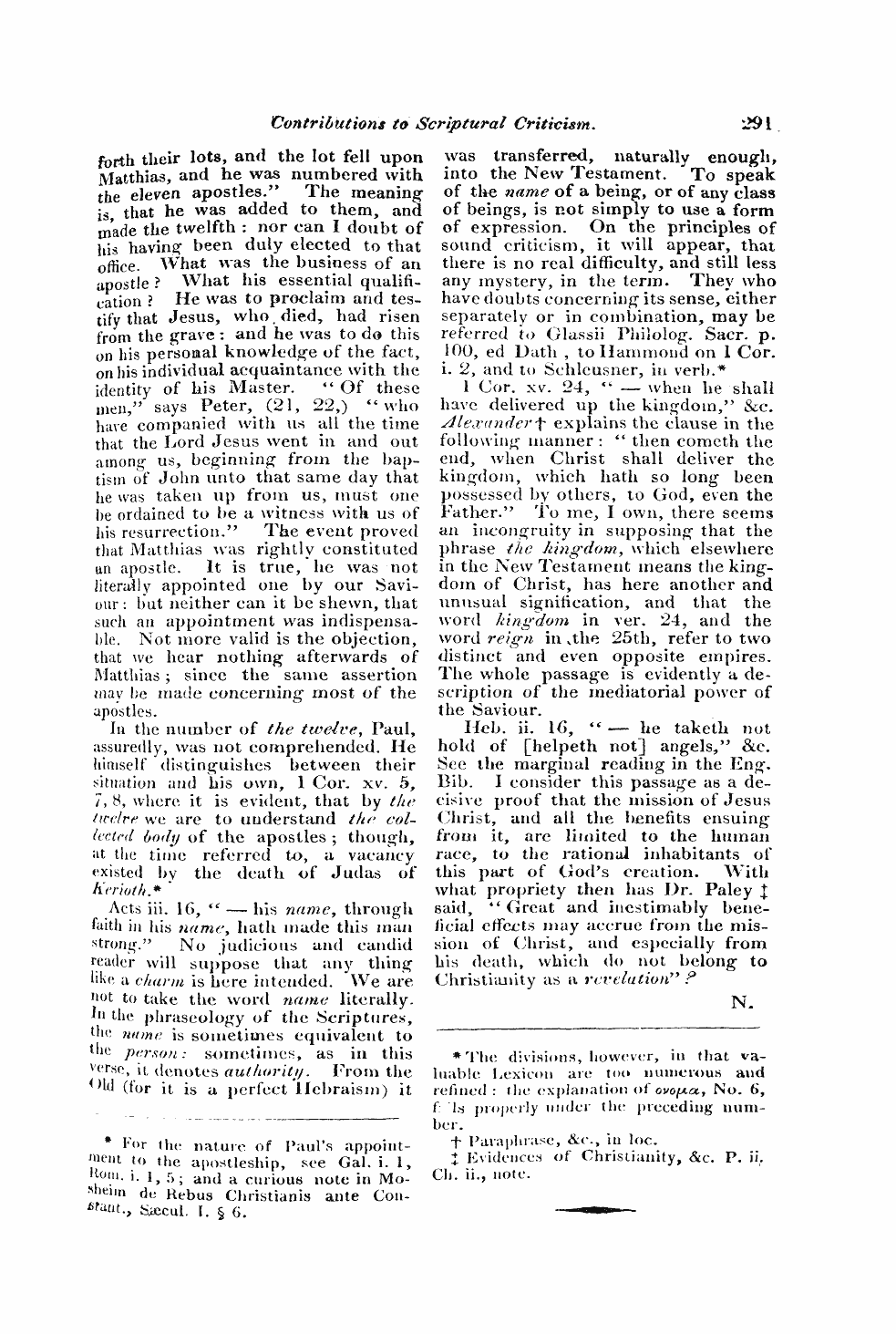
forth their lots , and the lot fell upon Matthias , and he was numbered with the eleven apostles . " The meaningis , that he was added to them , and made the twelfth : nor can I doubt of his having been duly elected to that office . What was the business of an apostle ? What his essential
qualification ? He was to proclaim and testify that Jesus , who # died , had risen from the grave : and he was to do this on his personal knowledge of the fact , on his individual acquaintance with the identity of his Master . " Of these men , " says Peter ^ ( 21 , 22 , ) -who have companied with us ail the time that the Lord Jesus went in and out
among us , beginning from the baptism of John unto that same day that he was taken up from us , must one be ordained to be a witness with us of his resurrection . " The event proved that Matthias was rightly constituted an apostle . It is true , he was not literally appointed one by our Saviour : but neither can it be shewn , that
such an appointment was indispensable . Not more valid is the objection , that we hear nothing afterwards of Matthias , since the same assertion may be made concerning most of the
apostles . In the number of the twelve , Paul , assuredly , was not comprehended . He himself distinguishes between their situation and his own , 1 Coi \ xv . 5
/ , 8 , where it is evident , that by the twelve we are to understand the collected body of the apostles ; though , at the time referred to , a vacancy existed by the death of Judas of Kerwth ' * ' Acts III . 16 . " — his name , through Acts III . 16 iC — his namethrough
, , faith in his name , hath made this man strong . " No judicious and candid reader will suppose that any thing like a charm is here intended . We are not to take the word name literally , hi the phraseology of the Scriptures , the name is sometimes equivalent to the per so ft : sometimes , as in this
v . rse , a denotes authority . From the ( ( for it is a perfect llcbraism ) it For the nature of Paul ' s appointment t <> the apostleship , see Gal . i . 1 , Horn . i . 1 , 5 ; and a curious note in Moahenn da Rebus Christianis ante Con-£ ^ "t . > &ecul . I . § 6 .
Untitled Article
was transferred , naturally enough , into the New Testament . To speak of the name of a being , or of any class of beings , is not simply to use a form of expression . On the principles of sound criticism , it will appear , that
there is no real difficulty , and still less any mystery , in the term . They who have doubts concerning' its sense , either separately or in combination , may be referred to Glassii Philology Sacr . p . 100 , ed Dath , to Hammond on 1 Cor .
i . 2 , and to Schlcusner , in verb . * 1 Cor . xv . 24 , " — when he shall have delivered up the kingdom , " &c . Alexander \ explains the clause in the following manner : " then cometh the end , when Christ shalL deliver the kingdom , which hath so long been possessed by others , to God , even the Father . " To me , I own , there seems
an incongruity in supposing that the phrase the kingdom , which elsewhere in the New Testament means the kingdom of Christ , has here another and unusual signification , and that the
word kingdom in ver . 24 , and the word reign in Kthe 25 th , refer to two distinct and even opposite empires . The whole passage is evidently a description of the mediatorial power of the Saviour .
Heb . ii . 1 < 3 , " — he taketh not hold of [ helpeth not ] angels , " &c . See the marginal reading in the Eng . Bib . I consider this passage as a decisive proof that the mission of Jesus
Christ , and all the benefits ensuing from it , are limited to the human race , to the rational inhabitants ol this part of God's creation . With what propriety then has Dr . Paley t
said , " Great and inestimably beneficial effects may accrue from the mission of Christ , and especially from his death , which do not belong to Christianity as a revelation" ? N .
* The divisions , however , in that valuable Lexicon are too numerous and refined : the explanation of ovofjea ,, No . 6 , f Is properly under the preceding number . f Paraphrase , & < -, hi loc . + Evidences of Christianity , &c . P . ii . Ch . ii ., note .
Untitled Article
Contributions to Scriptural Criticism . 291
-
-
Citation
-
Monthly Repository (1806-1838) and Unitarian Chronicle (1832-1833), May 2, 1822, page 291, in the Nineteenth-Century Serials Edition (2008; 2018) ncse-os.kdl.kcl.ac.uk/periodicals/mruc/issues/vm2-ncseproduct2512/page/35/
-