On this page
-
Text (2)
-
Untitled Article
-

Untitled Article
Note: This text has been automatically extracted via Optical Character Recognition (OCR) software. The text has not been manually corrected and should not be relied on to be an accurate representation of the item.
-
-
Transcript
-
Note: This text has been automatically extracted via Optical Character Recognition (OCR) software. The text has not been manually corrected and should not be relied on to be an accurate representation of the item.
Additionally, when viewing full transcripts, extracted text may not be in the same order as the original document.
Untitled Article
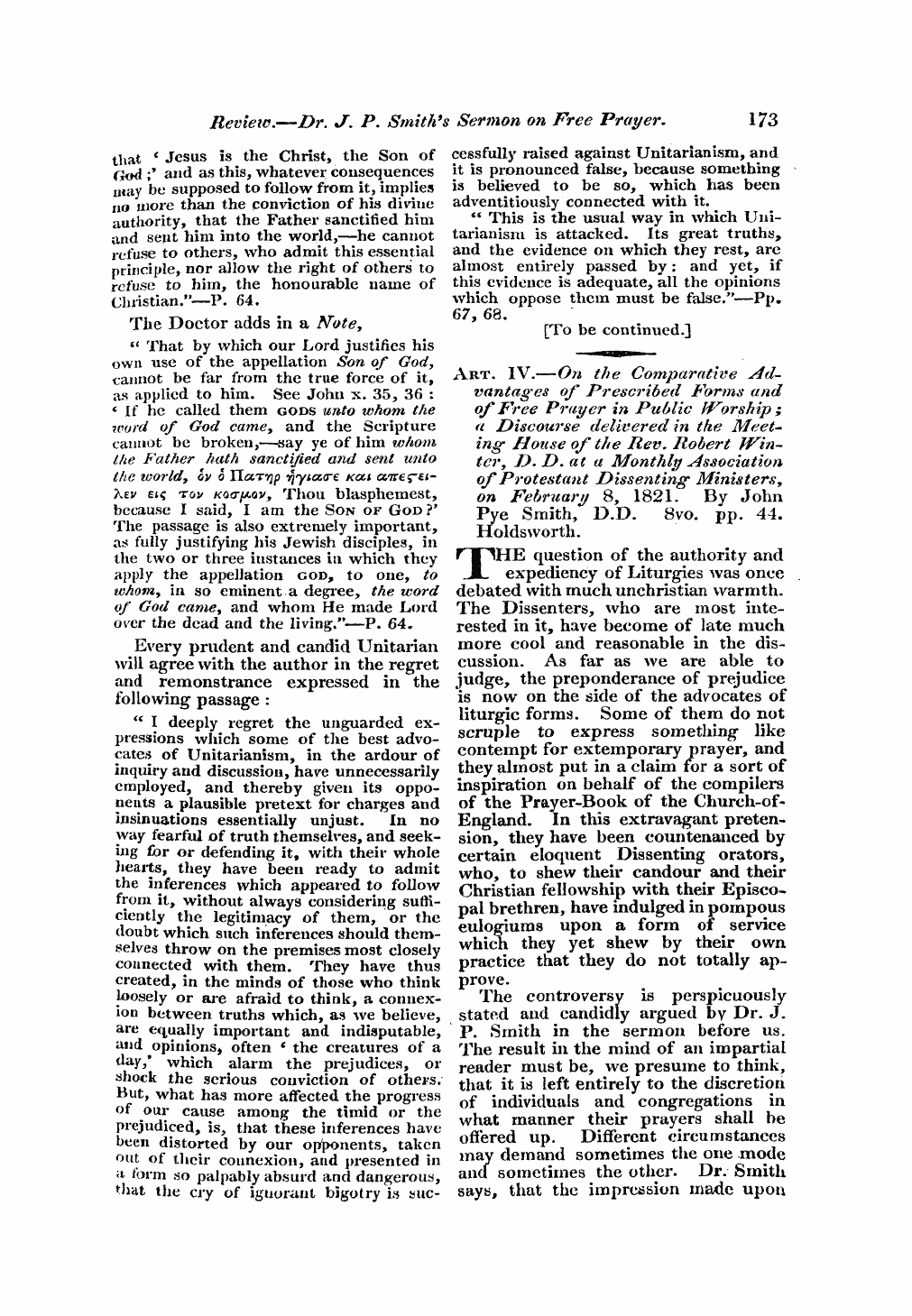
that < Jesus is the Christ , the Son of God ; ' and as this , whatever consequences may be supposed to follow from it , implies no more than the conviction of his divine
authority , that the Father sanctihed him and sent him into the world , —he cannot refuse to others , who admit this essential principle , nor allow the right of others to refuse to him , the honourable name of Christian . "—P . 64 .
The Doctor adds in a Note , " That by which our Lord justifies his own use of the appellation Son of God , cannot be far from the true force of it , as applied to him . See John x . 35 , 36 : c If he called them gods unto whom the
word of God came , and the Scripture cannot be broken , —say ye of him whom the Father hath sanctified and sent unto the world , hv 6 UuTr ^ p qyicccr € Kct i cnre s ~ £ i-Kev ei <; Toy kqo-jjlqv , Thou blasphemest , because I said , I am the Son of God ?'
The passage is also extremely important , as fully justifying his Jewish disciples , in the two or three iustauces in which they apply the appellation god , to one , to whom , in so eminent a degree , the word of God came , and whom He made Lord orer the dead and the living . "—P . 64 L
Every prudent and candid Unitarian will agree with the author in the regret and remonstrance expressed in the following passage :
< c I deeply regret the unguarded expressions which some of the best advocates of Unitarianism , in the ardour of inquiry and discussion , have unnecessarily employed , and thereby given its opponents a plausible pretext for charges and insinuations essentially unjust . In no
way fearful of truth themselves , and seeking for or defending it , with their whole hearts , they have been ready to admit the inferences which appeared to follow from it , without always considering sufficiently the legitimacy of them , or the doubt which such inferences should
themselves throw on the premises most closely connected with them . They have thus created , in the minds of those who think loosely or are afraid to think , a connexion between truths which , as we believe , are equally important and indisputable , and opinions * often * the creatures of a day / which alarm the prejudices , or
shock the serious conviction of others . Hut , what has more affected the progress of our cause among the timid or the prejudiced , is , that these inferences have been distorted by our opponents , taken out of their connexion , and presented in a form so palpably absurd and dangerous , that the cry of ignorant bigotry is suc-
Untitled Article
cessfully raised against Unitarianism , and it is pronounced false , because something is believed to be so , which has been adventitiously connected with it . iC This is the usual way in which
Unitarianism is attacked . Its great truths , and the evidence on which they rest , are almost entirely passed by : and yet , if this evidence is adequate , all the opinions which oppose them must be false . "—Pp . 67 , 68 . [ To be continued . ]
Untitled Article
Art . IV . —On the Comparative Advantages of Prescribed Forms and of Free Prayer in Public Worships a Discourse delivered in the Meeting House of the Rev . Robert Winter , D . D . at a Monthly Association of Protestant Dissenting Ministers , on February 8 , 1821 . By John Pye Smith , D . D . 8 vo . pp . 44 . Holds worth .
THE question of the authority and expediency of Liturgies was once debated with much unchristian warmth . The Dissenters , who are most interested in it , have become of late much more cool and reasonable in the
discussion . As far as we are able to judge , the preponderance of prejudice is now on the side of the advocates of liturgic forms . Some of them do not scruple to express something like contempt for extemporary prayer , and they almost put in a claim for a sort of
inspiration on behalf of the compilers of the Prayer-Book of the Church-of-England . In this extravagant pretension , they have been countenanced by certain eloquent Dissenting orators ,
who , to shew their candour and their Christian fellowship with their Episcopal brethren , have indulged in pompous eulogiums upon a form of service which they yet shew by their own practice that they do not totally
approve . The controversy is perspicuously stated and candidly argued by Dr . J . P . Smith in the sermon before us . The result in the mind of an impartial reader must be , we presume to think , reader must De , we presume to tnmK ,
that it is left entirely to the discretion of individuals and congregations in what manner their prayers shall be offered up . Different circumstances may demand sometimes the one mode and sometimes the other . Dr . Smith says , that the impression made upon
Untitled Article
Review . —Dr . J . P . Smith s Sermon on Free Prayer . 173
-
-
Citation
-
Monthly Repository (1806-1838) and Unitarian Chronicle (1832-1833), March 2, 1821, page 173, in the Nineteenth-Century Serials Edition (2008; 2018) ncse-os.kdl.kcl.ac.uk/periodicals/mruc/issues/vm2-ncseproduct2498/page/45/
-