
On this page
-
Departments (1)
-
Text (4)
-
Untitled Article
-
Untitled Article
-
* r- + c»#v "frhl*l*f fttY ^riVllf (v^Vi^jy u (^H . wd, ¦ + ¦
-

Untitled Article
Note: This text has been automatically extracted via Optical Character Recognition (OCR) software. The text has not been manually corrected and should not be relied on to be an accurate representation of the item.
-
-
Transcript
-
Note: This text has been automatically extracted via Optical Character Recognition (OCR) software. The text has not been manually corrected and should not be relied on to be an accurate representation of the item.
Additionally, when viewing full transcripts, extracted text may not be in the same order as the original document.
Untitled Article
corded of the Royal confidence in our High School University , and other seminaries of learning 2 . That the distinguished honour conferred by the auspicious visit of his Royal Highness will ever be associated in the minds of the citizens with feelings of satisfaction and delight , as having l > een the means of enabling them to witness the personal virtues which adorn the character of the prince and which have won for him their dutiful attachment and esteem . 3 . That this council , in
common- with their fellow-citiizens , rejoice in the opportunity which his Royal Highness has been . graciously pleased to embrace of visiting the places of historical and scientific interest in the city and its n eighbourhood ; and they humbly tender to the Prince the expression of their grateful and respectful acknowl edgments for the unvarying condescension and courtesy which have marked the demeanour of His Royal Highness during a residence of two months in the Scottish metropolis .
The Coming Shrievaltt . —Instead of the usual tawdry finery , next Lord Mayor ' s day it is intended that what is considered an apparently quiet taste shall prevail , and , instead of new chariots , with gold and silver mouldings , the sheriffs' chariots will be merely revivified for the occasion . The liveries will be wholly free from splendid ornamentations , and simply of ordinary cloth . / The beadles will not , as usual , be furnished with ' new cloaks , those which they received upon the election of the sheriffs elect being considered capable of being brushed up ; while , instead of those elegant massive gold chains « nd badges generally made , those belonging to the past sheriffs have been obtained and burnished up for the new sheriffs . Other deviations from the
usual shrieval display will also take place , such as dispensing with one out of each of the two footmen , and particularly the inauguration dinner . Cit y Sewers . — -The Commissioners held their first meeting yesterday since the commencement of the holidays . Deputy Christie in the chair . Some reports were presented from Dr . Letheby , after which the Court adjourned . . St . George ' s-iit-the-East . —Last Sunday the rector ' s after noon service and the ordinary ? o ' clock service were marked by actual riots of the most extravagant character , the authority of the churchwardens and the advice of the-Bishop being wholly
Bet aside and disregarded . The whole of the services ( with the exception of Mr . Allen ' s ) were interrupted and interpolated by remarks on the part of the congregation . The regular service of the church was taken ( according to his lordship ' s expressed desire ) by the Rev . Alexander Heriot Maconochie , M . A ., of Wadham College , Oxford , one of the ministers of the Mission Church which has been established by the Rev . Bryan King in his parish . There was nothing in the manner in which the Rev . A . H . Maconqchie performed the service to call for especial remark . Like his predecessor ( Mr . Lee ) , he performed the service in the choir stalls , but he wore nothing but the ordinary vestments of a Church of England clergyman—namely a black
stole , an Oxford master of arts hood , and the ordinary surplice . Mr . Maconochie preached a sermon which , strange to say , was not interrupted except by some boys in the gallery . Between 2 , 000 and 3 , 000 persons stayed until the 4 o ' clock service , which Mr . Maconochie had the courage to perform . He was hooted and threatened as he approached the altar , and as he retired he was " mobbed , " and his surplice torn away from him . In the evening the same scene was renewed , although during the course of a very eloquent sermon he kept the congregation in perfect silence . At its close loud and uncalled for hisses broke forth , and it was with difficulty that the churchwardens cleared the church . Mr . Selfe , the magistrate , was in attendance during the services of the day ,
How to Encourage Defaulters . — At - the weekly meeting of the directors of the poor of St . Pancras , the clerk to the board reported that the Police Commissioners had informed him that a letter had been received from Canada West , which stated that Charles Hibbard , late a clerk in the employ of the vestry , and who ajbsconded with upwards of . £ 800 of the parish money , was living at Ottawa , And requesting that the necessary documents to authorise his apprehensidn should be forwarded .
Some discusssion ensued , in the course of which it was stated that the cost of bringing Hibbard over to this country and prosecuting him would be about £ 300 , and it seemed to be the general opinion that it would not be" well to put the parish to that expense . Eventually a resolution was come to " that the cleric write to the Police Commissioners stating that the board do not feel disposed to prosecute Hibbard so long as he remains beyond the shores of England . "
The Right Hon . T . Milner Gibson has been rusticating on the French coast , and is at present « t Dieppe . It is understood the right hon . gentleman , returns to England next week , and will most probably make a short-stay in town . H '
Untitled Article
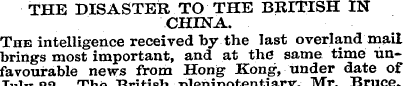
THE DISASTER TO THE BRITISH IN CHINA . The intelligence received by the last overland mail brings most important , and at the" same time unfavourable news from Hong Kong , under date of July 22 . The British plenipotentiary , Mr . Bruce , arrived off the Peiho on the 1 . 8 th of June , and sought communication with the authorities on shore . No officers of rank were found , but some messages were interchanged between some petty mandarins and Mr . Bruce ' s suitel The tenour of these was , that the foreign Ministers would be allowed to proceed
to Pekin by a passage to the northward , but that no man-of-war would be allowed to enter the Peiho . They disclaimed actingunder Imperial orders , stating that the forts and barriers were constructed by the country people to protect them against pirates * Failing to obtain any satisfactory intercourse , Mr Bruce handed the matter over to Admiral Hope * who , on the 25 th of June , proceeded to force a passage ; but we regret to say that our forces were repulsed with great loss . The North China Herald contains the following account of the action , from an . officer who was present : "On the 25 th of June *
the admiral , with his flag flying in the Plover * followed by the gunboats Lee , Nimrod , Cormorant , Opossum , Banterer , Starling , Forester , Kestrel , Janus , and Haughty , proceeded to take up a position off the Peiho forts , ready to attack in case the Chinese should offer any resistance to > clearing away the barriers . At 2 p . m ., the Opossum proceeded to clear away a passage through the iron stakes which composed the obstruction . Two of these having been drawn , the Plover , followed by the Opossum , passed through them . Almost
immediately a single gun was fired at her , and directly all the masks were rolled up a tremendous fire was opened on the squadron , and the action became general . The Lee , by signal from the Plover , passed through the stakes to the support of the admiraL The Plover and the Opossum were , however , soon obliged to slip , the fire being to , heavy for them . At 4 . 30 the enemy ' s fire was slackened considerably orders were sent down to the reserve for Marines and Naval Brigades to prepare to land , and the Forester and the Opossum , together with the
Toeywan , proceeded nnd towed them to the Nimrod the place of rendezvous . At an early period of the action the admiral had been wounded on board the Plover by a splinter in the thigh , and that vessel was almost entirely disabled . He slifted his flag to the Opossum . When there he took his station on the caboose , and thence issued his orders ,, until a round shtft cut the mainstay on which he was leaning and caused him to toll to the 4 pck , a height of some -eight feet , breaking a rib and severely shaking him . After a short time he left thTopLum in flie Pu Chuyla ' s rig , and Proceeded to the Cormorant where ho remained .. At 4 45 the boats having assembled alongside Nimrod , pushed for the SIS ? m near the stakes as possible and opposite to distant
tie left bastion , about 600 yards . « The landing here was composed of mud about knee deep , and the groatest difficulty was experienced in getfing up the scaling ladders and bridges . The Marines and Naval Brigade , a small portion of which had only just landed , pushed to the front under a Very heavy flro from six guns in flank and in front . The fire from the walls was very heavy . A ditch , five feet deep and ten broad , occurred , and Ll imvinir no choice , plunged across , and
thereby wetted their ammunition . A party of seme fifty officers and men again pushed on and crossed another wet ditch , which took thorn within twenty yards of the wall . In the meantime Captail&s Shadwoll and Vansittart , as also Colonel Lemon , uwring : been wounded , the commands devolved on Commanders Comraerell and Major Parke . It was now about nine o ' clock , and darkness had set in . Tiio position of the landing paxfcy was most precarious >
Untitled Article
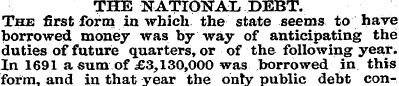
THE NATIONAL DEBT . The first form in which the state seems to have borrowed money was by way of anticipating the duties of future quarters , or of the following year . In 1691 a sum of £ 3 , 130 , 000 was borrowed in this form , and in that year the only public debt consisted of this temporary loan , upon which the interest was , £ 232 , 000 , or at the rate of about 7 £ per cent . These loans seem to have ceased in 1753 , or at least there is no separate account of them after that period . But the practice in another shape prevails to this day . In every quarter when there is a
deficiency in the means to meet the charges upon the Consolidated Fund and the dividends of the public debt , there are issued to the Bank of England deficiency Exchequer-bills for the amount , which are paid off from the accruing revenue of the coming quarter , and which constitute therefore a loan in anticipation of duties . Again , there is extant now a law which enables the Treasury to raise money for any of the services of the year , upon an issue of what are called " Consolidated Fund Bills , " but which must be paid off from the revenue of the next following quarter . These again form a loan in
anticipation of duties . The next form of debt which we find was in the shape of navy bills , which were issued in 1693 to the amount of . £ 1 , 430 , 439 . This form of debt existed until 1795 , when they , together with the ordnance debentures , appear to have been consolidated with . the funded debt . In the following year , 1694 , the first loan was made by the Bank of England to the Government , amounting to £ 1 , 200 . 000 , at 8 per cent . This loan continued stationary until 1709 , when it was increased to . £ 3 , 375 , 028 , and the interest reduced to 6 per cent . It remained at this amount until 1718 , when it
was increased to £ 5 , 375 , 000 , partly at 6 per cent , and partly at 5 per cent . The debt to the Bank of England reached its maximum of £ 14 , 686 , 800 in 1816 , at the rate of 3 per cent ., at which it stood till the renewal of the charter in 1834 , when it was reduced to £ 11 * , 100 , at which it now stands . The next form in point of date in which the nation borrowed was by the issue of the ordinary Exchequer-bills in 1696 , to the amount of £ 50 , 000 . This form of unfunded debt has been more largely used than any other , and their issue seems to have reached the maximum in 1814 * when
the amount was £ 56 , 98 ^ , 700 . " At the close of the last financial year they were reduced to £ 13 , 277 , 400 5 a quantity amounting to £ 7 , 000 , 000 having been funded a few months before . In point of date , the next form of public debt was a loan of £ 2 , 000 , 000 from the East India Company at 8 per cent . In 1707 this loan was increased to £ 3 , 200 , 000 , and the interest reduced to 5 per cent . In 1744 a further loan of £ 1 , 000 , 000 seems to have been made at 3 per cent ., and in 1757 the whole ( £ 4 , 200 , 000 ) was reduced to that rate . This loan continued at that amount till 1793 , when it was paid off . These loans
from the Bank of England and from the East India Company must be regarded in the light of payments from their stocks , as the price of the monopolies which they enjoyeil . It was not until 1706 that portion of the debt called the National Annuities was contracted . In that year annuities at the rate of 6 per cent , were contracted for to the amount of £ 664 , 263 . This sum was increased in 1711 to £ 5 , 125 , 033 , and in 1712 to £ 9 , 816 , 563 . In the following year a small amount was issued at 4 percent . In 1716 the 6 percent , annuities ceased , and for many yeara the National Debt was in the form of 4 and 5
percent , annuities . The first time the 3 percent , consolidated annuities appear is in 1722 , when the whole capital of the funded debt , including the debts to the Bank of England , the East India Company , and the South Sea Company , amounted only to £ 49 , 874 , 736 . At the same time the amount of the unfunded debt was £ 4 , 281 , 476 . TlrisfcSvas the growth of thirty-one years . The system of borrowing having been once fairly entered upon , it went on steadily from year to year , notwithstanding the remonstrances of enlightened men , until in 1 , 761 , at the beginning of the reign of George III ., the
funded debt had reached £ 109 , 908 , 974 , when the unfunded debt was £ 4 , 386 , 040 , making a total of £ 114 , 294 , 987 . In the next twenty years the amount was increased by another £ 100 , 000 , 000 , and in 1782 , it stood at £ 214 , 792 , 586 . In ten years more it increased to £ 239 , 663 , 421 , at which it stood in 1792 , before the commencement of the long struggles which end in 1815 . D uring those twenty-three years the debt increased by no less a sum than £ 621 , 375 , 628 , the total amount funded and unfunded „ , being
in that year £ 861 , 039 , 049 , the maximum point to which it ever reached . The only period in English history during which the public , debt did not increase , but , on the contrary , underwent a diminution since 1691 , when the art of State borrowing was first inaugurated , has been the time that has elapsed from 18 X 5 to the present time . Under the influence of the sinking fund established in 1821 , the debt diminished , until , in 1834 , it reached the minimum at which it had stood since the close of the
French war . It was then £ 773 , 234 , 401 , being a reduction from 1815 of £ 87 , 804 , 648 , or at the rate of upwards of four millions a-year . In 1835 aa increase took place in order to raise the Slave Indemnity Fund ; In 1841 it again rose tov £ 792 , 209 , 685 . A gradual reduction then took place until 1853 ; when it stood at £ 769 , 082 , 549 . Then came the Russian war , in consequence of which the amount rose in 1856 , to £ 808 , 108 , 722 . Since then
it has been reduced to the sum of £ 805 , 078 , 554 , at which the funded and unfunded debt together stood on the 31 st day of March , 185 S . It has been thus that in 168 years the public debt-of England has grown from a sum of £ 3 , 130 , 000 , and an annual charge of £ 232 , 000 , to a sum of £ 805 , 078 , 554 * involving an annual charge of £ 28 , 204 , 299 . to be borne by the capital and industry of the country . — Economist .
* R- + C»#V "Frhl*L*F Ftty ^Rivllf (V^Vi^Jy U (^H . Wd, ¦ + ¦
^ o raj p | ft eius . — : — - * -
Untitled Article
ISTo . 495 . Sept . 17 , 1859 . THE LEADE 1 1051
-
-
Citation
-
Leader (1850-1860), Sept. 17, 1859, page 1051, in the Nineteenth-Century Serials Edition (2008; 2018) ncse-os.kdl.kcl.ac.uk/periodicals/l/issues/vm2-ncseproduct2312/page/7/
-