On this page
-
Text (3)
-
Untitled Article
-
Untitled Article
-

Untitled Article
Note: This text has been automatically extracted via Optical Character Recognition (OCR) software. The text has not been manually corrected and should not be relied on to be an accurate representation of the item.
-
-
Transcript
-
Note: This text has been automatically extracted via Optical Character Recognition (OCR) software. The text has not been manually corrected and should not be relied on to be an accurate representation of the item.
Additionally, when viewing full transcripts, extracted text may not be in the same order as the original document.
Untitled Article
all the Rrim'an catacombs , and cannot be referred to a period , of high antiquity . In these remains Gtod is never represented under a human Form ; nor did any artist ^ for many ages after , allow himself to mark the presence of the Eternal by anything more than a hand issuing from a cloud . ^ u ln short , " to quote the author ' words , " the Christian tombs , pictures , mosaics , and bas-reliefs apprise us that the wretched idea of depicting the Deity in a work of art is modern ; that the traditional countenance of Jesus Christ was seldom drawn or
even Mated at ; that the predominance smce given to the Virgin was absolutely unknown ; that the Christians at first avoided the use of images , and when they adopted them , the first were symbols rather than effigies . " The question is ably discussed as to whether the Catholic Church baa really fostered art and protected and improved it to the degree held by many . It would be absurd to deny that Catholicism has rendered service to artists , were it only in the demand it makes on the productiveness of their talent ; but it is , no doubt , also the cause of great damage to the arts themselves . The Catholic worship and art have opposite interests ; their conditions of existence and of success exclude one
another . What is indispensable to the one is of ten hurtful , sometimes fatal , to the other . The subjects permitted by the Church are very limited , and have been , and are , treated over and over again with the most wearisome monotony . There are fifty-two Madonnas or Holy Families in existence ascribed to Raphael . j n the Borghese Gallery the Virgin is in more than the proportion of one to every eleven pictures . In the Barberini Palace fourteen pictures out of thirty are of Mary . These numbers are much below the proportion of Madonnas now-a-days ordered , since the proclamation of the dogma of the Immaculate
Conception . It may well be asked , is this protecting or inspiring art ? Is it not rather smothering it under intolerable monotony ? Then , again , the treatment of subjects permitted , and sometimes demanded , by the clerical authorities , offers the greatest outrage to modesty , good taste , and refinement . Buonyicino ' s . Saint Lucy offering to God , upon a trencher ,. her own eyes torn from their sockets , and Saint Agatha presenting to him her severed breasts , are cases in point . In the church of Sab Stefano Rotondo the eye meets nothing but
scenes of martyrdom . The walls are covered with upwards of seventy representations of tortures , the most barbarous , the most hideous , embracing details of nudity quite insupportable . Such instances afford practical proof of the real incompatibility -which exists between the claims of the Catholic religion and those of art . M . Coquerel avers , and with justice , that the ltomish Church has aimed at an impossible alliance , and has thus seriously injured the fine arts while continually making indecent concessions to them .
Untitled Article
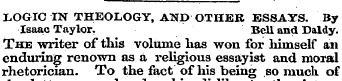
LOGIC IN THEOLOGY , AND OTHER ESSAYS . By Isaac Taylor . Bell and Daldy . The writer of this volume has won for himself an enduring renown as a religious essayist and moral rhetorician . To the fact of his being so muck of the latter may be due his dislike to the intermixture ; of logic with theology , and which dislike is elaborated into a theory in his initial essay . Such theory , of course , goes to prove- ^—and cannot prove anything else— -rthat the theo-logic is different from the merely rational or intellectual logic . Tlie theme which Mr . Taylor selects for the application of his principle is the famous Argument of Jonathan Edwards on Free Will . With this the public is already acquainted . The application is smarity and sharply -made . The doctrine of fatalism is displayed as at once true and false—rtrue to . the letter , but false to the feeling .
It is the latter element that Mr . Taylor seeks to f > enetrate . In pursuit of this object , tJnitarianism ay in his way . Over its simple formulae he loudly triumphs , and points to its empty pews as a proof that reasoning is a poor substitute for sentiment . He prefers evidently , the mysticism" of the ascetic ages ; and , in illustration of its profound veracity ^ notwithstanding its superficial errors , devotes four eloquent essays to the characters of Nilus , Paula , Theodosius , and Julian . The first he entitles " The Christian Courtier in theDesert ; " paints most pathetically the state of religious feeling which could separate a pious husband and a pious wife ,
and subject to the severest trials a pious son , in order to their consecration to the comtemplative Ufe and its duties—in the desert and in the convent . The triumph of the tale he . awards to tie woman . While the father , on the presumed loss of his son , utters the wildest lamentations , the mother exults in the Christian victory that she presumes her offspring to have achieved . The widowed mother , arrayed in jewels and gay attire , lifted her hands to heaven , and addressed the Deity in Ian- , guage of thanksgiving . She claimed to share the ' glories and the rewards earned by her eon by his sufferings . " He had endured extreme but ; brief
tortures ; she , in thus vanquishing the maternal instincts , had endured a worse pain . ' Not such , a mother am I , ' said she , ? as are the multitude of wpmen , who weep the death of a child , as if they were the mothers of bodies only ; 'tis not so ivita me . Ana I not the mother of a soul ? Happiest of mothers am I > who have borne so noble an agonist , and have thus returned him whole and triumphant to God . '" The son , however , supposed dead , yet lived , and , when restored to his father , found himself devoted , like the daughter of Jephthd , to the service of the sanctuary . Nilus himself also took priest ' s orders , and
became abbot of one of the religious houses , founded in the desert , westward of the Nile , and in the neighbourhood of the Natron , lakes . in the next character ,, . which is female , Mr . Taylor proceeds to exemplify what he cojls "big } quality , and asceticism in the fourth century , " and has the laudatory magniloquence of Jeroine to deal with . Paula , the lady in question , was one of those Cliristfan women of quality w * th whom Jerome maintained constant correspondence . Paula
was high-born and illustripus , and chronicled in the llomish and Eastern characters , as " saint , and widow , nnd abbess . " Her retirement from tho world , however , does not seom to have involved the surrender of hor funnily revenues , which apparently continued to bo at hor disposal , since to the laat eho was a builder of ohurchos and a founder of monasteries . She was possessed of a passion for pilgrimages . To gratify it she forsook her son , still young , with patrician heroism . ?* A young mothcr 8 oyoe are moistened with no tears while she looks
Untitled Article
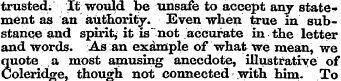
trusted ; It would be unsafe to accept any stater ment as an authority . Even when true in substance and spirit , it is " not accurate in the letter and words . As an example of what we mean , we 2 uote a most amusing anecdote , illustrative of loleridge , though not connected with him . To make the p assage clear , we include the few introductory sentences : — ? ' For instance , what sort of a German scholar was Coleridge ? We dare say that , because in his version of the ' Wallenstein' there are some inaccuracies , those who may have noticed them will hold hip cheap in this particular pretension . But to a certain degree they will be wrong . Coleridge was not very
a vague region of cloud and mist between two opposite shores . With this caution , however , not to accept , notwithstanding all showing to the contrary , any of the amusing anecdotes and curious pieces of learning , for anything more than they are worthbut only as amusing inventions to allure the reader to aim' at understanding the transcendental and metaphysical lore which it is the secret mission of the author to teach—the works of Mr . De Quincey deserve not onl y to be diligently read , tut deeply studied , —not so much for mere instruction and amusement , as for the . student ' s education , properly so called , and distinguished from both ; that is , for the purpose of mental evolution and spiritual development .
accurate in anything but in the use of logic . All his philological attainments were imperfect . He did not talk German ; or so obscurely , —and , if he attempted to speak fast , so erroneouslyy—that in his second sentence , when conversing with a German lady , of rank , he contrived to assure her that in his humble opinion she was a -. Hard it is to fill up the hiatus decorously ; but in fact the word very coarselyexpressed that she was no better than she should be . Wliich reminds us of a parallel misadventure to a German , whose English education had been equally neglected . Having obtained an interview with an English lady , who , having recently lost her husband , must ( as he in his unwashed German condition took
for granted ) be open to new offers , he opened Jus business thus : — ' Highborn madam ,, since your husband have kicked de bucket - ~ - —«'• • Sir ! ' interrupted the lady , astonished and displeased . ' Oh , pardon !—nine , ten tousand pardon ! Now I make new beginning— quite oder beginning . Madam , since your husband have cut his stick ' It may be supposed that this did not mend matters ; and , reading so much in the lady ' s countenance , the German drew out an octavo dictionary , and said , perspiring with shame at having a second time missed , fire , ' Madam , since your husband have gone to kingdom come ' ¦ ' This he said beseechingly ; but the lady was past propitiation by this time , and rapidly moved towards the door . Things had now reached a crisis ; and , if something were not done quickly , the game was
up . Now , therefore , taking a last hurried look at his dictionary , the German flew after the lady , crying out , in a voice of despair , ' Madam , since your husband — your most respected husband your never-enoff-to-be-worshipped husband—have hopped de twig - — - ' * This was his sheet anchor ; and , as this . also came home , of course the poor man was totally wrecked . It turned out that the dictionary he had used—( Arnold ' s we think ) , a Work of one hundred and fifty years back , and , from mere Ger ^ man ignorance , giving slang translations from Tom Brown , I / Estrange , and other jocular writers—had : put down the verb sterben ( to die ) with the following worshipful series of equivalents : —1 . To kick the bucket ; 2 . To cut one ' s stick ; 3 . To go to kingdom come ; 4 . To hop the twig : to drop off the perch into Davy ' s locker . "
What can be more amusing than this ? And who would not think that the one , two , tliree , and four heads of meaning cited were , at any rate , to be found in the old German lexicon of Arnold ? Heading , however , the above passage , we happened to recollect that among our German lumber , we had the obsolete dictionary in question , and we indulged the whim , at some trouble , of looking out the word—r-t ' . e ., the verb— " sterben" ( tQ "i e ) - " Here it is : — " SbtWbtn , to dye , decease , depart , depart this life , starve , breathe your last , exspire , give up the ghost , kick up your heels , tip off , tip over the pearch . "
QUOTING FItOM MEMORY . —DE QUINCEY ON ritl-XOSOl ' HY AND CRITICISM . ( 1 ) Speculations Literary and Philosophic ; with * German Tales and other Narrative Papers . By Thomas De Quincoy . ( 2 ) Critical Suggestions on Style and Rhetoric ; with German Talcs and other Narrative Papers . By Thomas De Quincoy . James Hogg and Sons . These fmrdvolumes pf collections , from the
periodical compositions of Mr . De Quincey , are remarkably brilliant . Among the papers in both are splendid defences of Milton and Coleridge . The former is protected against Dr . Johnson , whose biography of the great poet is denounced as malignant , and against Mr . Landov in his colloquy with Mr . Southey on the subject of the mighty bard . In these papers the power-of trcatihont and expression is something wonderful . On Coleridge , Mr . De Quincey still expatiates with impetuous enthusiasm . Ho writes , however , as a critic , and assuuies a certain superiority to his author , whom he
convicts of faults , from which wo arc led to imagine tbi \ t the critic must be free . That , however , is not always the case . IMCr . Coleridge waa confessedly careless in regard to statistical data , and the matter of citations . But is Mr . Do Quinooy less faulty in those particulars P On the contrary , Mr . Do Quincoy frequently quotes from memory , owns it , and ^ thus justified , without remorse proceeds to quote wrongly . JLoarnod , fine , rhetorically powerful , full of illustration , anecdote , and , in the main , just criticism , as they arc , these volumes contain wotting that caul bo . Uterajly
How different the fact from Mr . De Quinccy ' s reminiscence ! There is embellishment and amplification with a vengeance ! But it will also be seen that there is no approach in his statement to verbal accuracy , that the numeral division qf the meanings is pure invention ; that the slang phrases alluded to are in the dictionary itself , placod properly in a secondary position , and that the proper equivalents aro first given ; and that therefore the perplexed Gorman could not , except from sheer perversity , have derived his , errors from the source
indicated . Nor aro the slang phrases identical . The whole is manifestly a loose recollection , on which , as on a sandy base , the alleged anecdote has been built . Such is the ingenuity with * which Mi . Do Quincoy contrives to enliven his pages , by manufacturing for the nonce suitable parables in illustration of abstruse principles , in condescension to the weakness of the popular mind , without much caring whether the component materials ore true or false , or sonic phantom floating up from the unf a ithful sea of memory , and hovering uncertain in * Jut ebanjctxt gcatorbod wnn his Gorman ldcn , wkJou no thus rautorod la oIubhIouI English .
Untitled Article
Notices . ] THE LEADIB , 6 ^ 9
-
-
Citation
-
Leader (1850-1860), May 28, 1859, page 669, in the Nineteenth-Century Serials Edition (2008; 2018) ncse-os.kdl.kcl.ac.uk/periodicals/l/issues/vm2-ncseproduct2296/page/13/
-