On this page
-
Text (2)
-

Untitled Article
-

Untitled Article
Note: This text has been automatically extracted via Optical Character Recognition (OCR) software. The text has not been manually corrected and should not be relied on to be an accurate representation of the item.
-
-
Transcript
-
Note: This text has been automatically extracted via Optical Character Recognition (OCR) software. The text has not been manually corrected and should not be relied on to be an accurate representation of the item.
Additionally, when viewing full transcripts, extracted text may not be in the same order as the original document.
Untitled Article
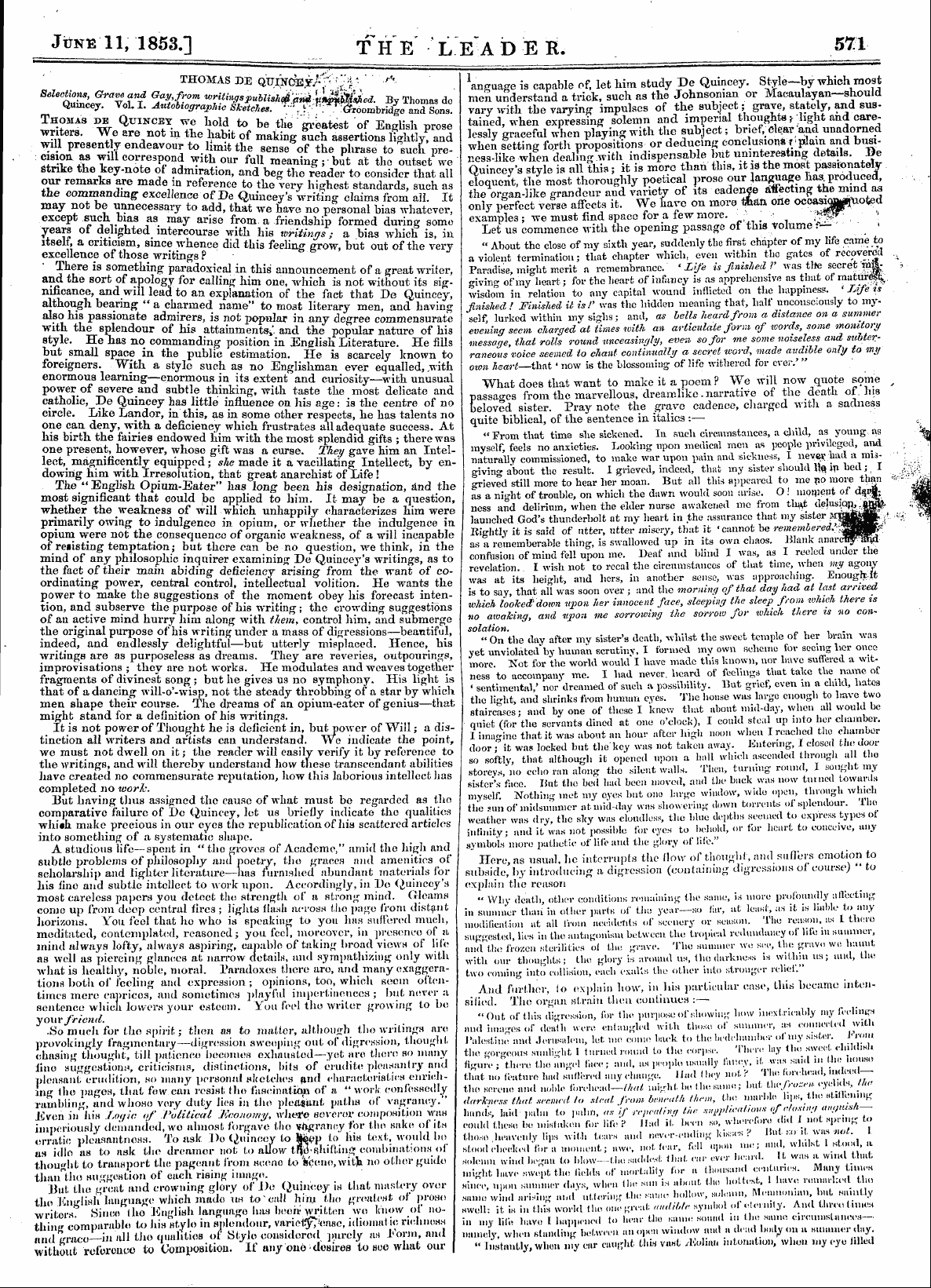
THOMAS DE gUrNTck ^ - ^^^ - ^ SeU oS ^ Tnff ^ f ^ ? t * W « Mislt 4 ? f 4 U ^ Ued . By Thomas do Quincey . Vol . I . Autobiographic Sketches . ' " \ ^ ;¦ ' ^ : (? roombridge and Sons . Thomas de Quincey we hold to be the greatest of English prose writers . We are not in the habit of making such assertions lightly , and will presently endeavour to limit the sense of the phrase to such precision as will correspond with our full meaning ;• but at the outset we strike the key-note of admiration , and beg the reader to consider that all our remarks are made in reference to the very highest standards , such as the commanding : excellence of De Quincey ' s writing claims from all . It may not be unnecessary to add , that we have no personal bias whatever , except such bias as may arise from , a friendship formed during some years of delighted intercourse with his writings ; a bias which is , in itself , a criticism , since whence did this feeling grow , but out of the very excellence of those writings P
There is something paradoxical in this announcement of a great writer , and the sort of apology for calling him one , which is not without its significance , and will lead to an explanation of the fact that De Quincey , although bearing " a charmed name" to mo 3 t literary men , and having also his passionate admirers , is not popular in any degree commensurate with the splendour of his attainments ^ and the popular nature of his style . He has no commanding position in English Literature . He fills but small space in the public estimation . He is scarcely known to foreigners . With a style such as no Englishman ever equalled , . with enormous learning—enormous in its extent and curiosity—with unusual power of severe and subtle thinking , with taste the most delicate and
catholic , De Quincey has little influence on his age : is the centre of no circle . Like Landor , in this , as in some other respects , he has talents no one can deny , with a deficiency which frustrates all adequate success . At his birth the fairies endowed him with the most splendid gifts ; there was one present ^ however , whose gift was a curse . They gave him an Intellect , magnificently equipped ; she made it a vacillating Intellect , by endowing him with Irresolution , that great anarchist of Life ! The " English Opium-Eater" has long been his designation , and the most significant that could be applied to him . It may be a question , whether the weakness of will which unhappily characterizes him were primarily owing to indulgence in opium , or whether the indulgence in opium were not the consequence of organic weakness , of a will incapable of resisting temptation ; but there can be no question , we think , in the
mind of any philosophic inquirer examining De Quincey ' s writings , as to the fact of their main abiding deficiency arising from the want of coordinating power , central control , intellectual volition . He wants the power to make the suggestions of the moment obey his forecast intention , and subserve the purpose of his writing ; the crowding suggestions of an active mind hurry him along with them , control him , and submerge the original purpose of his writing under a mass of digressions—beautiful , indeed , and endlessly delightful—but utterly misplaced . Hence , his writings are as purposeless as dreams . They are reveries , outpourings , improvisations ; they are not works . He modulates and weaves together fragments of divinest song ; but he gives us no symphony . His light is that of a dancing will-o ' -wisp , not the steady throbbing of a star by which men shape their course . The dreams of an opium-eater of genius—that might stand for a definition of his writings .
It is not power of Thought he is deficient in , but power of Will ; a distinction all writers and artists can understand . We indicate the point , we must not dwell on it ; the reader will easily verify it by reference to the writings , and will thereby understand how these transcendant abilities have created no commensurate reputation , how thi 3 laborious intellect has completed no work . But having thus assigned the cause of what must bo regarded as the comparative failure of I ) c Quincey , let us briefly indicate tho qualities whi « h make precious in our eyes the republication of hia scattered articles into something of a systematic shape . A ¦ - »• 1 •» i *¦*• ! fr A 1 » f "" 1 j 1 _ 1 " __ f- . 1 the of Academeamid the hih and
* A studious life—spent in " groves , " g subtle problems of philosophy and poetry , tho graces and amenities oi scholarship and lighter literature—has furnished abundant materials for his fino and subtle intellect to work upon . Accordingly , in Do Quincey ' s most careless papers you detect the strength of a strong mind . Gleams come up from deep central fires ; lights flash across tho page from distant horizons . You feel that ho who is speaking to you has suffered much , meditated , contemplated , reasoned ; you feel , moreover , in presence of a . mind always lofty , always aspiring , capable of taking broad vieww of life as well as piercing glances at narrow details , and sympathizing only with what is healthy , noble , moral . Paradoxes there arc , and many exaggerations both of feeling and expression ; opinions , too , which seem oftentimes mere caprices , and sometimes playful impertinences ; but never : i sentence which lowers your esteem . You feel tho writer growing to be youv friend .
-So much for tho spirit ,- then as to miitior , although tho writings are provokingly fragmentary—digression swooping out of digression , thought chasing thought , till patience becomes exhausted—yet are there so many iino suggestions , criticisms , distinctions , bils of erudite pleasantry and p leasant erudition , ho many personal sketches and clmnictoristicn enriching the pages , that fow can resist tho fuHcinatiqn of u " work confessedly rambling , and whoso very duty lies in tho plettsunt paths of vagrancy . " Even in his JAXjic of Political Economy , where severer composition whh imperiously demanded , wo almost forgave tho vibrancy for tho sake of its erratic pleasantness . To ask Do Quincey to Mfe ^ p to his text , would bo us idlo as to ask the dreamer not ; to allow tftti ; shilling combinations of thought to transport the pageant from scene to Vceno , wit ] h no other guido thaiAho suggestion of each rising imago .
But the grout and crowning glory of De Quincey in that mastery over tho English language which made uh tovah him tho grouioHt of proso writers . Since tho English language has heoh written wo know of nothing comparable to his Htylo in sp lendour , varioifpoiwe , idiomatic richness andaraco—in " nil tho qualities of Stylo considered , purely » w Form , and without rcforenco to Composition . If any 0116 desires to hoc what our
anguage is capable of , let him study De Quincey . Style—by which most men understand a trick , such as the Johnsonian or Macaulayan—should vary with the varying impulses of the subject ; grave , stately , and sustained , when expressing solemn and imperial thoughts v light and carelessly graceful when playing with the subject ; brief , ; clear and unadorned when setting forth propositions or deducing conclusions - plain and business-like when dealing with indispensable but uninteresting details . Be Quincey ' s style is all this ; it is moro than this , it ia the most passionately eloquent , the most thoroughly poetical prose our language has produced , the organ-like grandeur and variety of its cadence affecting the mind as only perfect verse affects it . We have on more * aii one oceasupquofed examples ; we must find space for a few more . ¦ _ : >^ r Let us commence with the opening passage of this volume f— ¦¦
" About the close of my sixth year , suddenly the first chapter of my Me came to a violent termination ; that chapter which , even within tho gates of recovered Paradise , might merit a remembrance . ' Life is finished V was tile secret mfflfc wivino- of my heart ; for the heart of infancy is as apprehensive as that of mature ^ wisdom in relation to any capital wound inflicted on the happiness . Life ts finished ' Finished it is 1 ' was the hidden meaning that , half unconsciously to myself , lurked within my sighs ; and , as bells heard from a distance on a summer evening seem charged at times with an articulate form of words , some monitory message , that rolls round unceasingly , even so for me some noiseless and subterraneous voice seemed to chant continually a secret word , made audible only to my own heart—that ' now is the blossoming of life withered for ever . '" What does that want to make it a poem ? We will now quote some passages from the marvellous , dreamlike - narrative of the death of . his beloved sister . Pray note the grave cadence , charged with a sadness quite biblical , of the sentence in italics : —
" From that time she sickened . In such circumstances , a child , as young as myself , feels no anxieties . Looking upon medical men as people privileged , and naturally commissioned , to make war upon pain and sickness , I never , had a misgiving about the result . 1 grieved , indeed , that my sister should \\ % in bed ; ( I grieved still more to hear her moan . But all this appeared to me no more than as a night of trouble , on which the dawn would soon arise . O ! moment of d * a * ness and delirium , when the elder nurse awakened me from that deluskap , || j
launched God ' s thunderbolt at my heart in the assurance that my sister K ljgnj » Rightly it is said of utter , wtter misery , that it ' cannot be remembered / rgBM / m as a rememberable thing , is swallowed up in its own chaos . Wank annrcfif ^ d confusion of mind fell upon me . Deaf mid blind I was , as I reeled under the revelation . I wish not to recal the circumstances of that time , when my agony was at its height , and hers , in another sense , was approaching . Enougfelt is to say , that all was soon over ; and the morning of thai day had at last arrived which looked ' down upon her innocent face , sleeping the sleep from tohich there is no awaking , and upon me sorrowing the sorrow for which there ts no
consolation . . " On the day after my sister ' s death , whilst the sweet temple of her brain was yet unviolated by human scrutiny , I formed my own scheme for seeing her once more . Not for the world would * I have made tins known , nor have suffered a witness to accompany me . I had never , heard of feelings that take the name of sentimental , ' nor ' dreamed of such a possibility . But grief , even in a child , hates the light , and shrinks from human eyes . The house was large enough to have two staircases ; and by one of these I knew that about mid-day , when all would be quiet ( for the servants dined at one o ' clock ) , I could steal up into her chamber . I imagine that it was about an hour after high noon when I reached the chamber
door f it was locked but the'key was not taken away . Entering , I closed the door so softly , that although it opened upon a hall which ascended through all tho storeys / no echo ran along the silent walls . Then , turning round , I sought my Bister ' s face . But the bed had been moved , and the back was now tinned towards myself . Nothing met my eyes but one lnrgc window , wide open , through which the ? un of midsuinmer at mid-day was showering down torrents of splendour . I ho weather was dry , the sky was cloudless , the blue depths seemed to express types ot infinity ; and it ' wan not possible for eyes to behold , or for heart to conceive , any symbols more pathetic of life and the glory of life . "
Here , as usual , he interrupts the flow of thought , and suffers emotion to subside , by introducing a digression ( containing digressions of course ; to explain the reason " Why death , other conditions remaining the same , is move profoundly affecting in summer than in other parts of tho year—so far , at leant , us it is liable to any modification at all from accidents of scenery or season . The reason , as L there suggested , lies in the antagonism between the tropical redundancy of life in summer , and the frozen . sterilities oi the grave . The summer we see , the grave we haunt , with our thoughts ; the glory is around us , the darkness is wilhm us ; and , the two coming into collision , each exalls the other into stronger relief . " And further , lo explain how , in hia particular case , this became intensified . The organ strain then continues : — - , y-v . * . I >• " _ / V-- JV .. ,,.,,, ! / vC-iLmr ' nur ll / lllf 1 1 ti'lV f T W * ! ll 11 V YWV \ OO \\ IIITH t of this di for tho of showing how inextricabl feelings
"Ou gression , purpose y my mid ima-os of death were entangled with those of summer , an connected with Palestine and Jerusalem , let me come hack to the bedchamber of my sister , hnnn the gorgeous sunlight I turned round to Hie corpse . There lay the sweet oIuUIihIi fi- 'ure ; there the angel face ; and , as people usually limey , it was said in the house that no feature had suffered any change . I Ia < l I hey not Y The forehead , ™ Y „ tho serene Mid noble forehead—/ hat niijrht be filename ; but , t \ u \/ rosr » eyelids , //«' darkness that see . mcd to . steal from , beneath ( horn , the marble lips , the Aliening hands , laid- piiliii to palm , as if repealn , }> lie « tu > ns of clusuu , anguish— - could these be mistaken for life ' ? Had it ben so , wherefore d . d I not . sprn . g to those heavenly lips with tears and never-endin- kisses ? Itui ... so it was not 1 stood checked ' for a moment ; awe , not fear , fell upon me ; and , whilst 1 stood , a solemn wind began to blow- < . he . : m < Mes (; < h .-il ear ever beard . 11- was a wind that miht have tthe Holds of mortality for a thousand centimes . Many tunes
g swep , since , upon summer days , when the sun is about the holiest . 1 have remarked the same wind arising ai . d ' uttering the san , e hollow , solemn , lUe . mioiiiun but Hiuntly swell ; it , is in this world the one great umliMv . symbol of eternity . And three times in my life have I happened lo hear the same sound in the same circumstancesnamely , when standing between an open window and a dead bod y on a summer day " Instantly when my ear caught thin vawt vHolinn intonation , whun my eyo filled
Untitled Article
June 11 , 1853 . ] THE ' LEA D E R . 571
-
-
Citation
-
Leader (1850-1860), June 11, 1853, page 571, in the Nineteenth-Century Serials Edition (2008; 2018) ncse-os.kdl.kcl.ac.uk/periodicals/l/issues/vm2-ncseproduct1990/page/19/
-