On this page
- Departments (2)
-
Text (7)
-
Untitled Article
-
Untitled Article
-
tfeafor ^
-

Untitled Article
-
$ttiiiir Iffairs.
-
Untitled Article
-
Untitled Article
Note: This text has been automatically extracted via Optical Character Recognition (OCR) software. The text has not been manually corrected and should not be relied on to be an accurate representation of the item.
-
-
Transcript
-
Note: This text has been automatically extracted via Optical Character Recognition (OCR) software. The text has not been manually corrected and should not be relied on to be an accurate representation of the item.
Additionally, when viewing full transcripts, extracted text may not be in the same order as the original document.
Untitled Article
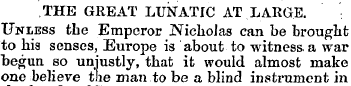
THE GREAT LUNATIC AT LARGE . Unless the Emperor Nicholas can be brought to his senses , Europe is about to witness , a war begun so unjustly , that it would almost make one believe tiie man to be a blind instrument in the hands of Providence for terminating a peace which has lasted too long . We believe , indeed , that the peace has been too long protracted , and that the consequences are , first , that insolent impunity which the barbarous races and barbarous tyrants now exercise over civilized countries ; and , secondly , the culpable acquiescence
of the superior countries and governments in wrong . Be that as it may , the manner in which this Emperor begins to shed the blood of his race is stamped with iniquity from the commencement—with the triple iniquity of cowardly insolence from the strong to the weak , of religious hypocrisy , and of treachery to the system which has helped to make him as strong as he is . By the treaties of 1815 , and the smaller treaties that have been the offspring of that great misdeed , Nicholas has been able to strengthen his
realms in peace , and to filch aggrandizement of territory from states not hi 3 own ; and now , when it suits him , he has broken away from that system , and prepared to deal upon his accomplices the just retribution of a selfish treachery . He affects , forsooth , to be one of the apostles of the three great branches of the Christian church , the Greek ; his transparent purpose being to unite the Pansclavonian races , which are \ distinguished * by » their-. half-European character' and ; , the * adhesion " - of ' many to that last of
the three forms of Christianity . It is the working of royal and tP ^ 6 tfial *< avarice under the mask of" religion . With respect to Turkey , his claim is simpl y inst » lent . He has asked for freedom on behalf of the Greeks , for security that Turkey would deal with them kindly , ' and for a genuine observance of such promise , and Turkey has granted all—practically granted his demand in detail , and has given such promises before the representatives of Europe as guaranteed her good faith . But he is not satisfied : he must have some abject submission—some bond to himself separately from the other PoAvers of Europe .
There have been many conjectures as to the motives which drive him on his bad and foolish course . It is reported in London , Berlin , and other Continental capitals , on- authority traced to his own representatives , that ho feels personally offended by the demeanour of Turkey , and that being touched in " his honour , " he cannot retract . Wo have reason to believe that he has actually uttered- such sentiments ; but on what ground it is diflicult to imagine , lie 1 ms been most offensive -. Prince MenzschikoH " , his
ambassador to Turkey , was affectedly insolent ; tho documents on his side have all boon insolent in tone ; and yet ho has boon met with . . calmness and studious courtesy in tho replica . Ifthe Czar really is oil ' ended , it must aviso from some inordinate expectations of servile humiliation in the Sultan , which would warrant tho second . supposition—that tho man is mad . There is \ plausibility in this idea , though it appears to uh to bo suggested by obvious / acts rather than stated by persons who have observed him recently . No ' doubt his manners have been
liable to impulsive changes ; but wo do not learn that they are more ho than they havo been . No doubt the disease is in his family , an it is in ho many royal stocks : a fact which proven tho unwholeBOHieness of tho crown for tho health of tho brain . Jlifi brother Avero mad , both his oldest and hia second brother ; his father avus xnad ; and tho total unreason of his conduct looks : like ¦ prlwAfacitt evident of Inn own disaster . Thus ,, whether ho demands the attention mf Dr . Forbes '; Winslcw or not , at all- events' Europe
ib'subjected to caprices so wild that his very actions suggest the disease . Tho question is asked , why liis nobles do not interfere—why the court institution of Russia is not called into play ? If the Emperor is in the condition supposed , clearly the time has arrived for issuing a commission de lunatico inquirendo , and in royal cases the Russians have ready appointed commissioners for that purpose , who execute their verdict in a peculiar manner , as in Paul ' s case . A traveller describing the present Emperor walking on some State occasion , s " aid , that he marched with his father ' s murderers in
front of him , his brother ' s murderers behind him ,-and his own on each side of him : and the question is mooted in English society , why those officers , do not perform their appointed duty , now that it has become necessary for the safety of Europe ? Seriously , we have heard this question asked by mild men and humane , and there is some reason in desiring that the only responsibility to which autocrats are liable shoiild . be enforced , when those men become as mischievous to their kind as w ild beasts .
But there is a reason , perhaps , why the Russian , nobles do not interpose , and the reason is one which it well behoves us in these peaceful parts of Western Europe to keep in view . Truly we have enjoyed our own way so long , that we are apt to think that all the world is growing like us ; that the reasons which , prevail with us would prevail with them ; and that it would require but a number or two of Chambers s Edinburgh Journal , with its sound information , or some work equally accurate and practical , to convince the Don Cossacks , the Croats , and an
Austrian Marshal , or a Russian noble , of the superiority of peace and free institutions over autocracy and war . At all events , they have not got to that length yet , in tho 3 e Eastern parts ; indeed , they have not , we may say , made any progress , but rather in an opposite direction . The old Moscovite nobles have an idea that they are destined to devour Turkey ; that the decree has gone forth ever since the Russian Emperor travelled down . the stream of the / . Turkish ... dominions , and recognised his superior . power . Peter the Great left a will , set all the
directing his descendants to European Powers by . the v ears , to patronise Austria for a time , to get a hold over the civil government of the Greek Christians in Turkey , and then to seize Turkey ; Alexander cherished such an icleat > and negotiated it with Napoleon ; the project of a partition was revived by Russia in . the time of Charles the Tenth ; and now we have Nicholas trying to work the scheme , to which the nobles are not averse . So far from preventing Nicholas , it is said that they urged him , and Menzschikoff represented not only his imperial master , but the Moscow party , tho ' Tories of Russia . So much , indeed , that the great autocrat dares not , if he would , ' disavow his representative bully . There thisbut incline to
may be some truth m , we doubt whether any of the Romanoff" family would yield his will even to the Russian nobles ; they have not done so before in questions of serfs ; and wo rather infer the fact "to be , from the reported'feelings of the nobles , that in this matter they and their Emperor arc thoroughly of accord . If so , Nicholas is not only individually . mad , but collectively ; representing the mania of a semibarbarous race to bring civilized Europe into subjection to itself . Th <> Great Lunatic is roaming abroad , not only " on his own hook , " but on" behalf of all the carnivorous chicks in his great nest ; and they arc open mouthed , and hoping that for the next mouthful ho may bring them an Empire .
Now Avhat can have suggested , whether to the Emperor or to bin nobles , tho extravagant icfeathat they can over-ride tho united councils of lUiropo , and dictate . boundaries to UioAVorldP The siijggeativo anise appears to uh to be very plain and wimple . Not long since Russia was n wild and barbarous country ; its lOmporor w » s tin apprentice notonlv in- tho art of ship-building , but in the art of State-building ; and ho served his time ; ii (! .., » within a « reno-ralion or two , ho has
built , tlits vastest empire of Europe . J < or that work he h acknowled ged by all mankind as " Peter tho G real . " niul if bis empire wan large and powerful in Win own time , under his deMcendun t ;; it has become larger and mow powerful . Some centuries buck tho Turk wan the scourge of Europe ; ho now trembles if Russia stump hor foot . A now power has grown up in hia own dominions , almost
inviting the suzerainty of Russia . Not long since there was a kingdom of Poland on the borders of Russia , peopled by as brave a race as any that has lived , though it wasnofc one that had learned the modern art of statecraft ; Russia has absorbed it , giving a small part to satisfy Austria , and a small part to satisfy Prussia . That state of Prussia has grown up in modern times to inherit the dominant power of Frederick the Great , but is a greater also than it was in the time of the man so called , and therefore something more respectable amongst states . Prussia is one of the
first Powers of Europe ; one of the five who dictated to other states ; and it is one of the least Mfpaired in its military constitution . Yet it has lately trembled before revolution ; its king has temporized Tiitli revolt ; he has tried , and tried vainly , to exercise independence of Austria or Russia ; and at last ho has sought to be reconciled to tho absolutist power . Denmark is an independent state , not far off ; and it has recently modified its succession to please Russia . There is another great power conterminous with Russia , and only one—Austria ; which in ' 48-9 had to beg
the aid of Russia to return to it its kingdom of Hungary , and now holds a constituent-part of its dominions by the grace of Nicholas . Are not these facts enough to teach a barbarous people like the Russians , that their power exceeds that of each one and all put together in Europe . As to the powers beyond , crowned France has been begging for recognition from the Northern Emperor ; and England is so sunk in trade that her people dread war as other peoples dread a pestilence ; and it is an old maxim in history that the people that fears war is easily conquered . such
Are not these facts and convictions as must surround the Russian mind , and completely fill it ? Is there , then , anything present to the Russian perception which could hinder its will and pleasure ? It is true that a Nesselrode , or a Pozzo di Borgo , might better appreciate tho forces of other countries ; but even a first class statesman is but one ; and neither Russian Emperors nor Russian nobles are likely to accept the dictate of pure intellectual refinement . They have from time to time measured their strength in council , in intrigue , and on the field ; and in the long run of a steady , but rapid course , they have
succeeded on every point of their frontier , lhc most discreet of European powers , Prussia , submits to the judgment of Russia . The most powerful , Austria , holds territory by the grace of Russia , and wherever Russia presses forward , her boundary advances . Uo ' . v then can she dread uncertain Franco , or unwarlike England ? There really is nothing to hold back the Russian ; and while wo in England balance the policy of peace and Avar by tho ledger , we shall commit a grievous mistake if we believe that Russian soldiers will abide by the same test . For indeed tho test is inverted for them who are merchants
of spoliation . If there is madness , there is more method in it than we thought at first . If there is a lunatic at large on those Eastern borders of Europe , he is more dangerous than the poor \ a retches against whom avo have lately passed statutes , and iio ought to bo looked after . But he is a strong lunatic , both in limb and will , and he needs a goodly poAver to bind him over to the peaeo . ho Avill
Yet if we let , him go at large , assuredly break somethiug , and perhaps destroy life , even the life of . States as well jih of multitudes , it will bo necessary to see that , a Commission do lunatico be issued , but , it must , be a strong and summary one , armed with complete powers , and with the resolution to accomplish its avoi-Ic of reducing the madman to reason . . If we posi ; pouo that , precaution we shall have to pay for it .
Untitled Article
INDIA AND HKlt NKW ( JOVHUNAIKN l \ India Avill have cause to regret that she is not represented in London , because she ean neithor compel a proper deference- in the Government , nor answer the prevarications of the . East , India Company , nor even organize her amateur champions into a systematic vindication of her clainiH . The measure compounded by Ministers for reconstructing the government of India is an evasion , a compromise between the old system and some of the suggestions nia'le by the reformers , Indian or Knglirfh . 11 in likely enough to retain
some of ( he advantages belonging to compromises , amongst them that ; of being carried ., Bui . it has also all the weakness of a compromise , especially an inherent inconwiriteney ; and wo may add , tho ( Voblenens of its own reforms , and a certainty , oi
Tfeafor ^
tfeafor ^
Untitled Article
. - ? - SATURDAY , JUNE 11 , 1853 .
$Ttiiiir Iffairs.
$ ttiiiir Iffairs .
Untitled Article
Tnere 13 nothing so revolutionary ; because there is nothing so unnatural and convulsive , as the strain to . keep things fixed when all the world is ' by the very law of its creation in eternal-progress . —Dk . Aenoltj .
Untitled Article
June 11 , 1853 . ] THE LE AD E R . ^ 5 _
-
-
Citation
-
Leader (1850-1860), June 11, 1853, page 565, in the Nineteenth-Century Serials Edition (2008; 2018) ncse-os.kdl.kcl.ac.uk/periodicals/l/issues/vm2-ncseproduct1990/page/13/
-