On this page
-
Text (1)
-

Untitled Article
Note: This text has been automatically extracted via Optical Character Recognition (OCR) software. The text has not been manually corrected and should not be relied on to be an accurate representation of the item.
-
-
Transcript
-
Note: This text has been automatically extracted via Optical Character Recognition (OCR) software. The text has not been manually corrected and should not be relied on to be an accurate representation of the item.
Additionally, when viewing full transcripts, extracted text may not be in the same order as the original document.
Untitled Article
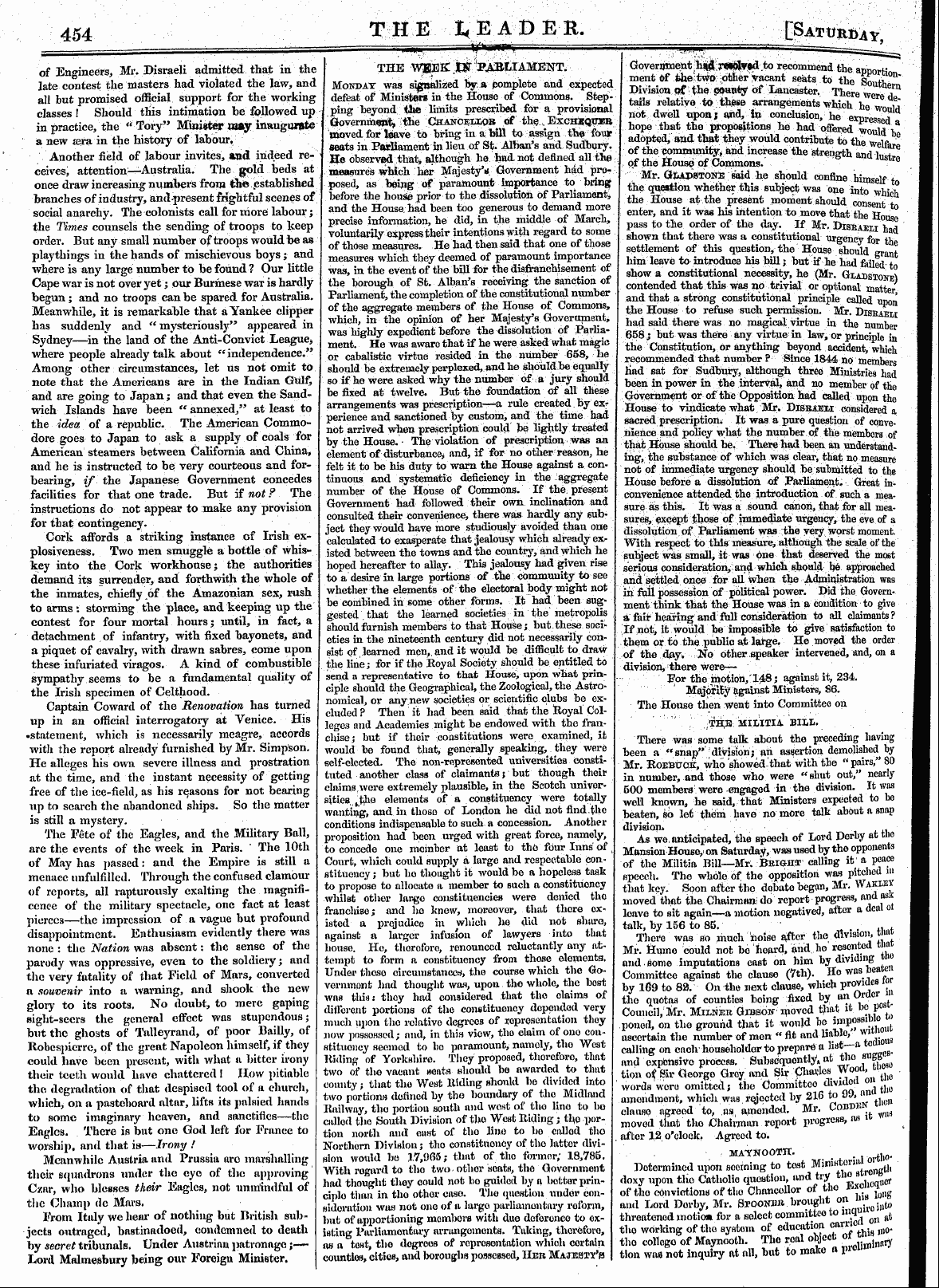
of Engineers , Mr . Disraeli admitted that in the late contest the masters had violated the law , and all but promised official support for the working classes ! Should this intimation foe followed up in practice , the " Tory" Minister may inaugurate a . new sera in the history of labour . Another field of labour invites , and indeed receives , attention ^—Australia . The gold beds at once draw increasing numbers from tibe established branches of industry , and present frightful scenes of social anarchy . The colonists call for more labour ; the Times counsels the sending of troops to keep
order . But any small number of troops would be as playthings in the hands of mischievous boys ; and where is any large number to be found ? Our little Cape war is not over yet ; our Burmese war is hardly begun ; and no troops can be spared for Australia . Meanwhile , it is remarkable that a Yankee clipper has suddenly and " mysteriously" appeared in Sydney—in the land of the Anti-Convict Leaguej where people already talk about " independence . " Among other circumstances , let us not omit to note that the Americans are in the Indian Gulf , and are going to Japan ; and that even the Sandwich Islands have been " annexed , " at least to
the idea of a republic . The American Commodore goes to Japan to ask a supply of coals for American steamers between California and China , and he is instructed to be very courteous and forbearing , if the Japanese Government concedes facilities for that one trade . But if not F The instructions do not appear to make any provision for that contingency .
Cork affords a striking instance of Irish explosiveness . Two men smuggle a bottle of whiskey into the Cork workhouse ; the authorities demand its surrender , and forthwith the whole of the inmates , chiefly _ 6 f the Amazonian sex , rush to arms : storming the place , and keeping up the contest for four mortal hours ; until , in fact , a detachment of infantry , with fixed bayonets , and a piquet of cavalry , with drawn sabres , come upon these infuriated viragos . A kind of combustible sympathy seems to be a fundamental quality of the Irish specimen of Celthood .
Captain Coward of the Renovation has turned up in an official interrogatory at Venice . His statement , which is necessarily meagre , accords with the report already furnished by Mr . Simpson . He alleges his own severe illness and prostration at the time , and the instant necessity of getting free of the ice-field , as his reasons for not bearing up to search the abandoned ships . So the matter is still a mystery . The Fete of the Eagles , and the Military Ball , are the events of the week in Paris . The 10 th
of May has passed : and the Empire is still a menace unfulfilled . Through the confused clamour of reports , all rapturously exalting the magnificence of the military spectacle , one fact at least pierces—the impression of a vague but profound disappointment . Enthusiasm evidently there was none : the Nation was absent : the sense of the parody was oppressive , even to the soldiery ; and the very fatality of that Field of Mars , converted n souvenir into a warning , and shook the new
glory to its roots . No doubt , to mere gaping sight-seers the general effect was stupendous ; but the ghosts of Talleyrand , of poor Bailly , of Robespierre , of the great Napoleon himself , if they could have been present , with what a . bitter irony their teeth would have chattered ! How pitiable the degradation of that despised tool of a church , which , on a pasteboard altar , lifts its palsied hands to some imaginary heaven , and sanctifies—the Eagles . There is but one God left for France to worship , and that is—Irony !
Meanwhile Austria and Prussia arc marshalling their squadrons under the eye of the approving Czar , who blesses their Eagles , not unmindful of the Champ do Mars . From Italy we hear of nothing but British subjects outraged , bastinadoed , condemned to death by secret tribunals . Under Austrian patronage ; - « - Lord Malmesbury being our Foreign Minister .
Untitled Article
' THE WjSEK jt $ rtR £ B £ lAMENT . ¦ Monday was signalized fty a jiomplete and expected defeat of Minister * in the House of Commons . Stepping beyond tl * e limits prescribed for a provisional Government , tne Chancellor of the , Excbuqiteb nioved for leiave to bring in a bill to assign the four seats in PaiBamerit jn lieu of St . Alban ' s and Sudhurjr . He observed that , although lie httcL not defined all tie measures which her Majesty ' s Government had proposed , as being of paramount importance to bring before the house prior to the dissolution of Parliament ^ and the House had been too generous to demand more
precise information , he did , in the middle of March , voluntarily express , their intentions with regard to some of those measures . He had then said that one of those measures which they deemed of paramount importance was , in the event of the bill for the disfrariehisement of the borough of St . Albany receiving the sanction of Parliament , the completion of the constitutional number of the aggregate members of the House of Commons , which , in the opinion of her Majesty ' s Government * was highly expedient before the dissolution of Parliament . He was aware that if he were asked what magic or cabalistic virtue resided in the number 658 , he
should be extremely perplexed , » nd he should be equally so if he were asked why the number of a jury should be fixed at twelve . But the foundation of all these arrangements was prescription—a rule created . by ex ^ perience and sanctioned by custom , and the time had not arrived when prescription could be lightly treated by the House .- The violation of prescription was an element of disturbance ; and , if for no other reason , he felt it to be his duty to warn the House against a continuous and systematic deficiency in the aggregate number of the House of Commons * If the . present Government had followed their own inclination and
consulted their convenience , there was hardly any subject they would have more studiously avoided than one calculated to exasperate that jealousy which already exp isted between the towns and the country , and which he hoped hereafter to allay . This jealousy had given rise to a desire in large portions of the community to see whether the elements of the electoral body might not be combined in some other forms . It had been suggested that the learned societies in the " metropolis should furnish members to that House : but . these
societies in the nineteenth century did not necessarily consist of learned men , and it would be difficult to draw the line ; for if the Royal Society should be entitled to send a representative to that House , upon what principle should the Geographical , the Zoological , the Astronomical , or anynew societies or scientific clubs be excluded ? Then it had been said that the feoyal Colleges and Academies might be endowed with the franchise ; but if their constitutions were examined , it would be found that , generally speaking , they were self-elected . The non-rflpresented universities constitnted another class of claimants ; but though their
claims , were extremely plausible , in the Scotch universities , i ( $ he elements of a constituency were totally wanting , and in those of London he did not find . the conditions indispensable to such a concession . Another proposition had been urged with great force , namely , to concede one member at least to thG four Inns of Court , which could supply a large and respectable constituency ; but ho thought it would be a hopeless task to propose to allocate a member to such a constituency whilst other lar-ge constituencies were denied tho franchise ; and ho knew , moreover , that there ox > isted a prejudice in which lie did not share ,
against a larger infusion of lawyers into that house . He , therefore , ronounced reluctantly any attempt to form a constituency from those elements . Under those circumstance * , the course which the Govornmont had thought was , upon tho whole , the best was this : they had considered that the claims of different portions of the constituency depended very much upon tho rolativo degrees of representation they jiow possessed ; and , in this view , tho claim of ono constituoncy seemod to bo paramount , namoly , tho West Hiding of Yorkshire They proposed , thoroforo , that two of tho vacant Heats should be awarded to that county ; that tho West Hiding should be divided into two portions dofincd by the boundary of tho Midland
Railway , tho portion south and west of tho lino to be called tho South Division of tho West Riding ; tip portion north and , oast of tho lino to bo callod tho Northern Division ; tho constituency of fcho latter division would bo 17 , 965 ; that of tho former ; 18 , 785 . With rogard , to tho two . other soats , tho Government had thought they could not bo guided b y a bettor principlo than in tho other caso . Tho question tinder consideration wan not ono of a largo parliamentary roform , but of apportioning momboi'B with duo deference to existing Parliamentary arrangements . Talcing , therefore , as a tout , tho degrees of representation which cortain counties , cities , and boroughs poaaeflsed , IIek Majestx ' o
Government | h ^ r 0 |^ w » d ; to recommend apportin ment of the , two Mother yacant seats to the Srmfv . Division j ^ the p ^ mty ot Lancaster . There wemT tails relative to these arrangements which he wo to not dwell aponj and , in conclusion , he expressed hope that the propbgitions he had offered would h adopted , and that they would contribute to the welf of the community ; and increase the strength and -i ,, J ^ of the Kous ^ of Commons : lustro Mr . GiiApsTONE said he should confine himself t the question whether this subject was one into which the House at the present moment should consent t
enter , and it was his intention to move that the Hous pass to the order of the day . If Mr . Disbaeii had shown that there was a constitutional urgency for th settlement of this question , the House should grant him leave to introduce his bill ; but if "he had failed to show a constitutional necessity , he ( Mr . Gladstone ^ contended that this was no trivial or optional matter and that a strong constitutional principle called upon the House to refuse such permission . Mr . Diseaeii
had said there was no magical virtue in the number 658 ; but was there any virtue in law , or principle in the Constitution , or anything beyond accident / which recommended that number ? Since 1844 no members Had sat for Sudbury , although three Ministries had been in power in the interval , and no member of the Government or of the Opposition had called upon the House to vindicate what Mr . Djsraeii considered a s ^ rea prescription ; It was a pure question of
convenience and policy what the number of the members of that House should be . There had been an understanding , the substance of which was clears that no measure not of immediate urgency should he submitted to the House before a dissolution of Parliament . Great inconvenience attended the introduction of such a measure as this . It was a sound canon , that for all measures , except those of immediate urgency , the eye of a dissoliition of Parliament was the very worst moment With respect to this measure , although the scale of the
subject was small , it was one that deserved the most serious [ consideration , and which shoald be approached and settled once for all when the Administration was in full possession of political power . Did the Government think that the House was in a coudition to give a fair hearin g and full consideration to all claimants ? If , not , it would be impossible to give satisfaction to them or to the public at large . He moved the order of the day * No other speaker intervened , and , on a division , there
werer—I ? or the motion , 1 ^ 8 ; against it , 234 . Majority' Against Ministers , 86 . The House then went into Committee on ' .. ' ¦ ¦ " , TH ; E MILITIA . PILL . There was some talk about the preceding having been a " snap "; division ; an assertion demolished by Mr . Roebuck , who showed ' that with tie " pairs , " 80 in number , and those who were " shut out , " nearly 500 members were engaged in the division . It was well known , he Baid , that Ministers expected to be beaten , so let them have no more talk about a snap division *
... As wo anticipated , the speech of Lord Derby at the Mansion House , , on Saturday , was used by the opponents of the Militia Bill—Mr . Bright calling it a peace speech . Tho whole of the opposition was pitched in that key . Soon after tho debate began , Mr . Wakiey moved that the Chairman ! do report progress , and asK leave to sit again—a motion negatived , after a deal oi talk , by 156 to 85 . . ,, . There was so much Wise after the division , thai MrHumo could not bo heardand ho resented torn 41 MV
¦*—. , . AT 1 . JL « J . 4 . U 111 V \^ V / WAV * UU * ivf «* w > - — ,, -flir t and some imputations cast on him by dividing w > Committee against the clause ( 7 th ) . Ho was beaten by 169 to 82 . On the next clause , which provides ior tho quotas of counties being fixed by an Order i Council , Mr . Milneb Gibson moved that « . J ? t 0 poned , on the ground that it would he imp ™ Bibw i ascertain the number of men « fit and liable , witn calling on each householder to prepare a hst--a to and oxnbnsiVo nroCess . Subsequently ; at tho 8 « bB ;
tion of Sir Goorgo Groy and Sir Charles Wo ° ' t , l 0 words woro omitted ; the Committee "iv ^ oa on amendment , which was rejected by 216 to . 09 . « nu clause agreed to , as ,, amended . Mr . Coupm * moved that the Chairman report progress , as after 12 o ' clock ? Agreed to . MAY NOOTH . . ^ Dotormincd upon seeming to tost M ^ f . ™ } JLth doxy upon tho Catholic question , and try thoi » w » of tho convictions of tho Chancellor of tho l * ou h and Lord Derby , Mr . 0 * ookk » brought on . m threatened motio * for a solecl ; committee to inqu ^ tho working of tho system of education carrioc tho college of Maynooth . Tho real object of tn tlon waa not inquiry at nil , but to make a VY 0 W
Untitled Article
454 THE READER . ' ' J-y ^ y - ^^^^^^
-
-
Citation
-
Leader (1850-1860), May 15, 1852, page 454, in the Nineteenth-Century Serials Edition (2008; 2018) ncse-os.kdl.kcl.ac.uk/periodicals/l/issues/vm2-ncseproduct1935/page/2/
-