On this page
-
Text (1)
-

Untitled Article
Note: This text has been automatically extracted via Optical Character Recognition (OCR) software. The text has not been manually corrected and should not be relied on to be an accurate representation of the item.
-
-
Transcript
-
Note: This text has been automatically extracted via Optical Character Recognition (OCR) software. The text has not been manually corrected and should not be relied on to be an accurate representation of the item.
Additionally, when viewing full transcripts, extracted text may not be in the same order as the original document.
Untitled Article
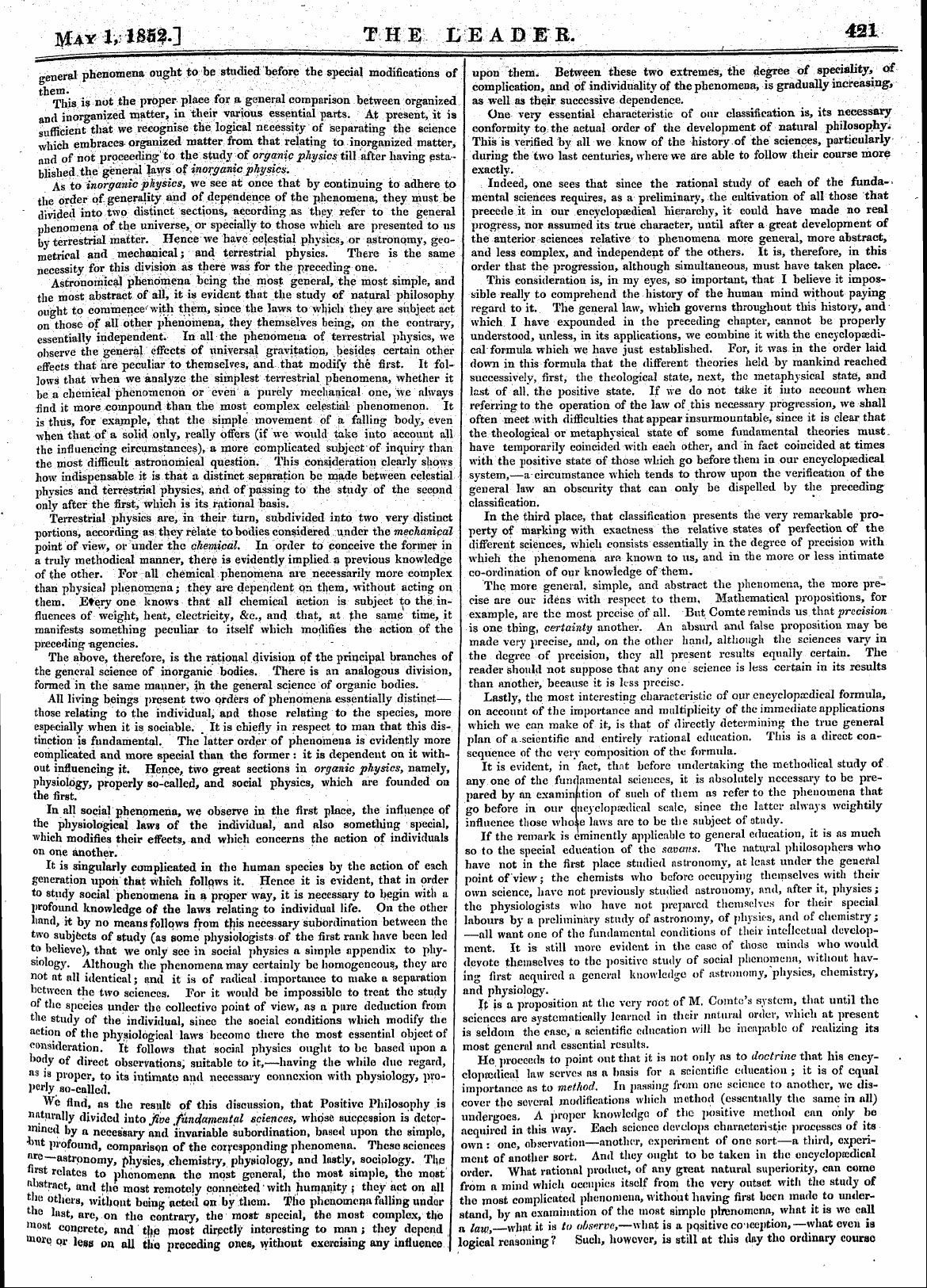
general p henomena ought to be studied before the special modifications of them- ' '¦ . ' . ' ¦ - . ¦ ¦ ¦ . ¦ ¦ . ; ' ¦ ¦ . ¦ . ¦ •• ' . ¦ ¦ ¦ ¦ ' ¦ _ "" ¦ ¦ - - ; - '' ¦¦¦ . . . ¦ ¦' ¦ ';' - ¦ ¦ - : -: . .,.-. . ' ¦ , ¦ ¦ " ¦ . ' ; This is not the VTPPer pl&ee * general comparison between organized and inorganized matter , in their various essential parts . At present , it is sufficient that we recognise thelogical necessity of separating the science which embraces organized matter from that relating to inprganized matter , jind of not prpceeo ^ ng' to the study of organic physics till after having established , the general Ja # s of inorganic pJiysics .
As to inorganic physics , we see at once that by continuing to adhere to the order of generality and of dependence of the phenomena , they must be divided into two distinct sections , according as they refer to the general phenomena of the umVerse , or specially to those which are presented to us by terrestrial master . Hence we have celestial physics , or astronqmy , geometrical and mechanical ; and terrestrial physics . There is the same necessity for this division asi ' therewas for the preceding one . Astronomical phenomena being the most general , the most simple , and the most abstract of all , it is evident that the stud y of natural philosophy ought to commence ' with them , since the laws to which they are subject act on those of all other phenomena , they themselves beings on the contrary , essentially independents In all the phenomena of terrestrial physics , we
observe the general effects of universal grayitation , besides certain other effects that are peculiar to themselves , and that modify the -first . It follows that when we analyze thesimplest terrestrial phenomena , whether it be a chemical phenomenon or even a purely mechanical one , we always find it more compound than the most complex celestial phenomenon . It is thus , for example , that the simple movement of a falling body , even when that of a solid only , really offers ( if we woulcl take into account all the inn * uencing circumstances ) , a more complicated subject of inquiry than the niost difficult astronomical question . This consideration clearly shows how indispensable it is that a distinct separation be made between celestial physics and terrestrial physics , and of passing to the study of the second only after the first , which . isits rational hasis .
Terrestrial physics are , in their turn , subdivided into two very distinct portions , according as they relate to bodies considered under the mechanical point of view , of under the chemical . In order to conceive the former in a truly methodical manner , there is evidently implied a previous knowledge of the other . For all chemical phenomena are necessarily more complex than physical piienornena ; they are dependent 0 n them , without acting on them . Etery one knows that all chemical action is subject to the influences of weight , heat , electricity , &c , and that , at £ he same time , it manifests something peculiar to itself wbich modifies the action of the preceding agencies . ¦
The above , therefore , is the rational division of the principal branches of the general science of inorganic bodies . There is an analogous division , formed in the same manner , in the general science of organic bodies . All living beings present two qrders of phenomena essentially distinctthose relating to the individual and those relating to the species , more especially when it is sociable . It is chiefly in respect to man that this distinction is fundamental . The latter Order of phenomena is evidently more complicated , and more special than the former : it is dependent on it without influencing jt . Hence , two great sections in organic physics , namely , physiology , properly so-called , and social physics , which are founded on the first .
In all social phenomena , we observe in the first place , the influence of the physiological laws of the individual , and also something special , which modifies their effects , and which concerns the action of individuals on one another . It is singularly complicated in the human species by the action of each generation upon that which follows it . Hence it is evident , that in order to study social phenomena in a proper way , it is necessary to tyegin with a profound knowledge of the laws relating to individual life . On the other liand , it by no means follows from this necessary subordination between the two subjects of study ( as some physiologists of the first rank have been led
to believe ) , that we only see in social physics a simple appendix to physiology . Although the phenomena may certainly be homogeneous , they arc not at all identical ; and it is of radical . importance to make a separation between the two sciences . For it would be impossible to treat the study of the species under the collective point of view , as a pure deduction from the study of the individual , since the social conditions which modify the action of the physiological laws become there the most essential object of consideration . It follows that social physics ought to be based upon a body of direct observations , suitable to it ,- —having the while duo regard , as is proper , to its intimate and necessary connexion with physiology , pyopcrly so-called . We find , as the result of this discussion , that Positive Philosophy is naturall y divided into jfive fundamental sciences , whose succession is determined by a necessary and invariable subordination , baaed upon the simple , Imt profound , comparison of the corresponding phenomena . These sciences "re— -astronomy , physics , chemistry , physiology , and lastly , sociology . Th , p '" 'st relates to p henomena the most general , the most simple , the most abstract , and the most remotely connected with humanity $ they act on all the others , withqut being acted « w by them . The phenomena falling under t hist , are , on the contrary , the most special , the most complex , the most concrete , and thp niost directly interesting to man j they depend oiorc or less on all the preceding ones , without exercising any influence
upon tbem > Between these two extremes , the degree of speciality , of complication , and of individuality of the phenomena , is gradually increasing :, as well as their successive dependence . One very essential characteristic of our classification is , its necessary conformity to- the actual order of the development of natural philosophy . This is verified by all we know of the history . of the sciences , particularly during the two last centuries , where we are able to follow their course more exactly . Indeed , one sees that since the rational study of each of the funda- . mental sciences requires , as a preliminary , the cultivation of all those that precede it in our encyclopaedical hierarchy , it could have made no real progress , nor assumed its true character , until after a great development of the anterior sciences relative to phenomena more general , more abstract , and less complex , and independent of the others . It is > therefore , in this order that the progression * although simultaneous , must have taken place . This consideration is , in my eyes , so important , that I believe it impossible really to comprehend the history of the human mind without paying regard to it . The general law , which governs throughout this history , and which I have expounded in the preceding chapter , cannot be properly understood , unless , in its applications , we combine it with the encyclopaedical formula which we have just established . For , it was in the order laid down in this formula that the different theories held by mankind reached successively , first , the theological state , next , the metaphysical state , and last of all ! the positive state . If we do not take it into account when referring to the operation of the law of this necessary progression , we shall often meet with difficulties that appear insurmountable , since it is clear that the theological or metaphysical state of some fundamental theories must , have temporarily coincided with each other , and in fact coincided at times with the positive state of those which go before them in our encyclopaedical system , — -a circumstance which tends to throw upon the verification of the general law an obscurity that can only be dispelled by the preceding classification . In the third place , that classification presents the very remarkable property of marking with exactness the relative states of perfection of the different scvences , which consists essentially in the degree of precision with which the phenomena are known to us , and in the more or less intimate co-ordination of our knowledge of them . The more general , simple , and abstract the phenomena , the more precise are our ideas with respect to them , Mathematical propositions , for example , are the most precise of all . But Comte reminds us that precision is one thing , certainty another . An absurd and false proposition may be made very precise , and , on the other hand , although the sciences vary in the degree of precision , they all present results equally certain . The reader should not suppose that any one science is less certain in its results than another , because it is less precise . Lastly , the most interesting characteristic of our encyclopaedical formula , on account of the importance and multiplicity of the immediate applications which we can make of it , is that of directly determining the true general plan of a-scientific and entirely rational education . This is a direct consequence of the very composition of the formula . It is evident , in fact , that before undertaking the methodical study of any one of the furu amental sciences , it is absolutely necessary to be prepared by an examination of such of them as refer to the phenomena that go before in our cncj clopaedical scale , since the latter always weightily influence those whole laws are to be the subject of atudy . If the remark is eminently applicable to general education , it is as much so to the special education of the savems . The natural philosophers who have not in the first place studied astronomy , at least under the general point of view ; the chemists who before occupying themselves with their own science , have not previously studied astronomy , and , after it , physics ; the physiologists who have not prepared themselves for their special labours by a preliminary study of astronomy , of physics , and of chemistry ; —all want one of the fundamental conditions of their intellectual development . It is still more evident in the case of those minds who would devote themselves to the positive study of social phenomena , without having first acquired a general knowledge of astronomy , physics , chemistry , and physiology . It is a proposition at the very root of M . Comtc ' s system , that until the sciences are systematically learned in their natural order , which at present is seldom the case , a scientific education will bo incapable of realizing its most general and essential results . He proceeds to point out that it is not only as to doctrine that his encyclopcedical law serves as a basis for a scientific education ; it is of equal importance as to method . In passing from one science to another , we discover the several modifications which method ( essentially the same in all ) undergoes . A proper knowledge of the positive method can only bo acquired in this way . Each science develops characteristic processes of its own : one , observation—another , experiment of one sort—a third , experiment of another sort . And they ought to be taken in the encyclopedical order . "What rational product , of any great natural superiority , can come from a mind which occupies itself from the very outset with the study of the most complicated phenomena , without having first been made to understand , by an examination of the most simple- phenomena , what it is wo call a faw ' what it is to observe , —what is a pqsitivc conception , —what even is logical reasoning ? Such , however , is still at this day the ordinary course
Untitled Article
¦' afc i ^ -iki «! l . ]¦ ¦ ¦ .:-.:. ; -., ' . '¦'¦ : ¦ . Tit ® JjEawmb . ' .. ¦ ¦ ¦ ' ^
-
-
Citation
-
Leader (1850-1860), May 1, 1852, page 421, in the Nineteenth-Century Serials Edition (2008; 2018) ncse-os.kdl.kcl.ac.uk/periodicals/l/issues/vm2-ncseproduct1933/page/17/
-