On this page
-
Departments (1)
-
Text (7)
-

Untitled Article
-

Untitled Article
-

Untitled Article
-

Untitled Article
-

-y -Sn^^^ omauicts
-

Untitled Article
-

Untitled Article
Note: This text has been automatically extracted via Optical Character Recognition (OCR) software. The text has not been manually corrected and should not be relied on to be an accurate representation of the item.
-
-
Transcript
-
Note: This text has been automatically extracted via Optical Character Recognition (OCR) software. The text has not been manually corrected and should not be relied on to be an accurate representation of the item.
Additionally, when viewing full transcripts, extracted text may not be in the same order as the original document.
Untitled Article
mouth . At the last meeting of the Farehara bench of magistrates , a man named Wheeler , a tramp , was committed to the assizes for trial , for feloniously setting fire to a stack of wheat , the property of Mr . J . G . Martin , of Cams Farm , near Fareham . On Monday morning last , about half-past seven o ' clock , a wheat rick , m a field between Fareham and Stubbington , belonging to Mr . John Whettern , was set on fire by an incendiary and completely destroyed . It contained nine loads of thrashed
A youn <* woman precipitated herself from the first recess on the Surrey side of Blackfriars-bridge , on Monday night and striking with great violence against one of the buttresses , dashed in her skull and rebounded upon the causeway . She was apparently about twenty-six years of age , short in stature , with fair complexion , and light brown hair . As the policeman on duty near Gore-house , the late residence of Lady Blessington , was passing along in front of that building , on Thursday afternoon , about half-past four o ' clock , he heard the report of firearms de k
discharged in one of the plantations in Hy-par , abutting on the Great Western-road , almost directly opposite Gore-house . He immediately ran across the road and entered the park at the small wicket-gate close to the spot , and discovered a gentleman lying on his back in the plantation , with his arms extended , and in his right hand was grasped tightly a double-barrelled pistol , one of the barrels of which had just been discharged , and on the lock of the other barrel was a percussion cap , and the lock cocked . The ball had passed out at the back of the head , and he expired in a few minutes . The body was identified as that of Mr .
Pennington , of Cumberland-street , Portman-square , a gentleman who for the last fifteen years has been employed in the Treasury . A oase of suspected murder in the neighbourhood ot Eaton-square has recently come to light . At an inquest held at the University College Hospital , on Thursday , on the body of a young gentleman who died in a cab , on Tuesday morning , on his way home from the Prince of Wales public-house , Elizabeth-street , Eaton-square , it was stated that prussic acid had been found in his stomach . The cabman said he had been called by the
landlord of the Prince of Wales to take the gentleman home . The latter , who appears to have been able to walk , told the cabman to drive to 14 , Tavistock-square . On arriving there the gentleman had become insensible , and , as the proprietor of the house could not recognize him , the latter was taken to the police-station , and thence to the hospital , but by that time he wus dead . It appeared that the deceased was at the Prince of Wales public-house with two vomen , that he had a little sherry and soda water , and that the landlord watched the women lest they might dru < r his drink . The inquest has been
adjourned till next Friday . . As a man ' named James Betts , in company with his wife , was leaving the fair of Newmarket to return to Snailwell , about seven o ' clock on Saturday evening , some unknown hand dealt the man a blow , and immediately disappeared . The man , Betts , was taken to Mr . Fyson ' s surgery , but died in a few minutes . No one is suspected of the offence , and the whole ailair is involved in rii 3 sterv . .. , - A girl named Eliza Smalley has been committed for trial on the charge of having poisoned her mistress , Mrs . Pa « -e , residing near Gainsborough , by administering arsenic in coffee . Mr . Page suffered severely also , from having taken some of the poisoned eofiee , but lie Has since recovered _
. . .. A daring attempt to murder the valuer of Caldecott enclosure , Monmouthshire , was made one ^ night last week . Mr . Williams had retired to rest at his lodgings , when at about two o ' clock in the morning some miscreant fired a charge of slugs through the window , fortunately he escaped without injury . The a uthorities have ottered a reward of £ 50 for the discovery of the offender .
Untitled Article
At the Repeal Association on Monday , Mr . John O'Conncll took Lord John llussell to task for his recent letter on the Pope ' sappointrnent of English bishops , and said that so evident wus it that this would excite a general hostility against Roman Catholics and their religion in England that he would at once propose to change the name of the association to that of " Catholic Association , " did he not fear that his doing so would deprive them of tho support of many Protestant Repeal friends . ± ne rent for the week was £ 5 3 s . Id . _ ^ of Limerick has
A fourth candidate for the county sprung up in the person of Mr . Michael Ryan , of I 3 rurop-lod « ro He is for repeal , tenant-right , appropriation of the ' revenues of the church , &u . Referring to his rivals already in the field , Mr . Ryan asks : — « Have they addressed you on the murders of your countrymen ? Have they addressed you on the subject ot exorbitant ents , anil the necessity of enforcing the principles of the Tenant Leiurne ? Have they alluded to the intended > onal enactments , or the threatened repeal of the liiinanliimtiim Act ? Have they denounced Whiskery ? Have hey altered a sin ^ lo lino in their specious addresses inee Lord John l ! u * sell insolently pronounced your not
uily religion » ' mummery ' ? They ecrtiunly Uave . . 'hoy have shirked the question of tumm-iight . . 1 hoy lave shrived Hie question of Repeal . They have been ilent ou the Church question . In a word , they have t'trayed a desire in their several appeal * to consult jerel ' y the sevcnil jin judiei-n and varying sentiments oi broken , debilitated , and disconsolate constituency . ' The corporation of Limerick , in solemn council ns-? inblrd , on Monday last , resolved to banish J ' itnch oiu their nailing-room , as a punishment for his serious [ feuees against the pie . Vurc of the Pope contained in st week ' s number . The Xrin \>/ llvaminor says that the Roman Catholics ' that , borough are netting up a requisition , calling upon r'Willi im JSomervillo to resign his seat , inconsequence Lord John Russell ' s letter .
Untitled Article
This page is accorded to an authentic Exposition of the Opinions and Acts of the Democracy of Europe : as such we do not impose any restraint o ' n . the utterance of opinion , and . therefore , limit our own responsibility to the authenticity of the statement .
Untitled Article
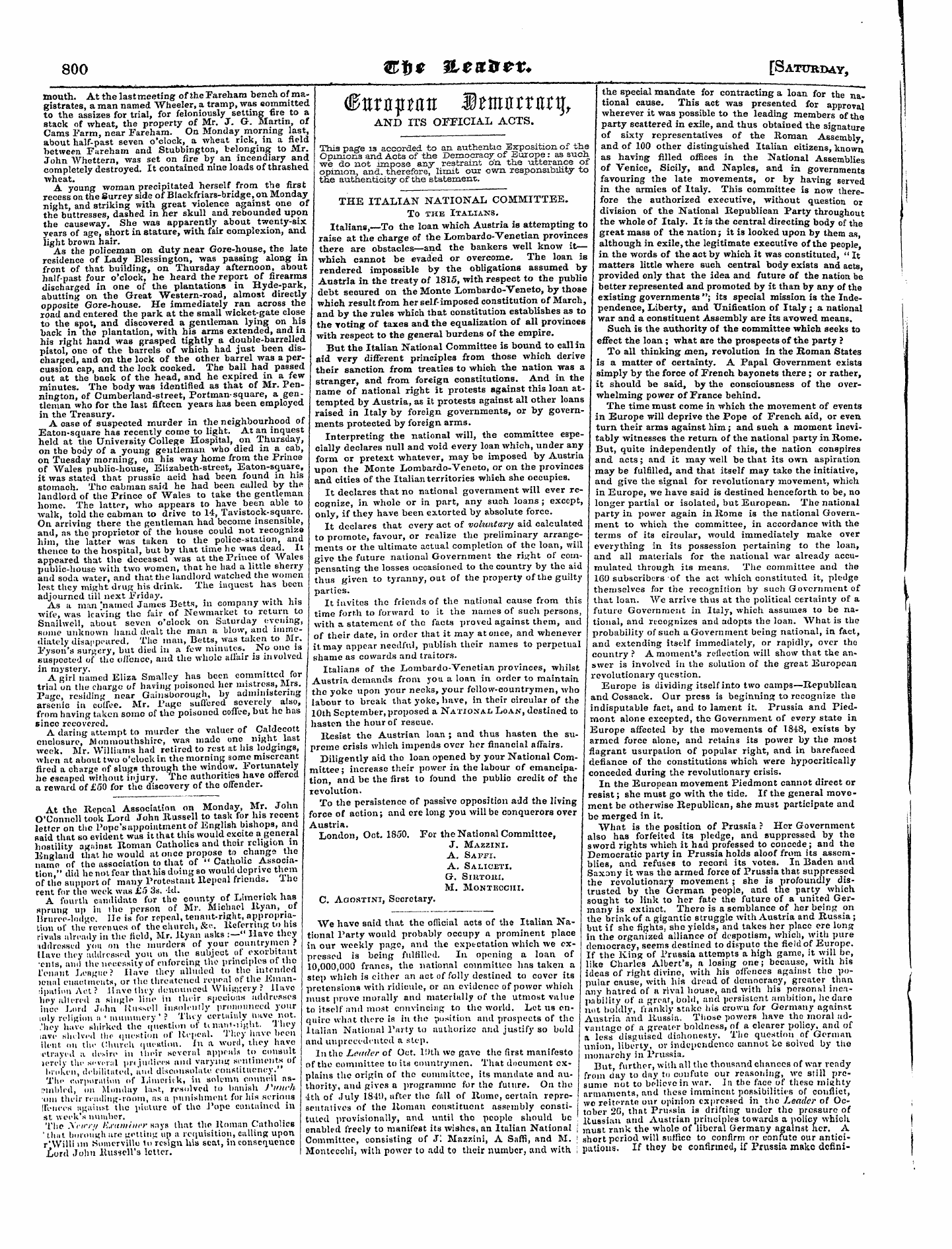
THE ITALIAN NATIONAL COMMITTEE . To the Italians . Italians ,--To the loan which Austria is attempting to raise at the charge of the Lombardo-Venetian provinces there are obstacles—and the bankers well know it— - which cannot be evaded or overcome . The loan is rendered impossible by the obligations assumed by Austria in the treaty of 1815 , with respect to the public debt secured on the Monte Lombardo-Veneto , by those which result from her self-imposed constitution of March , and by the rules which that constitution establishes as to the voting of taxes and the equalization of all provinces with respect to the general burdens of the empire .
But the Italian National Committee is bound to call m aid very different principles from those which derive their sanction from treaties to which the nation was a stranger , and from foreign constitutions . And in the name of national right it protests against this loan attempted by Austria , as it protests against all other loans raised in Italy by foreign governments , or by governments protected by foreign arms . Interpreting the national will , the committee especially declares null and void every loan which , under any form or pretext whatever , may be imposed by Austria upon the Monte Lombardo-Veneto , or on the provinces and cities of the Italian territories which she occupies .
It declares that no national government will ever recognize , in whole or in part , any such loans ; except , only , if they have been extorted by absolute force . It declares that every act of voluntary aid calculated to promote , favour , or realize the preliminary arrangements or the ultimate actual completion of the loan , will give the future national Government the ri ^ ht of compensating the losses occasioned to the country by the aid thus given to tyranny , out of the property of the guilty parties .
It invites the friends of the national cause from this time forth to forward to it the names of such persons , with a statement of the facts proved against them , and of their date , in order that it may at once , and whenever it may appear needful , publish their names to perpetual shame as cowards and traitors . Italians of the Lombardo-Venetian provinces , whilst Austria demands from you a loan in order to maintain the yoke upon your necks , your fellow-countrymen , who labour to break that yoke , have , in their circular of the 10 th September , proposed a National Loan , destined to hasten the hour of rescue .
Resist the Austrian loan ; and thus hasten the supreme crisis which impends over her financial affairs . Diligently aid the loan opened by your National Committee ; increase their power in the labour of emancipation , and be the first to found the public credit of the revolution . To the persistence of passive opposition add the living force of action ; and ere long you will be conquerors over Austria . London , Oct . 1850 . For the National Committee , J . Mazzini . A . Saffi . A . Saliceti . G . SiitToiti . M . MONTECCIII . C . Agostini , Secretary .
Untitled Article
the special mandate for contracting a loan for the national cause . This act was presented for approval wherever it was possible to the leading members of the party scattered in exile , and thus obtained the signat ure of sixty representatives of the Roman Assembly , and of 100 other distinguished Italian citizens , known * as having filled offices in the National Assemblies of Venice , Sicily , and Naples , and in governments favouring the late movements , or by having served in the armies of Italy . This committee is now therefore the authorized executive , without question or division of the National Republican Party throughout the whole of Italy . It is the central directing body of the great mass of the nation ; it is looked upon by them as , although in exile , the legitimate executive of the people , in the words of the act by which it was constituted , " It matters little where such central body exists and acts , provided only that the idea and future of the natio n be better represented and promoted by it than by any of the existing governments "; its special mission is the Independence , Liberty , and Unification of Italy ; a national war and a constituent Assembly are its avowed means . Such is the authority of the committee which seeks to effect the loan : what are the prospects of the party ?
To all thinking men , revolution in the Roman States is a matter of certainty . A Papal Government exists simply by the force of French bayonets there ; or rather , it should be said , by the consciousness of the overwhelming power of France behind . The time must come in which the movement of events in Europe will deprive the Pope of French aid , or even turn their arms against him . ; and such a moment inevitably witnesses the return of the national party in Rome . But , quite independently of this , the nation conspires and acts ; and it may -well be that its own aspiration
may be fulfilled , and that itself may take the initiative , and give the signal for revolutionary movement , which in Europe , we have said is destined henceforth to be , no longer partial or isolated , but European . The national party in power again in Rome is the national Government to which the committee , in accordance with the terms of its circular , would immediately make over everything in its possession pertaining to the loan , and all materials for the national war already accumulated through its means . The committee and the
160 subscribers of the act which constituted it , pledge themselves for the recognition by such Government of that loan . We arrive thus at the political certainty of a future Government in Italy , which assumes to be national , and recognizes and adopts the loan . What is the probability of such a Government being national , in fact , and extending itself immediately , or rapidly , over the country ? A moment ' s reflection will show that the answer is involved in the solution of the great European revolutionary question .
Europe is dividing itself into two camps—Republican and Cossack . Our press is beginning to recognize the indisputable fact , and to lament it . Prussia and Piedmont alone excepted , the Government of every state in Europe affected by the movements of 1848 , exists by armed force alone , and retains its power by the most flagrant usurpation of popular right , and in barefaced defiance of the constitutions which were hypocritically conceded during the revolutionary crisis . In the European movement Piedmont cannot direct or resist ; she must go with the tide . If the general movement be otherwise Republican , she must participate and be merged in it .
What is the position of Prussia ? Her Government also has forfeited its pledge , and suppressed by the sword rights which it had professed to concede ; and the Democratic party in Prussia holds aloof from its assemblies , and refuses to record its votes . In Baden and Saxony it was the armed force of Prussia that suppressed the revolutionary movement ; she is profoundly distrusted by the German people , and the party which sought to link to her fate the future of a united Germany is extinct . There is a semblance of her being on the brink of a gigantic struggle with Austria and Russia ; lace
but if she fights , she yields , and takes her p ere long in the organized alliance of despotism , which , with pure democracy , seems destined to dispute the field of Europe . If the King of Prussia attempts a high game , it will be , like Charles Albert's , a losing one ; because , with his ideas of right divine , with his offences against the popular cause , with his dread of democracy , greater than any hatred of a , rival house , and with his personal incapability of a great , bold , and persistent ambition , he dare not bokllv , frankly stake his crown for Germany against Austria and . Russia . Those powers have the moral advantage of a greater boldness , of a clearer policy , and of The of
a less disguised dishonesty . question German union , liberty , or independence cannot to solved by tiie monarchy in Prussia . But , further , with all the thousand chances of war vendy from day to day to confute our reasoning , we still presume not to believe in war . In the face of these michty armaments , and these imminent possibilities of conflict , we reiterate our opinion expressed in the Leader of October 26 , that Prussia is drifting under tho pressure of ltussian and Austrian principles towards a policy which must rank the whole of liberal Germany against her . A short period will suffice to confirm or confute our anticipations . If they be confirmed , if Prussia make
defini-We have said that the official acts of the Italian National Party would probably occupy a prominent place in our weekly page , and the expectation which we expressed is being fulfilled . In opening a loan of 10 , 000 , 000 francs , the national committee has taken a step which is either an act of folly destined to cover its pretensions with ridicule , or an evidence of power which must prove morally and materially of the utmost value to itself and most convincing to the world . Let us enquire what there is in the position and prospects of the Italian National Party to authorize and justify so bold ami unprecedented a step .
In the Leader of Oct . lDtli we gave the first manifesto of the committee to its countrymen . That document explains the origin of tho committee , its mandate and authority , and gives a programme for the future . On tho 4 til of July 1845 ) , after the fall of Home , certain representatives of the Human constituent assembly constituted provisionally , and until tho people should bo enabled freely to manifest its wishes , an Italian National Committee , consisting of Ji Mazzini , A Saffi , and M . Montecchi , with power to add to their number , and with
-Y -Sn^^^ Omauicts
( toflpflit Mtmuxu %
Untitled Article
800 2 Ef ) tf 3 Le $ ' tV [ Jl 0 * Saturday , _ _ _ . . . _ - , . - - - - ' i . ¦ - — ., - . . .. . . -
Untitled Article
AND ITS OFFICIAL ACTS .
-
-
Citation
-
Leader (1850-1860), Nov. 16, 1850, page 800, in the Nineteenth-Century Serials Edition (2008; 2018) ncse-os.kdl.kcl.ac.uk/periodicals/l/issues/vm2-ncseproduct1859/page/8/
-