
On this page
-
Text (2)
-
Untitled Article
-

Untitled Article
Note: This text has been automatically extracted via Optical Character Recognition (OCR) software. The text has not been manually corrected and should not be relied on to be an accurate representation of the item.
-
-
Transcript
-
Note: This text has been automatically extracted via Optical Character Recognition (OCR) software. The text has not been manually corrected and should not be relied on to be an accurate representation of the item.
Additionally, when viewing full transcripts, extracted text may not be in the same order as the original document.
Untitled Article
amends to Sir Harry Smith , for the rebuke implied in the despatch above quoted , the Governor ' s explanation being satisfactory to her Majesty's Government : "I have to signify to you her Majesty's approval of the course you felt it necessary to adopt . " In consideration of what the convicts have undergone , conditional pardons will be granted to them on their arrival in Van Diemen ' s Land ; " the case of Mitchel , which is quite distinct from that of all the others , " being reserved for separate consideration .
Untitled Article
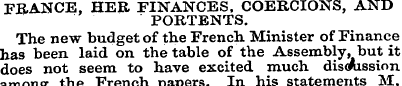
FRANCE , HER FINANCES , COERCIONS , AND PORTENTS . The new budget of the French Minister of Finance has been laid on the table of the Assembly , but it does not seem to have excited much discmssion among the French papers . In his statements M . FouiiD showed that the object of the budget of 1851 was , to make the income equal to the expenditure , to relieve the agricultural classes of a part of the taxation which presses exclusively on them , and to render the fiscal burdens more equable in their pressure . In order to relieve agriculture , he proposed to reduce the impot foncier to the extent of
27 , 000 , 000 francs , rather more than £ 1 , 000 , 000 . The local burdens also , which have been greatly augmented of late , and which amounted to 130 , 000 , 000 francs in ten departments , are to be reduced ; also the registry duties ; the latter to the extent of 6 , 000 , 000 francs . Among those taxes in which some modifica- ' tion is to take place , are the taxes on doors and windows . The duties on sugar and coffee are to be reduced . To make up for the loss of revenue arising from these changes , new taxes are to be imposed on powder and shot , on cards and certain chemical products , by which an increase of about
48 , 000 , 000 francs is anticipated . M . Fould also proposes to sell 50 , 000 hectares of forest land belonging to the state , by which questionable expedient he expects to receive 56 , 000 , 000 francs , and from these and the usual sources of income he calculates that the total revenue of 1851 will be 1 , 292 , 000 , 000 francs , which would give a surplus of 8 , 000 , 000 above the estimated expenditure . But that , as he remarked , depends upon the maintenance of order- In the event of any serious disturbance to shake public confidence , the income would inevitably fall off , while the expenditure would necessarily increase .
The most unsatisfactory part of the budget is the very small reduction which he proposes to make in the army estimates . In 1848 the cost of the army was 420 , 000 , 000 francs , upwards of £ 12 , 000 , 000 . Since that year it has been reduced to 314 , , 000 francs , and will now experience a further reduction of 12 , 000 , 000 francs , leaving still , however , an expenditure of nearly £ 9 , 000 , 000 a year for the maintenance of an army in a time of peace .
The first reading of the bill for the transportation and close imprisonment of political offenders was carried on the 5 th , in the French Assembly , after a fierce debate , by 431 to 217 votes . In a long and most eloquent speech M . Victou Hugo opposed the measure . He commenced by recalling the days of February , among which the most admirable was that one when mouths yet black with biting off the ends of cartridges joined in one cry of clemency . The decree of the abolition of death-punishment for political offences contained within it the germ of a whole code , leading logically to the entire abolition of the
extreme penalty . Yet now the Government asked them to retrace their way , and under the modest title of " law of transportation" proposed to them a law which public opinion had already construed in a single line—The re-establishment of death-punishment for political questions . The authors of the law denied this ; they said there was a gap in the penal code which it was necessary to fill up ; they had to substitute some punishment for that of death . How would they do this ? They had sought out a climate known us " the tomb of Europeans ; they combined climate , exile , and imprisonment ; instead of one executioner
they would have three . They were restoiing deathpunishment ; let them quit their wordy precautions , their hypocritical phraseology , and be at least sincere . . Doubtless they desired not merely a severe law , but one which could be executed ; but there were limits of punishment beyond which the legislator could not pass . These sacred limits were traced by the linger of God in the human conscience ; the moment the law endeavoured to transgress them it would meet the opposition of society . The tribunals would hesitate , the juries would acquit , the law would be a dead letter under the very t ; ycs of the
Judges . Though they built their iniquities in granite , a breath would throw them down—the breath of universal opinion . Over-severity renders a law powerless . JJut , supposing they should have the misfortune of carrying their law into execution , two questions would remain—the occasion and the necessity for it . L ) id he forget the loth of May , the 23 rd and the 13 th of June ? Was it not necessary to intimidate such attempts , and , us the revolution of February hud deprived them of the guillotine , to find for it the best substitute th ( 3 y could r For himself ho disavowed and condemned those rebellions . The right of the suilrago had abolished the right of insurrection .
Universal suffrage put an end to revolutions . Society ought to be protected ; but to do that there was no occasion for a new penalty . The law of transportation in the penal code was sufficient both for intimidation and punishment . Let them look at the power which the existing law conferred . A man condemned by a special tribunal for the most uncertain of all crimes—a political crime , by the most uncertain of all justice—political justice , — ( Murmurs from the Right ) . When he so qualified political justice , he was but the echo of history : This man , so condemned , this criminal according to some , this hero according to others—{ Explosion of murmurs from the Right } . The President . —When judgment is pronounced the criminal is a criminal for all the world ; he can only be a hero to his accomplices .
M . Victor Hugo would remark to the President that ; Marshal Ney , judged in 1815 , had been pronounced a criminal , yet , in his eyes , Ney was a hero , though he was not his accomplice . { Prolonged applause . } To resume : the criminal , or the hero , is seized in the midst of his renown , his influence , and his popularity , torn from his family and country , rooted out from all his interests and affections , and flung into darkness and silence , at a distance from his native soil . There he is kept , alone , a prey to his regrets if he thinks himself necessary to his country , to his remorse if he feels that he had been fatal to it . There he is detained , free , but guarded , escape impossible , unable to injure , or to influence , in isolation , impotence and oblivion , uncrowned , disarmed , broken , and annihilated . ** And this does not suffice for you " : —
" This man , vanquished , proscribed , condemned by fortune , you desire to shut up . You would do that nameless thing which no legislation has yet done ; joining to the tortures of exile the tortures of a prison , multiplying rigour by cruelty . It is not enough for you to have put this man under a tropical sky ; you would wall him up alive in a fortress , which even at this distance has so gloomy an aspect that you , who have built , are not sure how you shall baptize it , not knowing whether it is a dungeon or a tomb . You desire that
slowly , day by day , and hour by hour , this soul , this intelligence , this activity , this yet living ambition , four thousand leagues from the country , under that stifling sun , under the horrible weight of that prison-sepulchre , should writhe , and waste , and consume itself , and despair , asking pardon , appealing to France , imploring air , life , and liberty , till it expire in agony . It is monstrous . I protest against it in the name of humanity ! Ah , you are pitiless and neartless . What you call an expiation I call a martyrdom ; what you call iustice I denounce as an assassination . of reli
" Rise , then , Catholics , priests , bishops , men - gion , who sit in this Assembly . It is your duty . What are you doing on your benches ? To the tribune , and with the authority of your holy creeds , with the authority of your traditions , tell these inventors of cruel measures , these applauders of barbarous laws , that what they do is bad , detestable , and impious . Remind them that Christ came into the world bringing a law of kindness , and not of cruelty ; tell them that the day when the Man-God suffered the punishment of death he abolished it , because he showed that the foolishness of human justice could strike not only an innocent but a divine head . Tell the authors and defenders of this
law—tell these politicians that it is not by torturing the wretched in a cell four thousand leagues from their country that they can quiet the public streets . * * * " I said there would be three executioners . I forgot a fourth—the director of the Penitentiary . Have you taken into account the sort of man he must almost necessarily be who , in the face of the civilized world , will accept the moral charge of so odious an establishment , who will consent to be the gravedigger of this prison , the gaoler of this tomb ? St . Helenas produce Hudson-Lowes . Figure to yourselves the refinements of torture which a man of that temperament could invent for men who have not the glory of Napoleon . In our prisons in France , when an abuse arises , when an • • ' * * A ¦ i ¦ . _ M ~ A-M— — I — _ _^ - >— _» ~_ . _~ ¦ - BK ~ - ^ ~> L « ini is the of the reach
^ . quity attempted , cry prisoner can the Government and the people through the double echo of the press and the tribune . But in your citadel , in the Marquesas , the sufferer will be reduced to sigh mournfully—Ah , if the people but knew it ! There , at that dreadful distance , in the silence of that walled-up solitude , where human voice comes not nor departs , to whom shall the wretched prisoner complain ? Who shall hoar him ? Between his complaint and you will be the noise of sill the waves of ocean ; the shadow and the silence of death will overhang this frightful political hulk } nothing will transpire , nothing wili reach you , nothing save , from time to time , the mournful news traversing the sea to France and Europe—Such a one is dead . * * * I have examined Avhat are called reasons of state . I
recall all the evil counsels they have already given . Marat invoked them as well as Louis XI . For me , I will have neither the policy of the guillotine , nor the policy of power , neither that of Marat , nor that of Ilaynau , nor that of your law of transportation . ^ I am of those who will never hesitate between that virgin whom men call Conscience , and that prostitute they call Statepolicy . I bcc plainly that I am ' only a poet . ' " Should it be possible for this law to pass , it would
be a mournful spnetaele , —violence in the senate contrasting with wisdom in the streets , statesmen showing themselves blind and passionate where the people had shown themselves intelligent and just . In proclaiming mercy in February the people shut the door of revolutions , with your decrees of vengeance you reopen it . You say the law is intended for the future . For whom do you make it ? The sword of political punishment belongs not to justice but to chance . * * I am
defending you . You may shut your eyes to the future ; but will you shut them to the past ? Had the two last revolutions been overcome by royalty , and your law of transportation been then existing , Charles X . would have applied it to M . Thiers , and Louis Philippe to M ; Odilon Barrot . " M . Barrot indignantly denied that he had ever conspired against any government . M Hugo resumed : " I did not speak of justice , but of political and party judgments . * * * Jl . oolc and reflect ! Who regained the throne of France in 1814 ? The exile of Hartwell . Who reigned after 1830 ? The proscribed of Reichenau , to-day the banished of Claremont . Who governs at this moment ? The prisoner of Ham . Now pass your laws of proscription ! * * * When men put injustice in a law , God puts justice there , and strikes with the law the men who make it .
M . Hugo concluded with an energetic protest against whatever could tend to inflame the dissensions of France : — " Let us seek together , and cordially , the solution of the problem of civilization placed before us . Our fathers had only to serve France , we have to save it . We have not time for hate . " M . Rouher , Minister of Justice , defended the utility of the bill . The crimes it was intended to punish were those which had been formerly subjected to the penalty of death , the crimes of men who excited to civil war , and advocated devastation and pillage : —
" Perpetual imprisonment was not commensurate with such offences . He had heard an individual say from the tribune of that Assembly— I have conspired for twenty years j I have succeeded , and I shall not conspire again . Such language was odious . When a criminal has stained the streets with blood ; when he made an appeal to civil war" On the Left : " Boulogne ! " ( Loud interruption . } TheMiNisTEROF Justice : " Whenhe made an appeal to civil war" Another voice on the Left : " Strasbourg 1 " { Violent murmurs on the Right . }
The Minister of Justice : " He would perhaps feel some shame in appealing to those reminiscences after the elections of the 10 th of December . Had the justice of the country , he would ask , remained powerless ? had there been no condemnation ? " M . Charras : " For Strasbourg ? No ! " The Minister of Justice : ' * Did not the prisoner , on the threshold of his prison , deplore the attack which he had made against the laws of his country ? He had redeemed his past conduct , and an end should be put to that system of degrading the Government , which attacked it even when it proceeded from the majority of the nation . " ( Loud approbation . )
The President , addressing the Mountain : " The Government of the Republic itself finds no favour wjth you , because it is a Government . " ( Laughter and applatise . ) M . Emmanuel Arago , in reply to the Minister of Justice , read a speech uttered by M . Odilon Barrot in 1835 , which denounced the imprisonment of transported criminals as something even worse than the carcere duro of Austria . Referring to the chances of pardon , M . Arago said— " Calculate the time necessary to transmit this pardon , and , when you grant it , it will go forth to find a corpse . " The debate closed after a heated discussion , continually interrupted , the President himself not refraining from offensive remarks .
The outbreak ' which occurred at Limoges , in consequence of the punishment of an adjutant who had voted for the Democratic candidates at the recent election , is spoken of by the Siecle as a serious affair , and an indication of the general feeling of the army . The Limoges papers also allude to it as serious , with the exception of the Government paper , the Courrier de Limoges , which asserts it to have been onl y a trifling incident . "A sub-officer , when leaving to join a regiment in Africa , was accompanied as far as the bridge by some of his comrades . A handlul of wellknown democrats collected round them , and raised some cries in honour of Socialism . One of the officers desired the soldiers to return to their respective quarters , which they immediately did . That is the whole affair . "
The non-commissioned officers in garrison at Valenciennes deny the statement of the Republicain du Nord , that they are imbued with Socialist opinions . The municipal guard at Lyons is to be reorganized in order to render it more efficient for the preservation of public order . A letter from Belle He of March 30 th states , that lodgings are prepared there for 400 of the most violent of the political criminals detained in prison in France . M . Proudhon's journal , the Voix du Peuplc , has again been seized , ibr , an article on the Budget , " calculated to excite hatred and contempt against the Government . "
The Napoleon intimates that in case the approaching election for Paris be of the same kind as on tho 10 th of March , a revision of tho electoral law will become necessary . The paragraph is worth giving . ' An Electoral law which would continue to produce such results is already judged . Society must demand its reform . Tho constitution has only proposed tho princiiKil of election , the law fixes its conditions . It is from u new law that society will havo to demand
Untitled Article
Aprii . 13 , 1850 . ] Qttye ULe&ittt . 53
-
-
Citation
-
Leader (1850-1860), April 13, 1850, page 53, in the Nineteenth-Century Serials Edition (2008; 2018) ncse-os.kdl.kcl.ac.uk/periodicals/l/issues/vm2-ncseproduct1840/page/5/
-